



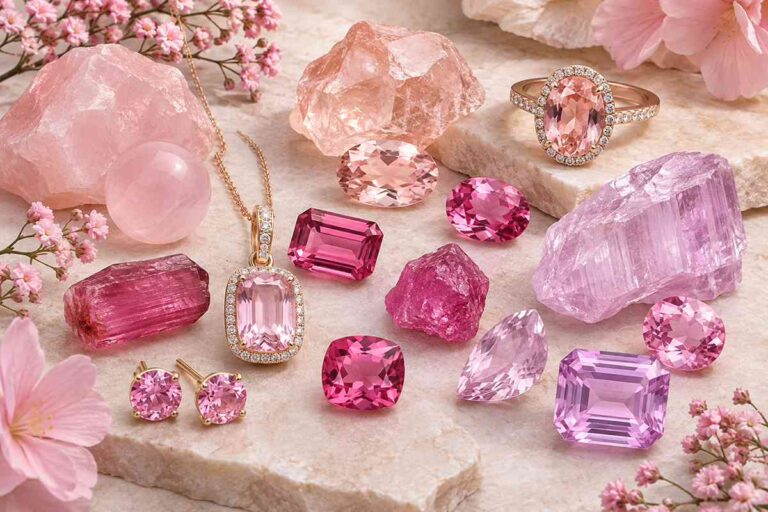
Pink gemstones can be soft and romantic, bright as bubblegum, or surprisingly dramatic. Remember the famous pink diamond engagement ring Ben Affleck gave Jennifer Lopez in the early 2000s? That blush-colored Harry Winston diamond certainly made an impression. Fortunately, you don’t need a celebrity jewelry budget to find a beautiful pink stone.
Rose quartz, morganite, pink tourmaline, pink spinel, and kunzite offer plenty of color without the price tag of a rare pink diamond. Pink sapphire is another gorgeous option, particularly if you’re shopping for a ring you’ll wear often. The trick is knowing which gemstone fits your budget, your taste, and how you plan to wear it.
If you’re curious about how these stones fit into the broader gemstone world, our semi-precious stones chart is a helpful place to start. Just remember that “semi-precious” is a traditional jewelry term, not a reliable measure of a gemstone’s beauty, rarity, or value.

Pink Gemstones at a Glance
Not all pink gemstones look alike, and some are better suited to everyday jewelry than others. Here’s a quick comparison of six popular choices.
| Gemstone | Typical color | Mohs hardness | Good for |
|---|---|---|---|
| Rose quartz | Soft, cloudy pink | 7 | Affordable beads, pendants, and carvings |
| Morganite | Blush, peach, or rose | 7.5–8 | Delicate-looking rings and necklaces |
| Pink tourmaline | Light pink to vivid magenta | 7–7.5 | Colorful rings, earrings, and pendants |
| Pink spinel | Soft pink to vivid hot pink | 8 | Durable fine jewelry |
| Kunzite | Pale pink to violet-pink | 6.5–7 | Statement pendants and occasional-wear jewelry |
| Pink sapphire | Pastel pink to vibrant pink | 9 | Engagement rings and everyday jewelry |
The Mohs scale measures resistance to scratching, not whether a stone can chip or break. A harder gemstone generally resists scratches better, but its setting, internal characteristics, and the care it receives matter, too.
Rose Quartz
Rose quartz is one of the most recognizable pink gemstones, and it’s a lovely choice if you prefer understated jewelry. This pink variety of quartz ranges from barely-there blush to richer rose tones. Its often-cloudy appearance is part of the charm, giving the stone a soft, hazy glow rather than the sharp sparkle of a transparent gem.
Much of the world’s rose quartz comes from Brazil, and it’s relatively abundant. That makes it an accessible option for anyone shopping on a budget, especially compared with fine-quality transparent pink gemstones.
Rose quartz is especially popular for beads, bracelets, pendants, and carved shapes such as hearts and small sculptures. Its delicate color works beautifully with silver, rose gold, and simple jewelry designs.
With a Mohs hardness of 7, rose quartz can be worn in jewelry, although it still needs protection from knocks and scratches. If you’re buying a piece, look for pleasing, even color and a cut or carving that shows the pink to its best advantage. A cloudy appearance is normal and doesn’t automatically mean the stone is poor quality.
Morganite
Morganite is the pink to orange-pink variety of beryl, the same mineral family that includes aquamarine and emerald. It’s known for its soft, romantic color, which can range from pale blush to peach, salmon, and stronger pink shades.
There’s an interesting bit of jewelry history behind its name. Morganite was named in honor of financier and gemstone collector J.P. Morgan, with gemologist George Frederick Kunz playing a role in the naming. Morgan supported important mineral collections, and the gemstone still carries his name.
Although morganite doesn’t have the instant name recognition of emerald, it has become an appealing choice for delicate-looking rings and necklaces. Its pastel color pairs particularly well with rose gold, while white gold can give it a cooler, more contemporary look.
Morganite has a Mohs hardness of 7.5 to 8, making it reasonably durable for jewelry. It can be a practical ring stone when set and cared for properly, although it isn’t scratchproof.
One detail worth knowing before you buy: morganite is commonly heat-treated to reduce orange or yellow tones and produce a purer pink. This treatment is generally stable. Ask the seller about treatments and compare stones in different lighting, since very pale morganite can look nearly colorless in some settings.
Pink Tourmaline
Pink tourmaline is a striking choice if you like color with a little personality. Some stones are a sweet, bubblegum pink, while others have deep raspberry, reddish-pink, or vivid magenta tones. Tourmaline comes in many colors, but the pink varieties are particularly attractive in jewelry.
You may also encounter the name rubellite. This trade name is associated with strongly colored pinkish-red to red tourmaline, rather than every pale pink tourmaline. The naming can be inconsistent between sellers, so it’s worth looking beyond the label and judging the actual stone.
Pink tourmaline is found in several parts of the world, including Brazil, Afghanistan, and parts of Africa. California is also known for producing attractive tourmaline. Some specimens display more than one color, including the wonderfully named watermelon tourmaline, which typically has a pink or red center surrounded by green.
Tourmaline can range from relatively affordable to quite valuable. The strongest colors, attractive cuts, larger sizes, and appealing clarity can command higher prices. Pink and red tourmaline may contain visible inclusions, so don’t assume that every small internal feature makes a stone undesirable.
With a Mohs hardness of 7 to 7.5, pink tourmaline works in rings, earrings, and necklaces. A protective setting is sensible for a ring that gets frequent wear.
Some people associate pink tourmaline with love and happiness. These are traditional symbolic meanings rather than scientifically established effects, but they can still make the gemstone feel personal when given as a gift.
How Much Is Pink Tourmaline Worth?
There’s no single price for natural pink tourmaline. Its value depends on color, size, clarity, cut, treatment, and the quality of the individual stone. A lightly colored, included gem may cost much less than a vivid, well-cut example of similar weight.
Before paying a premium, compare stones with similar characteristics and ask whether any color treatment has been disclosed. A larger carat weight alone doesn’t guarantee a more valuable gem.
Pink Spinel
Pink spinel deserves more attention than it gets. With its lively sparkle and colors ranging from gentle pink to intensely saturated hot pink, natural spinel can look remarkably similar to pink sapphire.
Spinel has sometimes been overlooked because synthetic spinel has been produced for many years. But natural and laboratory-created spinel are not the same thing, particularly where rarity and price are concerned. Fine natural pink spinel can be valuable, and exceptionally vivid examples are sought after by collectors.
Natural spinel is found in countries including Myanmar, Sri Lanka, Vietnam, and Tanzania. Its color, clarity, cut, and overall quality usually matter more to a jewelry buyer than an impressive-sounding source location.
Spinel ranks 8 on the Mohs hardness scale and has good toughness. That makes it a strong contender for rings and other fine jewelry, especially if you want bright color without choosing a sapphire.
If you’re buying an expensive pink spinel, confirm whether it’s natural or laboratory-created. For a high-value purchase, an independent gemological identification report can provide more assurance than a seller’s description alone.
Kunzite
Kunzite has an unmistakably delicate look. This pink-to-violet variety of the mineral spodumene can appear almost lavender in one light and more distinctly pink in another. It’s especially attractive in larger, faceted gemstones that show off its color.
The stone is named after gemologist George Frederick Kunz, who was associated with Tiffany & Co. and helped bring attention to the mineral. Kunzite is found in several locations, including Afghanistan, Brazil, Madagascar, and California.
One of kunzite’s fascinating characteristics is pleochroism. That means its color can appear different when viewed from different directions. Gem cutters consider this effect when deciding how to orient the stone.
Kunzite does have a drawback. Prolonged exposure to strong light or heat can cause its color to fade. It also has perfect cleavage in two directions, making it vulnerable to splitting if struck or placed under pressure.
Its Mohs hardness of 6.5 to 7 doesn’t tell the whole durability story. For this reason, kunzite is often a better choice for a pendant, earrings, or special-occasion jewelry than a ring worn during everyday activities.
Color matters when choosing kunzite. More saturated pink and violet hues can be especially desirable, but a pale, beautifully cut stone can be just as appealing if that’s the look you love. Store kunzite away from strong sunlight and clean it gently with warm, soapy water.
Pink Sapphire
Pink sapphire is worth considering if you’re looking for a gemstone that combines vibrant color with the durability needed for frequently worn jewelry. While sapphire is famous for its blue varieties, it also occurs in beautiful shades of pink, from pale pastels to stronger, more saturated tones.
Sapphire belongs to the corundum mineral family and has a Mohs hardness of 9. It’s one of the more scratch-resistant options on this list and is particularly well suited to engagement rings and other jewelry that gets regular wear.
Fine natural pink sapphires can be expensive, especially when they have vivid, attractive color. More affordable choices may include lighter-colored stones or laboratory-grown sapphires, which should always be clearly identified as such.
Heat treatment is common in sapphires, so ask about enhancements before buying. A beautiful treated sapphire isn’t necessarily a bad purchase, but the treatment should be disclosed and reflected in the seller’s description.
Which Pink Gemstone Should You Choose?
The best choice depends on what you want the jewelry to do. A stone that looks wonderful in a pendant might not be the most sensible choice for a ring worn every day.
- For affordable pink jewelry: Rose quartz is a lovely starting point, especially for beads, bracelets, and pendants.
- For a soft, romantic look: Morganite offers delicate blush and peach tones with attractive sparkle.
- For bold color: Pink tourmaline comes in an appealing range of brighter pink and reddish-pink shades.
- For a durable, colorful ring: Pink spinel and pink sapphire are particularly good options.
- For a statement pendant: Kunzite can provide beautiful pastel color in larger gemstones, provided it’s protected from knocks and intense light.
Don’t buy on color alone. Ask whether the gemstone is natural, laboratory-grown, or an imitation, and whether it has been treated. Look at the stone in more than one lighting condition, check the return policy, and pay attention to the setting as well as the gem itself.
For a significant purchase, especially an expensive natural sapphire or spinel, consider independent gem identification. The Gemological Institute of America (GIA) provides gemstone information and laboratory identification services.
How to Care for Pink Gemstone Jewelry
Most of these gemstones can be cleaned gently with warm water, mild soap, and a soft cloth or brush. Avoid harsh household chemicals, and don’t assume an ultrasonic or steam cleaner is safe for every stone. Treatments, fractures, and inclusions can change the care a gem needs.
Store pieces separately to reduce scratching, remove rings before rough activities, and keep kunzite away from prolonged bright light and heat. If you’re unsure how a particular piece was treated, ask a qualified jeweler before cleaning it.
What’s Your Favorite Pink Gemstone?
There’s something charming about the variety of pink gemstones. Rose quartz has that soft, dreamy glow, while pink tourmaline can be wonderfully bold. Morganite brings delicate warmth, spinel and sapphire offer brilliant color, and kunzite has a beauty all its own.
Which one would you choose for your jewelry collection? Tell us your favorite pink gemstone!
Think pink for jewelry!