





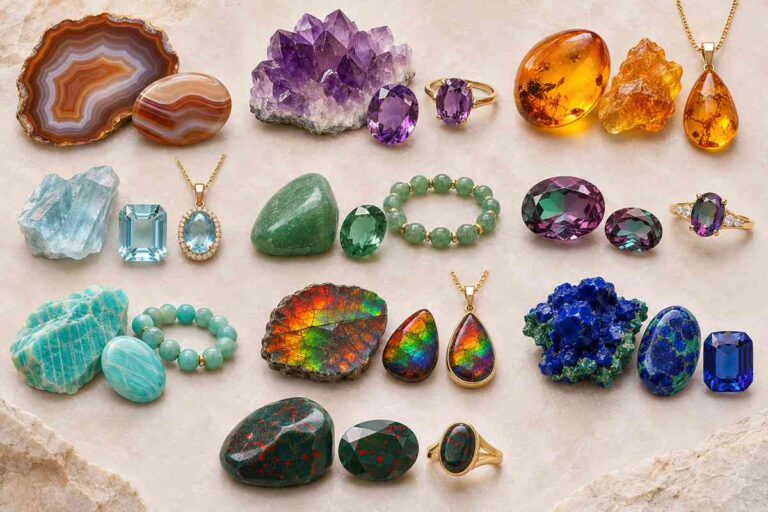
Looking for a semi-precious stones chart with names, colors, and pictures? Start with the quick-reference table below, then browse our illustrated A-to-Z list of 72 gemstone entries. You’ll find familiar favorites like amethyst and turquoise alongside less common collector stones.
“Semi-precious” is a traditional jewelry term, not a scientific grade or a guarantee of lower value. Fine alexandrite, spinel, and certain garnets can be exceptionally valuable. We’ve kept the familiar phrase to help you find the stones you’re looking for, but the individual gemstone name is more useful when comparing quality and price.
About crystal meanings: The traditional associations listed in the profiles below are folklore and personal beliefs, not proven medical or psychological treatments. Choose gemstones for their appearance, suitability for jewelry, and the meaning they hold for you.
Semi-Precious Stones Chart by Color

Use this color chart to narrow down a name, then select a stone to jump to its photo and description. Colors are typical examples, not an identification test. Natural variation, lighting, and treatments can change a gemstone’s appearance.
| Gemstone | Common colors or appearance |
|---|---|
| Agate | Various, often banded |
| Alexandrite | Green in daylight, reddish in warm light |
| Amazonite | Blue-green |
| Amber | Honey yellow to orange |
| Amethyst | Purple |
| Ametrine | Purple and yellow |
| Aquamarine | Pale blue to blue-green |
| Aventurine | Usually green |
| Carnelian | Orange to reddish brown |
| Citrine | Yellow to orange |
| Fluorite | Purple, green, blue, and more |
| Garnet | Red, green, orange, and more |
| Jade | Green, white, lavender, and more |
| Jasper | Many colors and patterns |
| Kunzite | Pink to violet |
| Labradorite | Gray base with iridescent flashes |
| Lapis Lazuli | Deep blue, often with gold-colored flecks |
| Malachite | Banded green |
| Moonstone | White, peach, gray, and more |
| Morganite | Pink to peach |
| Obsidian | Usually black |
| Onyx | Typically black in jewelry |
| Opal | Various, sometimes with color flashes |
| Peridot | Yellow-green |
| Rose Quartz | Pink |
| Spinel | Red, blue, pink, and more |
| Tanzanite | Blue to violet |
| Tiger’s Eye | Golden brown |
| Topaz | Blue, yellow, orange, pink, and more |
| Tourmaline | Many colors, including multicolor |
| Turquoise | Sky blue to green |
| Zircon | Blue, brown, colorless, and more |
A-to-Z gemstone pictures and profiles

Agate
Agate comes in a wide range of colors, and when discussing gemstones, generally, only banded forms of the stone are considered Agate. Exceptions are Moss Agate and Dendritic Agate, which lack banding patterns.
- Mineral Category: Chalcedony Quartz
- Variants: Banded Agate, Carnelian, Sardonyx, Onyx, Dendritic Agate, Fire Agate, Moss Agate
- Colors: Varied
- Traditional beliefs (not scientifically proven): Stone of Protection, used to fend off stress, tiredness, and bad dreams.

Alexandrite
Alexandrite changes color under different lighting. Under daylight, it can be green-blue to green-yellow, but if viewed in incandescent lighting, it is pink or red. Until recently, there were very few known sources for Alexandrite, and it was extremely rare and highly prized.
If you are interested in learning more about the stone, click on the real alexandrite guide.
- Mineral Category: Chrysoberyl
- Colors: Varied
- Traditional beliefs (not scientifically proven): Aids Discipline, Self Control, and Focus

Amazonite
Amazonite is a light green to a light blue gemstone, supposedly named after the blue Amazon River and the green Amazon Rainforest, but Amazonite is not actually found in the Amazon. Amazonite is less valuable than Jade but is sometimes mistaken for it.
- Mineral Category: Microcline
- Colors: Light green or blue, sometimes with white streaks
- Traditional beliefs (not scientifically proven): Stone of the Amazon Warriors, aids strength and stamina

Amber
Amber is the fossilized resin of ancient pine trees. It is a striking orange color and was historically thought to be linked to the sun due to this. Pieces and jewelry made from amber have been found in graves dated to as far back as 2000 B.C.
- Mineral Category: Non-Mineral Organic
- Variants: Blue Amber, Baltic Amber
- Colors: Commonly known as orange or yellow, but blue, red and green amber also exists
- Traditional beliefs (not scientifically proven): Promotes optimism and a positive outlook

Amethyst
Amethyst is the purple variety of quartz and is widely used in jewelry. Its purple color is associated with iron-related color centers in the crystal. Historically favored by nobility as purple is often seen as the color of royalty.
- Mineral Category: Macrocrystalline Quartz
- Variants: Ametrine
- Colors: Purple
- Traditional beliefs (not scientifically proven): Historically believed to combat the effects of alcohol. Promotes peace and balance, aids with financial or legal issues.
Ametrine
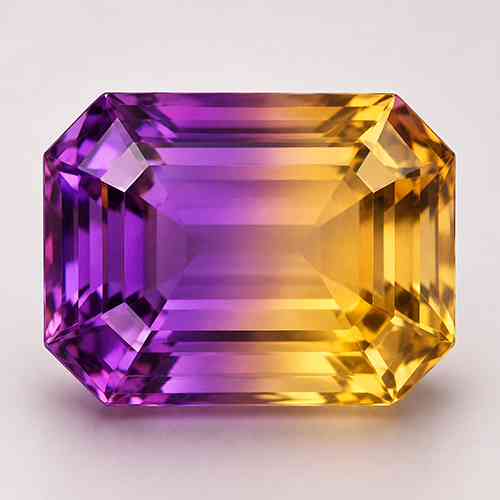
Ametrine is the combination of Amethyst and Citrine, and generally are partially purple and partially yellow/orange. Its contrasting colors can occur in distinct zones of a single crystal.
- Mineral Category: Macrocrystalline Quartz
- Colors: Distinctly split purple and yellow
- Traditional beliefs (not scientifically proven): Combines the qualities of Amethyst and Citrine
Ammolite
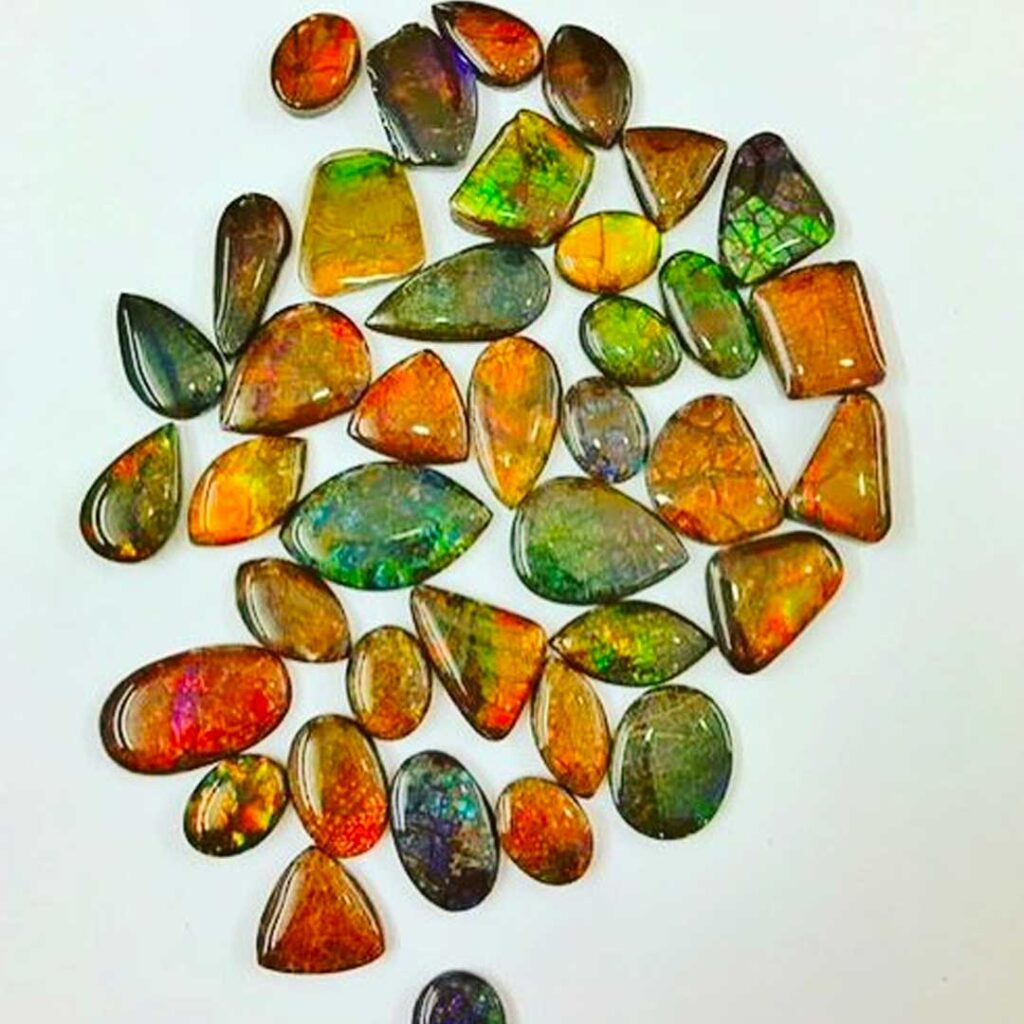
Ammolite is a gemstone formed from the fossilized shells of ammonites, extinct marine animals. Its iridescent colors can resemble those of precious opal.
- Mineral Category: Non-Mineral Organic
- Colors: Gray Brown with color play
- Traditional beliefs (not scientifically proven): Some Native Americans belives Ammolite represented wealth, health, and power.

Andalusite
Andalusite is pleochroic, meaning it can appear to have different colors when viewed from different angles. It typically ranges from green-yellow to orange-red, and is one of the lesser-known gemstones, although it is gaining in popularity. It is named after Andalusia, the area in Spain where it was first discovered.
- Mineral Category: Andalusite
- Variants: Chiastolite, Virdine
- Colors: Varied
- Traditional beliefs (not scientifically proven): Seeing stone, helpful with objectivity, and seeing without bias.

Apatite
A group of different minerals, Apatite, is used as a term as the individual minerals are often hard to distinguish. The name comes from the Greek ‘Apate’ , meaning deceit, and it is so named due to its similar appearance to many other minerals. Gemstone quality Apatite is quite rare.
- Mineral Category: Apatite
- Variants: Many
- Colors: Varied
- Traditional beliefs (not scientifically proven): Lesser known, but it is considered a stone of learning, inspiration, and extroversion.

Aquamarine
Aquamarine is a form of Beryl and is green-blue in color. Aquamarine means ‘seawater’ in Latin, and it is so named for its color, reflecting that of the sea. Aquamarine stones that exhibit the cat’s eye effect or star effect are very rare.
- Mineral Category: Beryl
- Variants: Cat’s Eye Aquamarine
- Colors: Blue
- Traditional beliefs (not scientifically proven): Historically, a popular gemstone among sailors. It signifies safe passage and protects from seasickness.

Aventurine
Aventurine is a quartz variety, typically green, with tiny mineral inclusions that create a subtle glittering effect called aventurescence.
- Mineral Category: Quartz
- Colors: Green, other colors exist but are rare and aren’t typically used as gems.
- Traditional beliefs (not scientifically proven): Stone of Luck, and also helps with obtaining peace of mind and patience.

Axinite
Axinite is the name of a group of minerals, and the name comes from the Greek ‘Axine’, meaning Axe, due to the sharp crystals found in the mineral. Axinite of gemstone quality is rare. Axinite is pleochroic, meaning it can show a variety of colors depending on the viewing angle.
- Mineral Category: Axinite
- Variants: Ferro-axinite, magnesio-axinite, manganaxinite, tinzenite
- Colors: Brown, Purple, Blue, Golden
- Traditional beliefs (not scientifically proven): Stone of Truth that can help with resolving conflict.

Azurite
Azurite is gemstone quality copper ore and is quite rare. Azurite is not that commonly used in jewelry and is more commonly carved into various shapes as decorative ornaments. Its name reflects its rich azure-blue color.
- Mineral Category: Azurite
- Variants: Azure-malachite
- Colors: Blue
- Traditional beliefs (not scientifically proven): Helpful for meditation, strengthens intuition, and creativity. It helps develop spiritual awareness.

Beryl
Beryl is a single mineral with many varieties (much like Quartz), with the most well known being Emerald and Aquamarine. It is abundant, but gemstone quality beryl is rarer and is referred to as ‘Precious Beryl’. Other varieties will often be referred to by their own name, while in the context of gemstones, Beryl most often refers to the more common yellow or golden beryl, which ranges from pale yellow to golden yellow.
- Mineral Category: Beryl
- Variants: Emerald, Aquamarine, Morganite, Goshenite, Bixbite
- Colors: Varied
- Traditional beliefs (not scientifically proven): Stone of the sun, Golden Beryl, can help increase determination and drive in the wearer.

Bixbite
Bixbite is an older name for red beryl, an exceptionally rare variety of beryl. The name is now generally avoided because it can be confused with bixbyite, a different mineral.
- Mineral Category: Beryl
- Colors: Red
- Traditional beliefs (not scientifically proven): Said to help overcome depression and grief, Red Beryl (Bixbite) helps with energy and creativity.

Bloodstone
Bloodstone is the opaque form of Chalcedony Quartz. It is dark green but gets its namesake from the red flecks or streaks that resemble blood. Bloodstone is mentioned in Christian scripture and is sometimes associated with martyrdom.
- Mineral Category: Chalcedony Quartz
- Colors: Green with red and brown flecks or streaks
- Traditional beliefs (not scientifically proven): Historically, Bloodstone was thought to derive from the blood of Jesus, and thus possessed healing powers.

Carnelian
Carnelian is another form of Chalcedony Quartz. It is orange-red to dark red and derives its name from cornel cherries, which share a similar color. There are written records showing knowledge of the stone that date back 4000 years.
- Mineral Category: Chalcedony Quartz
- Colors: Red
- Traditional beliefs (not scientifically proven): Carnelian was worn by Napolean for good luck, and brings good luck to the wearer. It also helps protect from poverty and can regulate emotions and help induce calmness.

Cassiterite
Cassiterite is tin ore and is a popular source of tin. Gemstone quality cassiterite is extremely rare and is highly sought after by gemstone experts and collectors. It is mostly dark brown or black, but other shades do exist.
- Mineral Category: Cassiterite
- Colors: Brown, Black
- Traditional beliefs (not scientifically proven): Cassiterite can aid meditation, and also can aid problem-solving and intellect.

Chrome Diopside
Chrome Diopside is most commonly green, and it was only relatively recently that it started becoming used as a gemstone.
- Mineral Category: Diopside
- Variants: Cat’s Eye Diopside, Star Diopside
- Colors: Green, Yellow, White, Brown, Black
- Traditional beliefs (not scientifically proven): As a relatively unknown gemstone, the chrome diopside doesn’t have much mystical reputation. Some people believe it can help creative visualization and awareness.

Chrysoberyl
Chrysoberyl gems are mostly yellow, with some also being brown, green, or orange. Chrysoberyl is actually not a Beryl; it is actually its own mineral group. Chrysoberyl is also one of the hardest types of semi precious stones.
- Mineral Category: Chrysoberyl
- Variants: Cat’s Eye Chrysoberyl, Alexandrite
- Colors: Commonly yellow, other colors also exist
- Traditional beliefs (not scientifically proven): Chrysoberyl is supposed to help with discipline and self-control, increase concentration, and aid learning ability.

Chrysocolla
Chrysocolla is a less well-known semi precious stone well-liked by enthusiasts for its unique patterns and colors. The name comes from the Greek words for ‘gold’ and ‘glue’ as it was historically used as a soldering agent for gold.
- Mineral Category: Chrysocolla
- Variants: Apache Chrysocolla, Eilat Stone
- Colors: Green/Blue with unique patterns
- Traditional beliefs (not scientifically proven): This stone is traditionally said to be helpful when negotiating, and can reduce violence and increase sensitivity.

Chrysoprase
Chrysoprase is another form of Chalcedony Quartz and is a striking green color. It is one of the rarest kinds of Chalcedony Quartz. The name comes from the Greek word for ‘leek,’ and the stone is somewhat reminiscent of the color of that vegetable.
- Mineral Category: Chalcedony Quartz
- Colors: Bright Green
- Traditional beliefs (not scientifically proven): Chrysoprase can help bring balance to the subconscious and conscious mind, and is also said to bring friendship, happiness, and success.

Citrine
Citrine is a popular yellow-to-orange variety of quartz, named for its lemon-like color. Much of the citrine sold in jewelry is produced by heating amethyst, so ask whether color treatment matters to you.
- Mineral Category: Macrocrystalline Quartz
- Variants: Ametrine
- Colors: Yellow, Golden, Orange
- Traditional beliefs (not scientifically proven): Success Stone, Citrine radiates positive energy and can help increase wealth and prosperity. Shopkeepers, in particular, favor this stone as a good luck charm.

Clinohumite
Clinohumite is a rare mineral, and gemstone quality Clinohumite is even rarer. The stone gets its name from Abraham Hume, a well-known mineralogist. Until recently, it was thought to be amongst the rarest gemstones in the world, but recently more sources have been discovered.
- Mineral Category: Humite
- Colors: Golden, Yellow, Brown
- Traditional beliefs (not scientifically proven): Given the rarity of the stone, Clinohumite lacks some of the myth and lore than many gemstones have. Some believe that it brings energy and vitality to the wearer.

Coral
Coral is organic, literally coming from the Coral in seas and oceans. Coral can come in a few different colors, but red and pink varieties are especially familiar in jewelry. Coral is an animal-derived gem material, so sourcing matters.
- Mineral Category: Non-Mineral Organic
- Variants: Black Coral, Red Coral/Precious Coral, Fossil Coral
- Colors: Red, Black, Orange, Pink, Gray
- Traditional beliefs (not scientifically proven): Coral is seen as a protective stone that can ward off danger.

Danburite
Danburite is a lesser-known gemstone mainly sought by enthusiasts and collectors. Generally, only the colorless variety of Danburite is used as a gemstone. The stone is named after Danbury, the town in Connecticut, where it was discovered.
- Mineral Category: Danburite
- Colors: Colorless
- Traditional beliefs (not scientifically proven): People believe Danburite has a pure vibration and can aid with dispelling negative emotions like anxiety and grief.

Dumortierite
Dumortierite is a distinct mineral that can occur as blue inclusions in quartz. Named after a French paleontologist Eugene Dumortier, Dumortierite is better known for its industrial purposes relating to the production of ceramics. It is sometimes known as ‘blue moon quartz.’
- Mineral Category: Dumortierite
- Colors: Blue
- Traditional beliefs (not scientifically proven): Dumortierite is said to be helpful for improving discipline and organization.

Fluorite
Fluorite is a colorful mineral valued by collectors and sometimes used in jewelry. The term “fluorescence” comes from fluorite. Purple and green are common, but it also occurs in blue, yellow, and other colors.
- Mineral Category: Fluorite
- Variants: Antozonite, Blue John, Chlorophane, Yttofluorite
- Colors: All Colors and colorless
- Traditional beliefs (not scientifically proven): There isn’t much lore to Fluorite, but people believe that it can be used to calm and soothe.

Garnet
Garnet is not a single mineral; rather, it describes a range of separate but similar minerals. Garnet derives its name from the Latin word for pomegranate, and although there are many varieties, it is most often associated with the dark red version of itself.
- Mineral Category: Garnet
- Variants: Many
- Colors: All colors
- Traditional beliefs (not scientifically proven): Garnet is known as the Travellers stone, good for explorers and adventurers. It is also said to help with the development of self-confidence and empathy.

Hambergite
Hambergite is a rare stone mostly sought after by enthusiasts and collectors. It is normally white or colorless.
- Mineral Category: Hambergite
- Colors: Colorless, White
- Traditional beliefs (not scientifically proven): Although not well known, Hambergite is highly valued by those who believe in crystal healing – it has powerful vibrations and can induce great joy.

Hematite
Hematite is the semi precious stone variety of iron oxide. It appears to be a gray/black color, but when powdered is actually red or brown (like rust).
- Mineral Category: Hematite
- Colors: Grey, Black
- Traditional beliefs (not scientifically proven): Hematite is believed to aid it in clearing the mind and improve focus, and is generally considered quite a strong healing stone.

Hessonite
Hessonite is a variety of grossular garnet and is often brownish red in color. Some people refer to it as the ‘cinnamon stone’ for its similarity in color to the spice.
- Mineral Category: Garnet
- Colors: Yellow Red, Brown Red
- Traditional beliefs (not scientifically proven): Hessonite carries special meaning in Indian culture, where it Is believed that the mineral is the fingernails of one of the Gods.

Hiddenite
Hiddenite is a green gem and is a variety of Spodumene. This semi precious stone is named after the man who discovered and identified it, William Earl Hidden.
- Mineral Category: Spodumene
- Colors: Green
- Traditional beliefs (not scientifically proven): It is said that Hiddenite can bring the wearer to greater levels of compassion and kindness.

Iolite
Iolite is the gemstone version of the Cordierite mineral. Its use in jewelry has grown over time. Iolite comes in a variety of purple-blue hues. Due to its affordability, it can often act as a useful substitute for Sapphire.
- Mineral Category: Cordierite
- Variants: Bloodshot Iolite
- Colors: Blue, Purple
- Traditional beliefs (not scientifically proven): Iolite helps bring out creativity and can aid with insomnia.

Jade
Jade refers to two different gem materials, jadeite and nephrite. Although rich green is especially familiar, jade also occurs in white, lavender, yellow, and other colors. Fine, vivid green jadeite is often sold as imperial jade.
- Mineral Category: Jadeite (pyroxene) or nephrite (amphibole)
- Variants: Imperial Jade
- Colors: Green, white, lavender, yellow, and others
- Traditional beliefs (not scientifically proven): In Chinese culture, Jade is seen in a similar vein that gold is seen in the West. It is believed that Jade is protective and absorbs negative energy.

Jasper
Jasper is a form of Quartz, and it is often striped, spotted, and be found in any color. Jasper often has interesting patterns on it that arise from impurities.
- Mineral Category: Chalcedony Quartz
- Variants: Many
- Colors: All colors with stripes or spots
- Traditional beliefs (not scientifically proven): Jasper is seen as a nurturing stone, aiding the wearer through difficult periods.

Jet
Jet is a black gemstone with organic origins. It starts off as wood and is formed over long periods of time under pressure in seas and rivers. Jet was very popular in the Victorian era, as Queen Victoria wore Jet as part of her mourning attire after the death of Prince Albert.
- Mineral Category: Non-Mineral Organic
- Colors: Dark Grey, Black
- Traditional beliefs (not scientifically proven): Jet is believed to be a protective stone, and can also bring luck and help alleviate grief.

Kornerupine
Kornerupine is a very rare gemstone, and is typically green in color, although other colors can also be found. Kornerupine is rarely used in jewelry due to its rarity – it is more commonly sought out by collectors.
- Mineral Category: Kornerupine
- Variants: Star Kornerupine
- Colors: Green, White, Pink, Yellow, Blue
- Traditional beliefs (not scientifically proven): Kornerupine is rare and not well known, but some believe it can help mold and improve personality and aid in improving character.

Kunzite
Kunzite, along with Hiddenite, are the two gem varieties of Spodumene. Kunzite is named after famed jeweler and mineralogist George Frederick Kunz. It is pink or violet and has industrial applications beyond use as a gemstone.
- Mineral Category: Spodumene
- Colors: Pink, Violet
- Traditional beliefs (not scientifically proven): Kunzite brings good fortune and helps with sociability, and can help in repairing damaged relationships.

Kyanite
Kyanite is most commonly found as a blue gem, and its name comes from the Greek for deep blue. Kyanite colors are normally inconsistent, with lighter and darker areas, and sometimes the gemstones have white streaks or spots. One interesting feature of Kyanite is that it exhibits different hardness when cutting along and across its axes.
- Mineral Category: Kyanite
- Colors: Blue
- Traditional beliefs (not scientifically proven): Kyanite is supposed to help the wearer with communication and expression.

Labradorite
Labradorite is named after Labrador, Canada. Its distinctive flashes of blue, green, or gold are called labradorescence, an optical effect caused by light interacting with thin internal layers. The shifting colors are one reason this feldspar is popular in pendants and polished stones.
- Mineral Category: Feldspar
- Variants: Rainbow Moonstone, Andesine-Labradorite, Spectrolite
- Colors: Dark grey, Colorless, Orange Red, Brown
- Traditional beliefs (not scientifically proven): This stone is believed to aid the wearer to find their true calling, and is also said to help provide insight.

Lapis Lazuli
Lapis lazuli is an opaque blue rock used in jewelry for thousands of years. Its white calcite patches and golden-colored pyrite flecks can help distinguish it from other blue stones. Historically, high-grade lapis was ground to make ultramarine pigment.
- Mineral Category: Classified as a Rock
- Colors: Blue with white streaks and spots
- Traditional beliefs (not scientifically proven): Lapis Lazuli has been valued as a gemstone since the time of ancient Egypt, and is considered a stone of companionship and truth. Lapis can be used to strengthen relationships and friendships.

Larimar
Larimar is the gem-quality, rare variety of Pectolite, and the name is trademarked. Pectolite is quite common, but Larimar is found only in the Dominican Republic and is quite rare. Larimar has only become a commercially produced gemstone in recent years, but it has been highly valued in the Dominican Republic for a long time.
- Mineral Category: Pectolite
- Colors: Blue with lighter and darker areas
- Traditional beliefs (not scientifically proven): Larimar is known as the Atlantis Stone, and can help relieve stress and induce calm.

Malachite
Malachite is a green gemstone but is also used as a source of copper. Malachite has been used as a material for jewelry since the time of ancient Greece.
- Mineral Category: Malachite
- Variants: Azurite-Malachite
- Colors: Green
- Traditional beliefs (not scientifically proven): Historically, Malachite is said to have protective properties.

Moonstone
Moonstone is quite a well-known gemstone and exhibits adularescence, the effect where it seems as though there is light coming from within a gemstone. Moonstone can come in a variety of colors.
- Mineral Category: Feldspar
- Variants: Cat’s Eye Moonstone, Rainbow Moonstone, Star Moonstone
- Colors: Many colors
- Traditional beliefs (not scientifically proven): Moonstone has a lot of mythology and lore attached to it. It is said to bring about passion and arousal in couples.

Morganite
Morganite is the pink variety of Beryl and is actually named after the renowned banker JP Morgan (you may know him from the bank that he started).
- Mineral Category: Beryl
- Colors: Pink
- Traditional beliefs (not scientifically proven): Morganite is known as the stone of love. In men, it is said to aid in balancing masculine and feminine energy, and in women, it is believed to help encourage self-reliance.

Obsidian
Obsidian is volcanic glass and is named after a Roman general. It forms from cooled lava and is not a true mineral. Obsidian comes in mainly darker colors like brown and grey; other colors are less common.
- Mineral Category: Glass
- Variants: Apache Tears, Mahogany Obsidian, Rainbow Obsidian, Sheen Obsidian, Snowflake Obsidian
- Colors: Black, Grey, Brown, Lighter colors are rare
- Traditional beliefs (not scientifically proven): Obsidian is known as a Stone of Truth, and can bring forward hidden feelings and reveal secrets.

Onyx
Onyx is traditionally a banded variety of chalcedony. In jewelry, the name often refers to uniformly black material, which may have been dyed. Ask about treatments when buying black onyx.
- Mineral Category: Chalcedony Quartz
- Colors: Black
- Traditional beliefs (not scientifically proven): Onyx is supposed to enhance the strength, confidence, and discipline of the wearer.

Opal
Opal is Australia’s national gemstone. Precious opal can show shifting flashes of color as it moves in the light, a phenomenon called play-of-color. Common opal does not display this effect, so not every opal will look rainbow-colored.
- Mineral Category: Opal
- Variants: Well known varieties include Black Opal, Boulder Opal, Chocolate Opal, Fire Opal, Moss Opal, and Common Opal, but there are many more varieties
- Colors: All colors
- Traditional beliefs (not scientifically proven): Opal purportedly helps combat depression and can inspire creative and out of the box thinking.

Pearl
Pearls are formed in certain kinds of mollusks, chiefly mussels, and oysters. Natural pearls are very rare, and most pearls on the market today are cultured.
- Mineral Category: Non-Mineral Organic
- Colors: White, Pink, Yellow, Cream, Golden, Purple, Blue, Black
- Traditional beliefs (not scientifically proven): Pearls are a symbol of purity and integrity, and can heighten these characteristics.

Peridot
Peridot is the name of the gem-quality variety of the mineral Olivine and is a light green or olive-colored semi precious stone. The name comes from the Arabic word for gem and has been used as a semi precious stone since early human history.
- Mineral Category: Olivine
- Colors: Light/Olive Green
- Traditional beliefs (not scientifically proven): Peridot can help with emotional balance, self-esteem, and security.

Prehnite
Prehnite is a green gem and often has a milky or cloudy quality to it. It is named after its discovery, Hendrik von Prehn, a mineralogist.
- Mineral Category: Prehnite
- Colors: Green
- Traditional beliefs (not scientifically proven): Prehnite is said to be a stone of prophecy, and can help enhance the spiritual side of the wearer. It also helps with improving intuitiveness.

Pyrite
Pyrite, in the past, also known as ‘Fool’s Gold’, is a metallic yellowish-grey color. Historically it was relatively commonly used as a gemstone but is less popular nowadays.
- Mineral Category: Pyrite
- Colors: Metallic, Yellow-Grey
- Traditional beliefs (not scientifically proven): A protective stone, Pyrite should help guard against others trying to bring harm to you.

Quartz
Quartz is one of the most common minerals on Earth, and many gemstones fall into the Quartz family.
- Mineral Category: Quartz
- Variants: Many
- Colors: All colors
- Traditional beliefs (not scientifically proven): Each variety of Quartz can have different effects.

Rhodochrosite
Rhodochrosite is a red or pink color and has stripes or bands of lighter and darker shades across, making it an attractive gemstone, and the name comes from the Greek for ‘Rose-Colored’.
- Mineral Category: Rhodochrosite
- Colors: Red, Pink, with stripes
- Traditional beliefs (not scientifically proven): The stone is said to aid emotional development, including in areas of love, empathy, and inner strength.

Rhodonite
Rhodonite is a red or pink color with black patterns and features. The name comes from the Greek ‘Rhodos’, which translates to ‘Rose-Colored’.
- Mineral Category: Rhodonite
- Colors: Red, Pink, with black veins
- Traditional beliefs (not scientifically proven): Rhodonite is a pink gem and is thus associated with emotions. It is said to be helpful with relationships and friendships.

Rock Crystal
Rock crystal, also known as Clear Quartz, is the colorless Quartz variety. It is the most common variety of Quartz.
- Mineral Category: Macrocrystalline Quartz
- Colors: Colorless
- Traditional beliefs (not scientifically proven): Rock Crystal, despite being common, is seen as the ‘master healer’, and is supposed to help the body and mind in many positive ways. It is said to help regulate and balance energy.

Rose Quartz
Rose Quartz is a very popular variety of Quartz and is usually a light, soft pink. Rose Quartz is relatively inexpensive and is a popular choice for both jewelry hobbyists and industry professionals.
- Mineral Category: Macrocrystalline Quartz
- Variants: Star Rose Quartz
- Colors: Pink
- Traditional beliefs (not scientifically proven): As with other pink semi precious stones, Rose Quartz is said to help with emotional developments and is particularly supportive of any kind of love (romantic, familial, etc.).

Sard
Sard is a darker brown Chalcedony Quartz, quite similar to Carnelian, and the two are often hard to distinguish as there is no clear cut line.
- Mineral Category: Chalcedony Quartz
- Colors: Brown
- Traditional beliefs (not scientifically proven): Sard can help promote openness and extroversion.

Sardonyx
Sardonyx is a variety of Agate that has brown with white or black bands.
- Mineral Category: Chalcedony Quartz
- Colors: Brown with bands
- Traditional beliefs (not scientifically proven): Sardonyx is a stone of strength and protection, and can encourage honorable behavior, build character, and boost will power.

Sodalite
Sodalite is a blue gemstone with white streaks and patterns. It was named Sodalite due to the high amount of sodium found in the material.
- Mineral Category: Sodalite
- Variants: Hackmanite
- Colors: Blue with white streaks
- Traditional beliefs (not scientifically proven): Sodalite can strengthen the logical ability and has a calming effect

Spinel
Spinel comes in a wide range of colors but is most well known for its red variety, which can often resemble Ruby.
- Mineral Category: Spinel
- Variants: Flame Spinel, Balas Spinel, Pleonast, Almandine Spinel, Blue Spinel, Gahnospinel, Picotite, Rubicelle, Ruby Spinel
- Colors: Many colors
- Traditional beliefs (not scientifically proven): Spinel can be used to help soothe and calm the wearer, and is helpful for anxiety or stress relief.

Sugilite
Sugilite is a rare mineral, and the gemstone variety is even rarer. It is purple in color and is named after Japanese geologist Kenichi Sugi who discovered it. Sugilite often has patterns and veins, and pure, unpatterned sugilite is considered more valuable.
- Mineral Category: Sugilite
- Colors: Purple
- Traditional beliefs (not scientifically proven): Sugilite can bring positive energy to the wearer and help them increase focus and determination.

Sunstone
Sunstone is a gem in the Feldspar family and is known for its shimmering effect (known as aventurescence). It is usually orange or red in color and is the official gemstone of Oregon.
- Mineral Category: Feldspar
- Variants: Star Sunstone
- Colors: Orange, Red, Pink, Brown
- Traditional beliefs (not scientifically proven): It is said that Sunstone can bring good fortune, improve luck, and increase prosperity. Historically it has also been thought to be linked to the sun and can bring vitality and warmth to the wearer.

Tanzanite
Tanzanite is the blue-to-violet gem variety of zoisite. Its name comes from Tanzania, the country associated with its discovery and commercial source.
- Mineral Category: Zoisite
- Variants: Yellow Tanzanite
- Colors: Blue, Purple
- Traditional beliefs (not scientifically proven): Tanzanite is helpful for meditation and can also enhance feelings of calm as well as empathy.

Tiger’s Eye
Tiger’s Eye is a golden brown gemstone from the Quartz family. It is known for its chatoyancy (Cat’s Eye effect). It shares a color with the Tiger, hence its name.
- Mineral Category: Chalcedony Quartz
- Colors: Golden Brown, Golden Yellow
- Traditional beliefs (not scientifically proven): Tiger’s Eye is said to help develop physical endurance and power.

Topaz
Topaz comes in a range of colors. Imperial topaz generally refers to prized orange, reddish orange, or pinkish orange material, rather than every yellow topaz. Many blue topaz gems sold today have been treated to create their color.
- Mineral Category: Topaz
- Variants: Azotic Topaz, Imperial Topaz, Mystic Topaz, Blue Topaz, Rutilated Topaz, Sherry Topaz, White Topaz
- Colors: Many colors
- Traditional beliefs (not scientifically proven): Topaz is said to be helpful for self-expression and thus should be useful to artists and writers.

Tourmaline
Tourmaline is a popular gemstone thanks to the wide variety of colors it is found in. It is also occasionally multicolored. It gained much of its modern popularity when it was introduced to Tiffany & Co by George Kunz.
- Mineral Category: Tourmaline
- Variants: Achroite, Canary Tourmaline, Chrome Tourmaline, Dravite, Elbaite, Indicolite, Paraiba Tourmaline, Rubellite, Schorl, Watermelon Tourmaline
- Colors: Many colors
- Traditional beliefs (not scientifically proven): Tourmaline is believed to attract positive energy, and can be helpful with detoxification.

Tsavorite
Tsavorite is a vivid green variety of grossular garnet found in East Africa, including Kenya and Tanzania. Its name refers to Kenya’s Tsavo region. Fine stones are prized for their lively green color.
- Mineral Category: Garnet
- Colors: Green
- Traditional beliefs (not scientifically proven): Tsavorite is thought to encourage strength, optimism, and positive energy.

Turquoise
Turquoise is a green-blue or sky-blue gem, and in French, the name means ‘Turkish Stone’; this is due to the fact that the stone was introduced to Europe from Turkey originally. Historically it has been valued by many civilizations and maintains its popularity today due to its striking blue color.
- Mineral Category: Turquoise
- Variants: Eilat Stone
- Colors: Blue, Green-Blue, sometimes with black veins
- Traditional beliefs (not scientifically proven): This stone can offer protection, and is thought to be helpful for career development.

Variscite
Variscite is a lesser-known green gemstone that often has interesting patterns and veins. It is also known as Utahlite, as Utah is the main source of the gemstone.
- Mineral Category: Variscite
- Variants: Green
- Traditional beliefs (not scientifically proven): Variscite is less well known, but some believe that this and other green semi precious stones are helpful for the development of intelligence and wealth.

Zircon
Zircon is not well known but is exceedingly important in the gemstone trade due to its many similarities to Diamond. Zircon comes in a variety of colors and has a sparkle shared with Diamond that many other gemstones may lack.
- Mineral Category: Zircon
- Variants: Jacinth, Jargon, Matura Diamond, Starlite
- Colors: Many colors
- Traditional beliefs (not scientifically proven): Zircon is said to be helpful in encouraging wisdom and honor in wearers.
For more on gemstone names, quality, and color treatments, see the GIA Gem Encyclopedia and the GIA guide to gem treatments.
FAQs
Which stones are semi-precious?
Common examples include amethyst, citrine, peridot, aquamarine, garnet, moonstone, jasper, onyx, and turquoise. The label “semi-precious” is historical, not a reliable measure of rarity, price, or quality.
Which is the best semi-precious stone?
It depends on how you plan to wear it. Amethyst and citrine are versatile options for everyday jewelry, while turquoise, opal, and pearl generally need more careful handling. Color, cut, treatments, and setting matter more than the “semi-precious” label.
Is quartz a semi precious stone?
Yes. Quartz and its gem varieties are commonly included in semi-precious stone lists. Examples include clear rock crystal, purple amethyst, yellow citrine, and pink rose quartz.
Can you identify a gemstone by color alone?
Not reliably. Different gems can look nearly identical, and some stones are dyed, heated, or otherwise treated. Use the photos as a starting point, then ask a qualified gemologist for identification when authenticity or value matters.
What should you check befoare buying gemstone jewelry?
Ask for the exact gem name, whether it is natural or laboratory-grown, and whether it has been treated. Consider the stone’s durability and the setting, especially for a ring you plan to wear daily. A color name alone is not proof of identity.
Final Thoughts
Use the color chart to make a shortlist, then compare the photos and notes for each stone. A gemstone’s name, natural appearance, durability, and any treatments tell you much more than the old “precious” versus “semi-precious” distinction.
Did we miss a stone you think belongs on the list? Let us know so we can keep the chart useful.


