




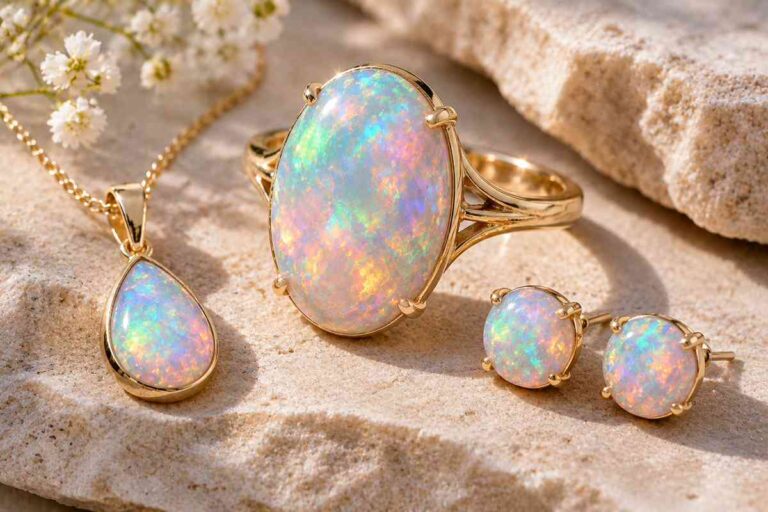
Opal jewelry has a charm that’s hard to mistake. Turn an opal ring or pendant toward the light, and you might see flashes of green, blue, orange, or fiery red moving across the stone. That shifting color is what makes precious opal so distinctive.
But there’s more to choosing opal jewelry than finding a pretty stone. Opals come in different varieties, their prices can vary dramatically, and some need considerably more care than other gemstones. Before buying, it’s worth understanding what you’re looking at and how well it will suit the way you plan to wear it.
Formation of Opal
Opal forms when water carrying dissolved silica moves through cracks and spaces in rock. As conditions change and water evaporates, silica can accumulate and eventually form opal.
Unlike many familiar gemstones, opal doesn’t have a regular crystalline structure. It’s made of hydrated silica, meaning that water is part of its composition. The amount varies between stones, but gem-quality opals commonly contain several percent water.
So where do those flashes of color come from? In precious opal, tiny silica spheres are arranged in an orderly structure that causes light to diffract, separating it into visible colors. Gemologists call the effect play-of-color.
Not every opal displays this effect. Common opal, sometimes called potch, usually lacks play-of-color, although it can still be attractive in jewelry.
Where Does Opal Come From?
Australia is the world’s best-known source of precious opal and has historically supplied most of the global market. Its major opal-producing regions include South Australia, New South Wales, and Queensland.
Each region is associated with distinctive material. Lightning Ridge in New South Wales is especially famous for black opal, while Queensland is known for boulder opal. South Australia’s opal fields produce a variety of light, white, and other precious opals.
Australia isn’t the only source worth knowing. Ethiopia, Mexico, Brazil, Peru, and the United States also produce opal, among other locations. Ethiopian opals are particularly familiar to today’s jewelry buyers, while Mexico is well known for fire opal.
Origin can influence a stone’s reputation and appeal, but an Australian label alone doesn’t guarantee superior quality. The individual opal’s appearance, condition, and characteristics matter more than its country of origin.
Opal Jewelry and October Birthdays
Opal is one of October’s traditional birthstones, alongside tourmaline. That makes opal jewelry a meaningful option for birthday gifts, especially for someone who loves colorful gemstones.
Opals have long been associated with hope, purity, confidence, and good fortune. Those meanings belong to gemstone folklore rather than scientifically established effects, but they can still give an opal necklace, ring, or pair of earrings a personal significance.
For a gift, think about how the recipient actually wears jewelry. Someone who rarely removes a ring may appreciate opal earrings or a pendant instead. They’ll get the beauty of the stone without exposing it to as many everyday knocks.

Opal Colors: What Makes Each Stone Different?
One of the fascinating things about opal is that two stones can look completely different. Some have a pale, milky background with delicate blue and green flashes. Others display brilliant patches of red, orange, and violet against a dark body color.
It’s useful to distinguish an opal’s body color, the background appearance of the stone, from its play-of-color, the changing flashes visible as light strikes it.
Fine black opal is especially sought after because its dark background can make the changing colors appear remarkably vivid. Red play-of-color is often prized, but color alone doesn’t determine quality. Brightness, contrast, pattern, and how much of the stone displays color all contribute to its appeal.
When comparing stones, look at them under more than one lighting condition. Gently turn each opal and notice whether the color remains attractive from different angles. A stone that looks dazzling in one carefully positioned photograph may appear quite different in ordinary light.
What Determines the Value of Opal Jewelry?
There’s no single price that defines a good opal. Common opal and precious opal occupy very different places in the market, and even two precious opals of similar size may have substantially different values.
Several characteristics matter when evaluating a stone:
- Play-of-color: Bright, attractive flashes that cover a substantial portion of the stone are generally desirable.
- Pattern: The arrangement of color matters. Distinctive patterns can be more desirable than scattered, weak flashes.
- Body color: Dark backgrounds can create dramatic contrast, although excellent light and crystal opals can also be valuable.
- Clarity and condition: Transparency, inclusions, visible cracks, and surface damage influence the stone’s appearance and desirability.
- Cut and size: A well-proportioned, polished stone that displays its colors effectively is generally more appealing. Size matters, but a larger stone isn’t automatically better.
- Construction and treatment: A solid natural opal is different from a doublet, triplet, or treated stone, and the distinction can affect value.
Some exceptional opals command high prices, but comparisons with diamonds or emeralds don’t tell you much about an individual piece. Jewelry value also depends on the setting, craftsmanship, metal, and seller’s pricing.
For an expensive purchase, ask for a clear written description of the stone and its treatments. An independent gemological report may be worthwhile for a particularly valuable piece.
Opal Treatments and Assembled Stones
Many opals are sold in their natural state, but others undergo treatments that change their appearance. These may include smoke or sugar treatments to darken the stone, or impregnation with substances such as oil, wax, or plastic.
A treated opal can still be beautiful. What’s important is knowing what you’re buying, especially because treatments may affect value, durability, and recommended care. Sellers should disclose treatments rather than leaving buyers to assume a stone is untreated.
You’ll also encounter opal doublets and triplets. These are assembled stones rather than single pieces of solid opal.
- Solid opal: A stone fashioned from a single piece of natural opal, without an added backing or protective cap.
- Opal doublet: A thin layer of precious opal attached to a backing, often dark material that helps the colors stand out.
- Opal triplet: A thin layer of opal placed between a backing and a transparent protective top, commonly made of glass or quartz.
Doublets and triplets can offer an attractive look at a lower price than comparable solid opals. However, their layered construction brings additional care considerations, including the possibility of damage to the adhesive or separation between layers.
Laboratory-created opal is another category. It shouldn’t be confused with naturally mined opal or with imitation materials that merely resemble it. Ask the seller to identify the material accurately rather than relying on descriptions such as “genuine-looking” or “opal style.”
If you enjoy seeing several colors in one stone, boulder opal is also worth considering. Its natural ironstone backing can create distinctive patterns and contrasts. You can compare other colorful stones in our semi-precious stones chart.

The Artistic Appeal of Opal
There’s a reason opal appeals to jewelry designers and people who love unusual gemstones. A good stone can look almost like a miniature painting, with shifting patches of color that change as you move.
Opals also have a long cultural history. The name is commonly traced through the Latin word opalus, associated with the gemstone. Over time, opal has gathered stories about luck, inspiration, and creativity.
For contemporary jewelry, its appeal is wonderfully straightforward. A single opal can provide enough color and character that a simple gold or silver setting is all it needs.
Common Categories of Opals
Knowing the names of the main opal varieties makes shopping considerably easier. These are some of the types you may encounter:
- White Opal: Usually has a white or light-colored background, often with delicate flashes of color. Its appearance ranges from understated to remarkably bright.
- Black Opal: Has a dark body color that can make play-of-color particularly striking. Fine examples are highly sought after, but quality varies from stone to stone.
- Boulder Opal: Precious opal naturally attached to its host rock, often ironstone. The combination creates distinctive patterns and contrasting colors.
- Matrix Opal: Opal distributed through the surrounding host rock rather than forming a separate, continuous seam.
- Water Opal: Typically transparent to translucent and relatively colorless in body appearance. Some examples display play-of-color, while others have a more understated look.
- Dendritic or Moss Opal: Known for branching, moss-like inclusions that can resemble tiny landscapes. These patterns are often caused by mineral inclusions rather than play-of-color.
- Fire Opal: Usually transparent to translucent with a warm yellow, orange, or red body color. Despite its name, fire opal doesn’t necessarily display play-of-color.
- Crystal Opal: Transparent to translucent precious opal in which flashes of color may appear to float within the stone.
For a broader look at gemstone varieties and their characteristics, see our gemstone reference chart.
Can You Wear Opal Jewelry Every Day?
You can wear opal jewelry regularly, but it’s not the most forgiving choice for someone who is hard on their accessories.
Opal generally measures about 5 to 6.5 on the Mohs hardness scale, which means it can scratch more easily than harder gemstones such as sapphire or diamond. It can also chip or fracture if struck. The Mohs scale measures resistance to scratching, not toughness or resistance to impact.
Opal earrings and pendants are often practical choices because they’re less likely to bump into hard surfaces. Rings face more hazards, particularly during exercise, gardening, household chores, or hands-on work.
If your heart is set on an opal ring, look for a protective setting that helps shield the stone’s edges. A jeweler can explain whether a bezel or another design is suitable for the particular opal. Just remember that no setting makes a delicate gemstone completely damage-proof.
How to Care for Opal Jewelry
Opal’s water content and relatively delicate structure make sensible care especially important. High heat and sudden temperature changes can cause damage, and some stones may develop fine cracks known as crazing.
For untreated solid opal jewelry, gentle cleaning with lukewarm water, a little mild soap, and a soft cloth is generally recommended. Dry the piece carefully afterward.
A few habits will help protect your jewelry:
- Remove opal rings before cleaning, exercising, gardening, or doing work that could knock the stone.
- Avoid ultrasonic and steam cleaners, which can damage opal.
- Keep opals away from harsh chemicals, excessive heat, and sudden temperature changes.
- Apply perfume, hairspray, and lotions before putting on your jewelry.
- Store opal pieces separately in a soft pouch or padded compartment to reduce scratching.
One important exception: Don’t assume every opal can be safely soaked in water. Some Ethiopian hydrophane opals absorb water, and assembled doublets or triplets may be affected by moisture. For these pieces, avoid soaking and follow the seller’s specific care instructions.
You also don’t need to keep ordinary opal jewelry submerged in water to preserve it. Sensible storage away from extreme heat is a better starting point. If you’re unsure about a stone’s treatment or construction, ask a qualified jeweler before cleaning it.
Where to Buy?
Choosing a trustworthy seller matters just as much as choosing an attractive stone. Whether you’re shopping at a local jewelry store or online, look for clear photographs, accurate material descriptions, treatment disclosures, and a reasonable return policy.
Before paying, ask whether the opal is natural, laboratory-created, or an imitation, and whether it’s solid, a doublet, or a triplet. For a higher-priced piece, get the details in writing. It’s also worth checking the setting, especially if you’re buying a ring.
For wholesale buyers, Rananjay Exports offers gemstone jewelry, including moonstone designs and opal rings. It operates as a business-to-business supplier, so shoppers purchasing a single piece should confirm ordering requirements before browsing its collection.
If you’re buying for yourself, don’t let a dramatic color display make the entire decision. The best opal jewelry is a piece you love looking at, understand how to care for, and can comfortably fit into your everyday style.
For further guidance on evaluating gemstones, the GIA opal buyer’s guide explains the qualities that influence appearance and value. Its opal care guide also provides practical cleaning and durability advice.