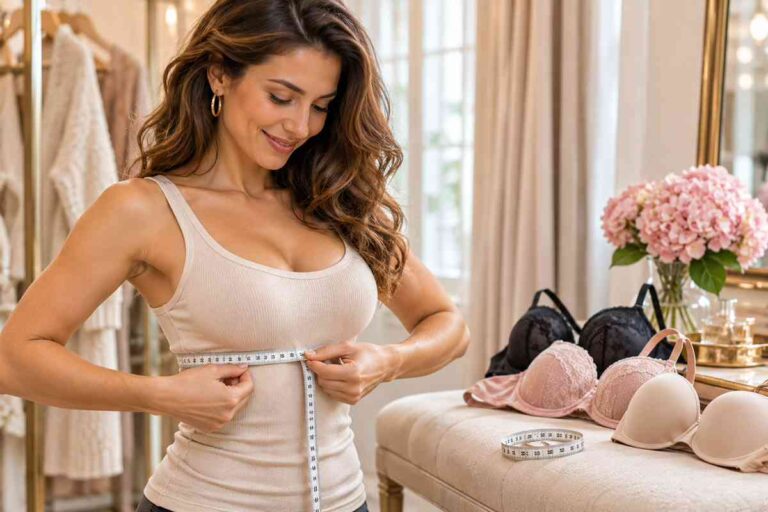
To find your bra size at home, you need two measurements: one around your rib cage just below your bust and another around the fullest part of your bust. Those numbers give you a starting point for choosing a band and cup size.
The tricky part? A size that works perfectly in one brand might feel completely different in another. That’s why a bra size chart is helpful, but checking how the bra actually fits matters just as much.
Why Finding the Right Bra Size Matters
An ill-fitting bra can dig into your shoulders, rub against your skin, or leave you constantly adjusting the band. It may also contribute to discomfort in your back or shoulders, especially if you’re not getting the support you need.
A well-fitting bra should feel supportive without restricting your movement. The band stays in place, the cups fit your breast tissue, and the straps don’t do all the work.
How to Measure Bra Size at Home
Grab a soft measuring tape and wear an unlined, non-padded bra if you have one. Measure in inches, preferably in front of a mirror so you can check that the tape stays level.
Step 1: Find Your Band Size
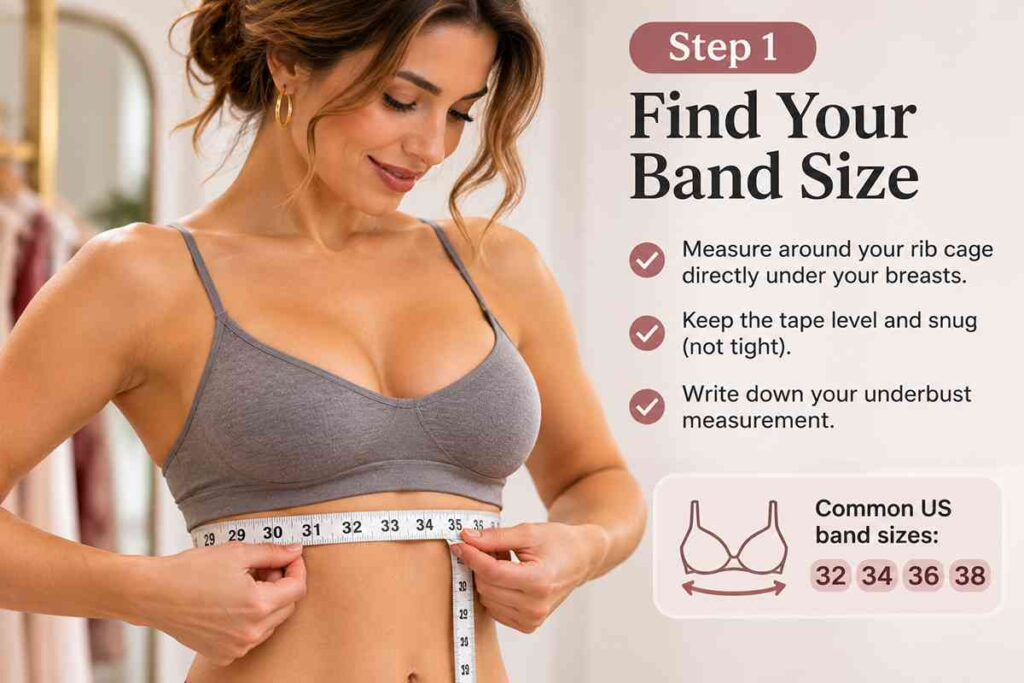
Wrap the measuring tape around your rib cage directly beneath your breasts, where your bra band sits. Keep the tape parallel to the floor and snug against your body without squeezing.
Write down your underbust measurement. Many US bra bands come in even-numbered sizes, such as 32, 34, 36, and 38. Some sizing methods round your measurement to a nearby even number, while others use different measurement ranges. Check the brand’s chart rather than assuming one rounding rule works everywhere.
Step 2: Measure Your Bust
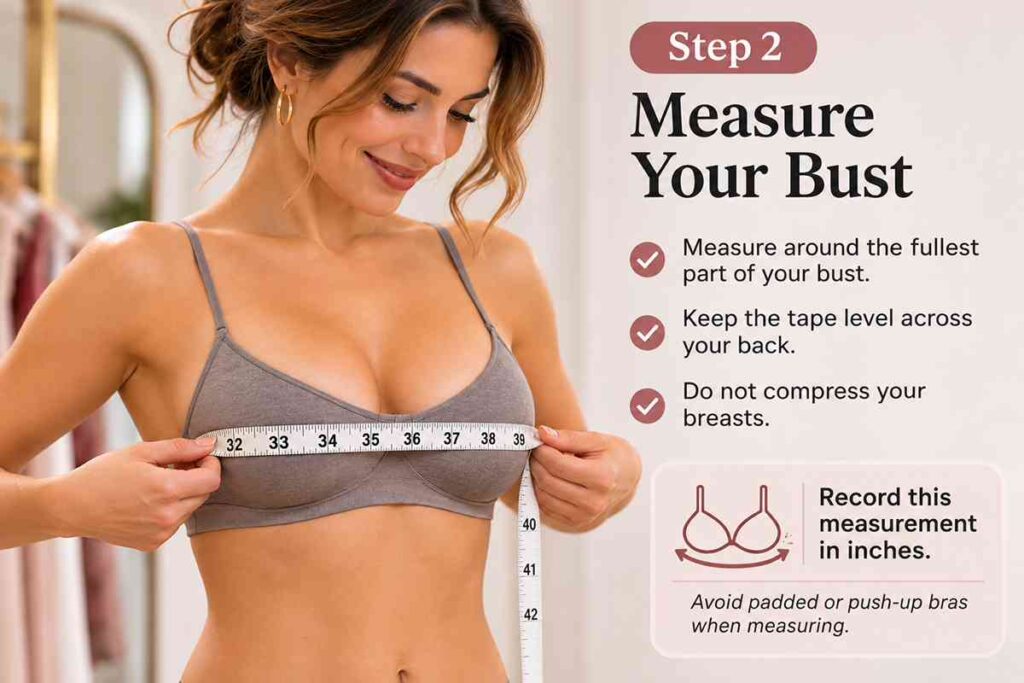
Wrap the tape around the fullest part of your bust, keeping it level across your back. The tape should rest against your body without compressing your breasts.
Record this measurement in inches. If you’re wearing a bra, avoid padded or push-up styles that could change the measurement.
Step 3: Calculate Your Cup Size
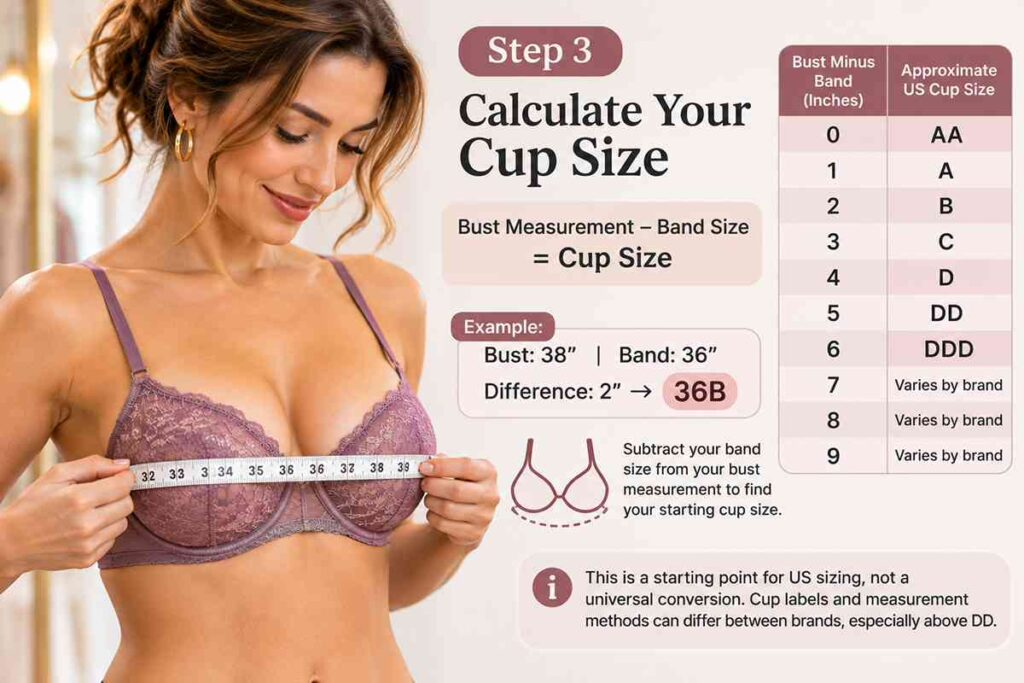
For a basic US sizing estimate, subtract your band size from your bust measurement. The difference helps you identify a starting cup size.
| Bust Minus Band (Inches) | Approximate US Cup Size |
|---|---|
| 0 | AA |
| 1 | A |
| 2 | B |
| 3 | C |
| 4 | D |
| 5 | DD |
| 6 | DDD |
| 7 | Varies by brand |
| 8 | Varies by brand |
| 9 | Varies by brand |
For example, if your band size is 36 inches and your bust measures 38 inches, the difference is 2 inches. Using this chart, you’d start by trying a 36B.
Don’t worry if the first size you try isn’t quite right. Bra sizing isn’t perfectly standardized, and cup volume also changes with band size. A 34C and a 36C, for example, don’t have the same cup volume.
Measuring Bra Size Without a Measuring Tape
No soft measuring tape? You can use a non-stretchy piece of string or ribbon and a ruler instead.
- Choose a non-stretchy string or ribbon: It should be long enough to wrap comfortably around your rib cage and bust.
- Measure your underbust: Wrap the string directly beneath your breasts, keeping it level. Mark where the ends meet.
- Check the length: Lay the string flat against a ruler or yardstick and record the measurement.
- Repeat for your bust: Measure around the fullest part, then use both measurements with your preferred brand’s sizing chart.
This method won’t be quite as convenient as a flexible measuring tape, but it can give you a useful estimate. A bra size calculator can also help once you have both measurements.
How to Tell if Your Bra Fits Correctly
Your measurements get you into the fitting room. What happens next determines whether you’ve found a keeper.
- Check the band: It should sit level around your body without riding up your back. Try fastening a new bra on its loosest hooks so you have room to tighten it as the elastic stretches.
- Look at the cups: Your breast tissue should fit comfortably inside them without spilling over the top or sides. Wrinkling or gaping can indicate a cup-size or shape mismatch.
- Check the center: On a structured underwire bra, the center panel between the cups should generally rest against your chest. If it floats away, try adjusting the cup size or style.
- Adjust the straps: They should stay on your shoulders without digging in. If you need to tighten them excessively for support, check the band fit.
- Move around: Raise your arms, sit down, and bend forward slightly. Your bra shouldn’t shift dramatically or need constant adjustment.
If your cups fit but the band doesn’t, try a sister size. For example, 34C, 32D, and 36B have approximately the same cup volume with different band lengths. Going down one band size means going up one cup size to maintain similar cup volume, and vice versa.
Just remember that sister sizes aren’t interchangeable in every style. A looser band may feel more comfortable but offer less support. Fit always comes before the number on the label.
Understanding Your Breast Shape
Finding the right bra goes beyond measurements. Breast shape also affects how cups sit, where straps feel comfortable, and whether a particular style gives you the coverage you want.
Here are a few common breast shapes and styles worth trying. They’re suggestions, not rules. You may recognize your shape in more than one description.
1. Full, Round Breasts
If you have full, round breasts, fullness tends to be distributed across both the upper and lower parts of your bust. Depending on the coverage and support you prefer, consider:
- Triangle bras: These offer a natural shape and lighter coverage, especially in soft, wireless designs.
- Plunge bras: Their lower center section works well beneath low-cut tops and dresses.
2. Teardrop Breasts
Teardrop breasts tend to have more fullness at the bottom than at the top. If you’ve noticed empty space near the top of molded cups, a different cup shape may help.
- Sweetheart demi bras: Their lower coverage can work well when you have less upper-bust fullness.
- Bras with flexible fabric overlays: Stretch lace or softer cup fabrics may follow your natural shape more comfortably than rigid molded cups.
3. Compact Breasts
Compact breasts typically have a smaller base or occupy less space on the chest. Cup width, depth, and strap placement can make a noticeable difference in comfort.
- Stretch fabric bras: Flexible cups can adapt to your shape without leaving unnecessary space.
- Bras with contoured padding: These can provide a smooth, rounded appearance if that’s the look you prefer. Check that the cup shape actually follows your breast tissue rather than creating gaps.
4. Wide-Set Breasts
Wide-set breasts have more space between them. A bra’s center section and underwire shape can affect how comfortably it sits against your chest.
- Bras with gently curving underwires: Look for wires that follow your breast roots without resting on breast tissue.
- Bras with generously spaced gores: A wider center panel may feel more comfortable if your breasts are naturally farther apart.
5. Asymmetric Breasts
It’s common for one breast to be larger than the other. You don’t need perfectly symmetrical breasts to find a comfortable bra.
- Bras with stretchy cups: Flexible fabrics can accommodate differences in breast size without obvious gaps or pressure.
- Contour bras with removable padding: Try fitting the larger breast first, then adjusting the smaller side with removable padding if you’d like a more balanced appearance.
If a bra fits your measurements but still feels awkward, don’t automatically assume you need a different size. Sometimes a different cup shape solves the problem.
The Importance of Regular Bra Size Checkups
Our bodies change over time, and so can our bra sizes. Weight changes, pregnancy, hormonal fluctuations, and aging can all affect how a familiar bra fits.
Checking your measurements about once a year is a reasonable habit, but you don’t need to wait for a calendar reminder if your bras are already uncomfortable. Recheck your fit whenever the band starts riding up, the cups no longer sit properly, or your body has changed.
Bra Shopping Tips
Now that you have a better idea of your measurements and breast shape, a few shopping habits can make finding a comfortable bra easier.
- Try before you buy: Visit a lingerie store or department store that offers bra fitting services. A professional fitter can help you compare sizes and find styles that suit your shape.
- Consider different styles: Experiment with wireless, strapless, sports, and underwire bras. The best option depends on your comfort preferences, activities, and wardrobe.
- Invest in quality: Look for secure stitching, supportive construction, and materials that hold their shape. A higher price doesn’t automatically guarantee a better fit.
- Pay attention to the fabric: Cotton, microfiber, mesh, and stretch lace all feel different against the skin. Choose materials that feel comfortable and suit how you’ll wear the bra.
- Check the care instructions: Proper washing and drying help protect the elastic, cups, and overall shape of your bras.
Be open to trying different cup sizes and styles, even if you’ve worn the same size for years. The right bra is the one that fits your body comfortably, not the one with your favorite number on the tag.