






Not sure whether you are wearing the right bra size? Start with two measurements: the circumference just under your bust and the circumference around its fullest part. They can help you narrow down a starting band and cup size, but the real test is how a bra feels when you put it on.
You can do this at home with a soft measuring tape and a mirror. I’ll walk through where to place the tape, what the numbers mean, and how to tell when the label and the actual fit disagree. If you would rather skip the arithmetic, try our bra size calculator after taking your measurements.
What you need to measure your bra size
- A flexible measuring tape, preferably marked in inches and centimeters.
- A mirror to check that the tape stays level across your back.
- A lightly lined or non-padded bra if it helps you measure your bust without compressing it. You can also measure without a bra.
- A note on your phone for recording your numbers.
You can measure yourself. A trusted person can help keep the tape level, but there is no need to arrange an in-store fitting if you would prefer privacy.
How to measure your bra size, step by step
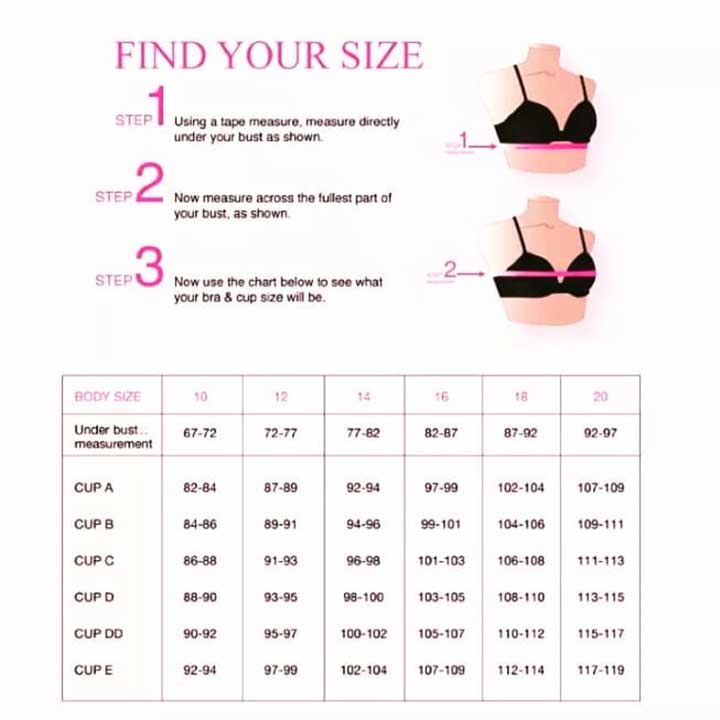
1. Measure your underbust for a starting band size
Wrap the tape directly beneath your breasts, around the rib cage where the bra band normally sits. Keep it parallel to the floor, breathe normally, and pull it comfortably snug without digging into your skin. Record the number, ideally in inches if you shop US or UK bra sizes.
For one common starting method, round your snug underbust measurement to a nearby even-numbered band size. For example, an underbust near 32 inches suggests trying a 32 band first. This is not a universal rule: some brands use a different size chart or a different measuring convention. In particular, do not automatically add four or five inches without checking the brand’s instructions.
2. Measure around the fullest part of your bust
Move the tape around the fullest part of your breasts, usually at nipple level. Keep it straight across your back and resting gently against your body. It should not press your breast tissue flat. Record this as your full-bust measurement.
If your breast shape makes a standing measurement difficult, you can also compare measurements while leaning forward. Differences between those measurements are useful clues about shape, but they do not automatically produce a single correct cup size.
3. Use the measurements to estimate a cup size
In a simple US/UK starting method, subtract your starting band number from your full-bust measurement in inches. A difference of about one inch commonly corresponds to A, two inches to B, three to C, and four to D. Larger differences continue through DD and beyond, although cup lettering differs between US and UK brands.
| Approximate difference | Common starting cup |
|---|---|
| 1 inch | A |
| 2 inches | B |
| 3 inches | C |
| 4 inches | D |
| 5 inches | DD |
| 6 inches | UK E / often US DDD or F |
For example, if your snug underbust is around 32 inches and your fullest bust is around 36 inches, 32D is one reasonable size to try. The next step is trying that size in a real bra and checking the band, cups, and wires. A calculator cannot account for every breast shape or fabric.
Prefer centimeters? Measure both circumferences in centimeters and enter them in our bra size and sister size finder. You can also convert centimeters to inches by dividing by 2.54. For perspective, 70 cm is about 27.6 inches, not 32 inches.
How to tell whether your bra actually fits
The measurements get you into the fitting room. The fit checks tell you whether to stay with that size. A bra should feel supportive and comfortable without pinching, slipping, or needing constant adjustment.
- Band: It should stay roughly level around your back and feel snug without painful pressure. A new bra should generally fit securely on the loosest hook, leaving room to tighten it as the elastic relaxes.
- Cups: Breast tissue should sit inside the cups without spilling over the top or sides. Persistent wrinkles or gaps may mean the cup is too large, or simply the wrong shape.
- Underwires: Wires should follow the breast root rather than resting on breast tissue or poking your underarms. In a wired style, the center usually sits close to the sternum, although body shape affects this.
- Straps: They should stay up without digging in. Most support should come from the band, not from tightening the straps as far as possible.
You can find similar fit checks in the Bravissimo bra fitting guide and Nordstrom’s fitting advice. Their emphasis on real fit is a useful reminder that measuring is only the beginning.
Common bra fit problems and what to try
| What you notice | What to check next |
|---|---|
| Band rides up your back | Try a firmer or smaller band, while adjusting cup size as needed to preserve volume. |
| Breast tissue spills over the cups | Try a larger cup or a shape with more room, and check that the band is not too loose. |
| Cups wrinkle or gape | Try a smaller cup or a different cup shape. Gaping alone does not prove that the cup is too big. |
| Straps dig into shoulders | Check band support and cup fit before tightening or changing straps. |
| Underwire pokes or sits on breast tissue | Try a different wire width, cup size, or non-wired construction. |
If a bra is persistently uncomfortable, do not force the fit because the tag matches your calculated size. Try another style or get a fitting from someone who respects your comfort and personal boundaries.
What are sister sizes?
Sister sizes have approximately the same cup volume with different band lengths. For instance, 34D and 32DD are sister sizes in common US/UK labeling. Moving down a band usually means moving up one cup letter to maintain a similar volume; moving up a band means moving down one cup step.
That does not make them interchangeable. A 32 band still feels different from a 34 band, and cup construction changes with the size. Sister sizing is a troubleshooting option when the band is the main problem, not a reason to buy a bra that does not fit.
US, UK and Australian bra band size conversion
If you are shopping across regions, this familiar band conversion is a quick reference. It converts labeled band sizes, not the tape measurement used to select them.
| US / UK band | Australia / NZ band |
|---|---|
| 30 | 8 |
| 32 | 10 |
| 34 | 12 |
| 36 | 14 |
| 38 | 16 |
| 40 | 18 |
| 42 | 20 |
| 44 | 22 |
| 46 | 24 |
The cup letters require more care. US, UK and European brands do not all use the same progression after D, and the same printed letter does not always mean the same cup volume.
Do you need an above-bust measurement?
Some fitting systems also measure around the upper chest, above the breasts. That can offer extra context about torso proportions, but it is not a universal requirement for determining your cup size. For most at-home starting estimates, the underbust and fullest-bust measurements are the essentials.
When should you measure again?
Remeasure when your bras stop fitting as they used to, after noticeable body changes, or before buying from a brand with an unfamiliar sizing chart. Hormonal changes, weight fluctuations, pregnancy, and other changes can affect breast size and shape. You may also find that you need different sizes or constructions for different styles.
Bra sizing FAQs
Can I measure my bra size without anyone helping?
Yes. Use a mirror to keep the tape horizontal around your back and take each measurement twice. An in-store fitting is optional.
Do I add four inches to my underbust measurement?
Not automatically. Some brands use an add-inches method and others do not. Use your snug measurement as a starting point, follow the particular brand’s chart, and check the fit on your body.
Is a B cup bigger than an A cup?
Within the same band size and sizing system, B is one cup step larger than A. Across different band sizes, cup letters alone do not tell you the volume.
Why does the same bra size fit differently in two brands?
Brands use different patterns, wire shapes, elastic, and cup constructions. A size that works beautifully in one design may need adjusting in another.
Can I use a bra size calculator instead?
Absolutely. Measure your underbust and full bust first, then enter both into the BluFashion Bra Size Calculator. Treat its recommendation as a starting size, then use the fit checks above before deciding what to keep.
The takeaway: Two careful measurements help you find a sensible size to try. A level band, comfortable cups, and a shape that works with your body are what make that size worth wearing.


