




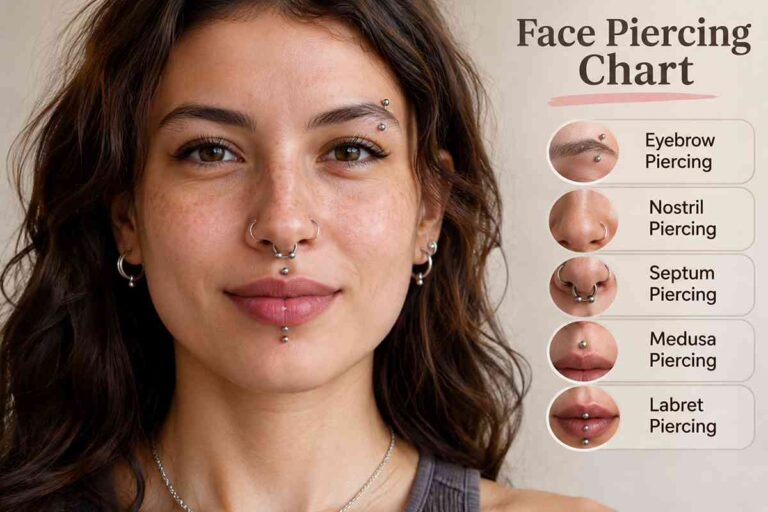
Every face piercing has its own trade-offs. A nostril stud is over in seconds but takes months to heal. A septum ring heals relatively fast and, once healed, flips up out of sight when you need it to. A cheek piercing looks amazing and takes forever. The chart below lists the common face piercings by name, where each one goes, how much it typically hurts, how long initial healing usually takes, and what jewelry it usually starts with. After that, you’ll find what the chart can’t show: what each area is really like to live with, what you’re paying for, and how to keep a new piercing happy.
(Related: Cute Face Piercings for Your Face Shape).
Face Piercing Chart: Placement, Pain and Healing at a Glance
Two things to know before you read the chart. Pain levels are what people commonly report, not measurements, and yours will depend on your anatomy, your piercer’s skill, and your own tolerance. Healing times are rough ranges for initial healing. Published healing estimates vary from source to source, full healing often takes longer, and your piercer’s timeline for your piercing is the one to follow. The same goes for starter jewelry: your piercer will choose what fits your anatomy.
| Piercing | Where it goes | Pain (commonly reported) | Typical initial healing | Usual starter jewelry |
|---|---|---|---|---|
| Nostril | Side of the nostril, in or just above the crease | Low to moderate | 4 to 6 months, often longer | Flat-back or L-shaped stud (rings usually wait until it heals) |
| High nostril | Higher on the side of the nose, through firmer cartilage | Moderate | Longer than a standard nostril | Flat-back stud |
| Septum | The thin “sweet spot” of soft tissue between the nostrils, just in front of the cartilage | Low to moderate (your eyes will water) | 6 weeks to 3 months | Circular barbell or captive ring |
| Bridge | Horizontally across the top of the nose, between the eyes | Low to moderate | 2 to 6 months | Straight barbell |
| Nasallang | One straight bar through both nostrils and the septum | High | At least as long as a nostril | Long straight barbell |
| Eyebrow | Vertically through the brow, usually toward the outer end | Low | 6 weeks to 3 months | Curved barbell |
| Anti-eyebrow | Surface piercing on the upper cheekbone, below the outer corner of the eye | Moderate | Several months; rejection is common | Surface bar |
| Third eye | Vertical surface piercing between the eyebrows | Moderate | Several months; rejection is common | Surface bar |
| Dermal anchor | A single-point anchor under the skin, often on the cheekbone; only the top shows | Moderate | Several months; rejection is common | Dermal anchor with a decorative top |
| Cheek (dimple) | Through the full thickness of the cheek into the mouth, where a dimple would sit | Moderate to high | 6 months or more | Flat-back labret stud or straight barbell |
| Labret | Centered below the lower lip, above the chin | Low to moderate | 6 weeks to 3 months | Flat-back labret stud |
| Side labret | Below the lower lip, off to one side | Low to moderate | 6 weeks to 3 months | Flat-back labret stud |
| Vertical labret | Through the lower lip from top to bottom, with no exit inside the mouth | Moderate | 6 to 12 weeks | Curved barbell |
| Ashley | Center of the lower lip itself, exiting inside the mouth | Moderate | Similar to other lip piercings | Flat-back labret stud |
| Monroe and Madonna | Above the upper lip, off-center (Monroe on your left, Madonna on your right) | Moderate | 6 weeks to 3 months | Flat-back labret stud |
| Medusa (philtrum) | Centered in the groove above the upper lip | Moderate | 6 weeks to 3 months | Flat-back labret stud |
| Jestrum | Vertically through the center of the upper lip | Moderate to high | Similar to a vertical labret | Curved barbell |
| Snake bites | Two piercings below the lower lip, one on each side | Moderate | 6 weeks to 3 months | Two flat-back labret studs |
| Spider bites | Two piercings close together below the lower lip, on the same side | Moderate | Similar to other lip piercings | Two flat-back labret studs |
| Angel bites | Two piercings above the upper lip, one on each side | Moderate | 6 weeks to 3 months | Two flat-back labret studs |
| Dahlia | One piercing at each corner of the mouth | Moderate | Similar to other lip piercings | Two flat-back labret studs |
| Smiley | The small web of tissue inside your upper lip; it shows when you smile | Low | Quick, but it often migrates out, and the jewelry can wear on teeth and gums | Small circular barbell or ring |
| Tongue | Vertically through the center of the tongue | Moderate; the swelling is the hard part | 4 to 6 weeks | Long straight barbell, shortened once swelling drops |
For photos and more detail on the less common placements, see our guide to facial piercings, from simple to extreme.
Nose Piercings
The classic nostril stud is the most common starting point, and for good reason: it’s quick, the pain is brief, and a tiny stud reads as polished rather than edgy. The catch is healing. It goes through cartilage, so expect months of gentle care, not weeks. A high nostril sits farther up where the cartilage is firmer, which usually means more pressure during the piercing and a longer heal.
The septum is the sleeper hit. A good piercer goes through the thin tissue in front of the cartilage, so it often hurts less than people expect and heals faster than a nostril. Once it’s healed, it’s the easiest face piercing to hide: flip a ring or retainer up into the nose and it disappears, like a secret badge of coolness you can wear to a job interview. While it’s fresh, leave the jewelry where your piercer put it, and if you’ll need to hide it right away, say so at the appointment.
A bridge piercing depends on having enough skin between your eyes to pinch, and it sits right where eyeglasses rest, so wearers should ask about placement first. The nasallang and septril are advanced pieces. A nasallang passes through both nostrils and the septum in one line, and a septril usually requires a stretched septum. Neither is a first piercing, and both need an experienced piercer.
Eyebrow and Upper Face Piercings
The eyebrow piercing is usually described as fairly mild, and if you ever retire it, the small marks it leaves tend to hide in the brow hair. Its weakness is migration: because it’s a fairly shallow piercing, it can slowly drift toward the surface, especially if it gets snagged on towels or sweaters.
The anti-eyebrow and third eye are surface piercings, meaning they run under a flat patch of skin rather than through a fold of tissue like a nostril or lip. They look striking, but they’re more prone to rejection, where the body slowly pushes the jewelry out. Dermal anchors work differently: a single small anchor sits under the skin and only the decorative top shows, but they share the same tendency to reject. For any of these, pick a piercer who does surface and dermal work regularly.
Lip, Cheek and Mouth Piercings

Lip piercings come in more variations than any other area, but most are built from a few basic positions: below the lower lip (labret, side labret, snake bites, spider bites), above the upper lip (Monroe, Madonna, medusa, angel bites), through the lip itself (vertical labret, Ashley, jestrum), or at the corners of the mouth (dahlia). Our breakdown of the differences between lip and labret piercings covers the main ones in more detail.
Here’s the trade-off the rest of your face doesn’t have: jewelry that touches your teeth and gums. The American Dental Association advises against cosmetic piercings in and around the mouth, because the jewelry can chip teeth and wear away gum tissue over time. If you go ahead anyway, two habits reduce the rubbing: a flat-back labret stud rather than a ring for piercings that sit against your gums, and a return visit to have the post shortened once the initial swelling goes down. They lower the risk without removing it, so tell your dentist about the piercing and keep up with checkups.

Cheek piercings are an advanced placement. They go through the full thickness of the cheek into the mouth, close to the ducts that carry saliva from the parotid glands. An experienced piercer locates those ducts before marking the spot, because damage to one can’t be fully undone and can leave saliva leaking through the piercing. Cheeks also swell a lot, commonly take six months or more to settle, and are more likely than most face piercings to leave a visible mark if you take them out. They’re best for people who already know they love the look and have found a piercer who does them often.
Tongue piercings sound scary but heal fast, usually in about a month. The first week is the rough part: your tongue swells, talking gets lispy, and soft, cool food is your friend. That swelling should be manageable. If it ever makes breathing or swallowing hard, treat it as an emergency and call 911. If the snake eyes piercing has caught your eye, read up first: the bar runs horizontally across the tip of the tongue, where it can knock against your teeth far more than a standard vertical piercing.
How to Choose Your First Face Piercing
- If you need to hide it sometimes, a healed septum ring flips up, and a healed nostril can wear a tiny clear or skin-tone retainer.
- If you want a gentle start, a nostril, septum, or eyebrow is a common first choice.
- If you wear glasses, think twice about a bridge or anti-eyebrow piercing, where frames can press or rub.
- If you’re worried about your teeth, stick to the nose and brow. Any jewelry in or around the mouth carries some risk to teeth and gums.
- If you want something rare, surface piercings, dermals, and cheeks deliver, but plan for a long heal and a real chance of rejection or scarring.
What It Costs
Here’s where your wallet might shed a tear. The price usually has two parts: the piercing fee and the jewelry, and the jewelry can easily cost as much as the service. Prices vary by city, studio, and placement, so call around, and ask whether the quote includes the jewelry and a follow-up visit to shorten the post.
This is the place to choose quality over cheap thrills. A good studio pierces with a sterile, single-use needle, never a piercing gun, and uses starter jewelry that meets the Association of Professional Piercers standard: implant-grade titanium, implant-grade steel, niobium, or solid 14k or higher gold that’s free of nickel and cadmium (not plated or gold-filled). Bargain jewelry in a fresh piercing is how you end up with your nose looking like a Christmas ornament gone wrong.
The Care and Keeping of Your New Shiny Friend
Don’t get lazy once it’s in. A neglected piercing can get angrier than a cat in a bathtub. The basics:
- Rinse with sterile saline and pat dry with clean gauze or paper towel.
- Wash your hands before touching it, and otherwise leave it alone. No twisting.
- Skip hydrogen peroxide, alcohol, and harsh antibacterial soaps, which irritate healing skin.
- Keep makeup, skincare, and hair products off the piercing while it heals.
- For lip, cheek, and tongue piercings, keep brushing and flossing gently with a new soft toothbrush, rinse with water or saline after eating, and use an alcohol-free mouthwash only a couple of times a day, since overusing it irritates the piercing.
- Don’t swap in fashion jewelry until your piercer says the piercing is healed.
Some redness, tenderness, and clear or whitish crust are normal for the first few weeks. Thick yellow or green pus, redness that spreads, increasing pain, or a fever are not. See a doctor, and don’t pull the jewelry out on your own, since that can trap an infection inside.
The Scars of War (or Piercing, Rather)
If you ever take a face piercing out, expect it to leave a small mark. Holes in thin tissue like the septum often shrink to almost nothing, while cheeks and surface piercings are more likely to leave a visible dot or dimple. Plenty of people wear theirs like a battle wound. If you or your family tend to form keloids (raised scars that grow beyond the wound), talk to your doctor before getting pierced anywhere.
Ready to Rock?
Whether you’re into the chic Monroe, the striking snake bites, or the avant-garde nasallang, the best first step is the same: book a consultation with an experienced piercer, bring this chart, and ask how your anatomy fits the placement you want.
Stay edgy, my friends!