





For a 6.5-inch wrist, a 37 to 40 mm classic watch is a good place to start. But case diameter isn’t the whole fit. Lug-to-lug length, thickness, and the shape of your wrist can make two watches with the same diameter feel completely different. Use the sizing tool below, then check the charts before you buy.
Watch Case Size Guide
Find your perfect watch size based on your wrist measurements and style preferences. Get recommendations for case diameter, lug-to-lug distance, and more.
How to Measure Your Wrist
- Use a flexible measuring tape or string
- Wrap snugly around your wrist where you'll wear the watch
- Make sure the tape sits flat against your skin
- Don't pull too tight - allow for natural movement
- If using string, mark the measurement and use a ruler
- Measure at different times of day as wrists can swell
Quick answer
- Measure around your wrist where you normally wear a watch.
- Start with a case diameter from the style chart below, then check the watch’s lug-to-lug length.
- Make sure the lugs sit on the flatter part of your wrist without sticking past the edges.
- Check thickness, strap fit, and protruding bracelet end links before ordering.
How to measure your wrist, fast
- Wrap a soft tape just behind your wrist bone, where the watch will sit. Keep it snug, not tight.
- No tape? Wrap a strip of paper around your wrist, mark the overlap, and measure it with a ruler.
- Write down the circumference in inches and millimeters. Multiply inches by 25.4 to get millimeters.
- Look straight down at the top of your relaxed wrist. If possible, measure the flatter area where the watch lugs would rest. This width is more useful for checking overhang than circumference alone.
Why this matters: Most watches list their dimensions in millimeters. Circumference gives you a starting size, while the width and shape of the top of your wrist help you judge whether the watch actually sits comfortably.
Watch sizing is personal, too. Hodinkee’s discussion of Mark Cho’s wrist-size survey is a useful reminder that people can prefer very different case sizes on similar wrists.
What case size really means
- Case diameter is the width of the watch case across the face, excluding the crown.
- Lug-to-lug is the distance from the tip of the top lugs to the tip of the bottom lugs. It shows how much of your wrist the watch spans.
- Thickness is the height from the case back to the top of the watch. It affects how easily a watch fits under a cuff.
- Lug width is the gap between the lugs where the strap attaches. A 20 mm lug width generally calls for a 20 mm strap.
Don’t confuse lug width with lug-to-lug length. They measure two different directions, and only the latter helps you judge whether the case may overhang your wrist.
Quick wrist math you can use anywhere

Here’s the useful calculation: wrist circumference in inches × 25.4 = wrist circumference in millimeters. For example, 6.5 inches is about 165 mm.
You may see advice to divide wrist circumference by 3.1416 to estimate wrist width. That gives the diameter of an imaginary circular wrist. Real wrists are usually flatter, so it is not a dependable lug-to-lug limit. Use the following numbers only to start comparing watches, then check your actual wrist shape.
Wrist circumference and lug-to-lug starting points
| Wrist circumference | Circumference in mm | Lug-to-lug lengths worth comparing first |
|---|---|---|
| 5.5 in | 140 mm | 40 to 44 mm |
| 6.0 in | 152 mm | 43 to 47 mm |
| 6.5 in | 165 mm | 46 to 50 mm |
| 7.0 in | 178 mm | 49 to 53 mm |
| 7.5 in | 191 mm | 52 to 56 mm |
These are approximate shopping ranges, not maximums or guaranteed fits. A flat wrist may accommodate longer lugs than a round wrist with the same circumference. Downturned lugs can help, while rigid bracelet end links may extend the effective length. When in doubt, measure a watch you already find comfortable.
The size table you can screenshot
Use your wrist measurement and the look you want to find an initial case diameter. Then compare lug-to-lug measurements and actual wrist photos. A smaller dial with a wide bezel usually looks more compact than a large, open dial of the same case diameter.
Case diameter ranges by wrist and style
| Wrist | Minimalist | Classic | Sporty |
|---|---|---|---|
| 5.5 in | 34 to 36 mm | 34 to 37 mm | 36 to 38 mm |
| 6.0 in | 35 to 37 mm | 36 to 38.5 mm | 38 to 40 mm |
| 6.5 in | 36 to 38.5 mm | 37 to 40 mm | 39 to 41.5 mm |
| 7.0 in | 37 to 39.5 mm | 38 to 41.5 mm | 40 to 43 mm |
| 7.5 in | 38 to 41 mm | 39 to 43 mm | 42 to 45 mm |
How to use it
- Find your wrist row.
- Choose the style you prefer, not the gender label on the box.
- Compare the diameter range with each watch’s published lug-to-lug length.
- If you wear buttoned shirt cuffs, a case around 12 mm thick or less may be easier to wear, but cuff clearance varies by shirt and case shape.
Thinking about cost and wear? A watch you reach for four days a week may be the better purchase than a special-occasion piece you rarely wear. Our Cost Per Wear Calculator can help compare them.
Watch Case Size Guide for women’s and men’s wrists
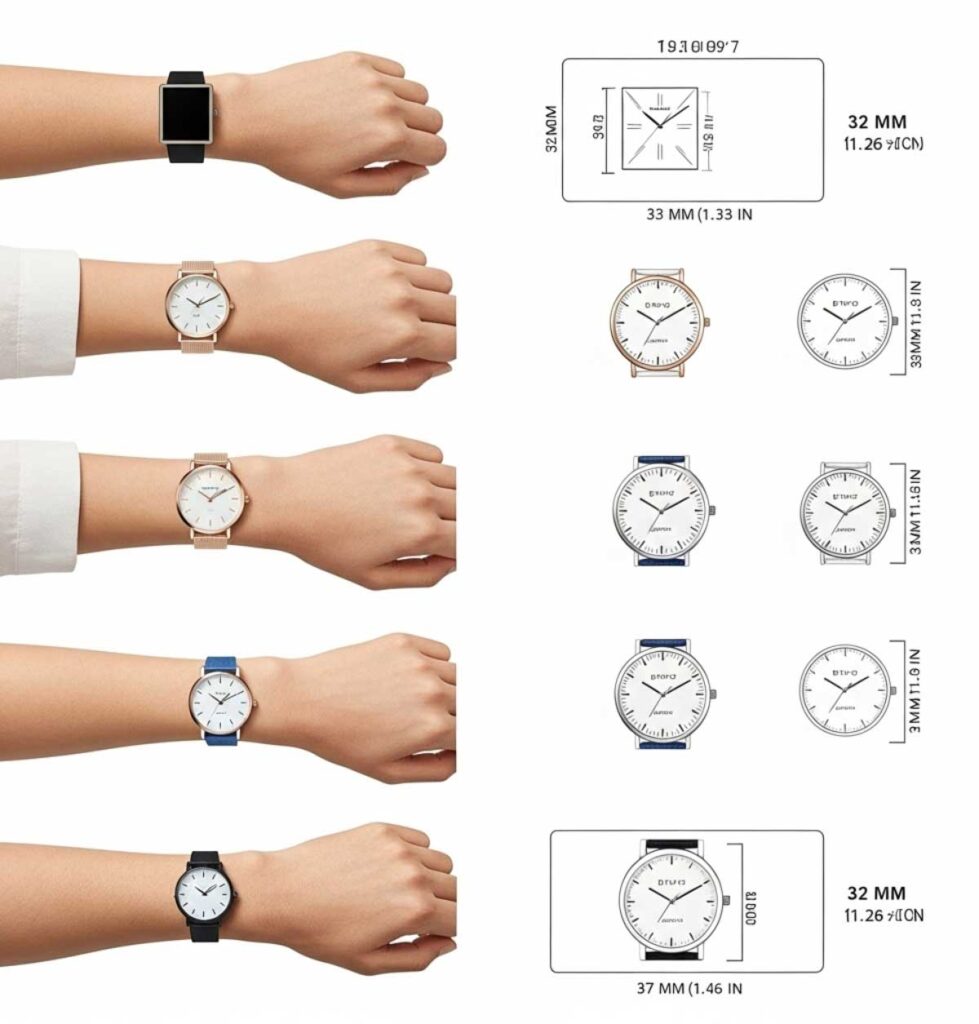
Ignore the gender tag and use proportions. On the same wrist, a 34 mm dress watch can look refined, while a 38 mm sport watch may feel just as natural if its lugs are short and the strap sits well.
- For a smaller or subtler look: Try a classic 34 to 36 mm watch with short lugs. If you prefer a sportier look, a 38 mm case may work just as well.
- For a medium-size wrist: A 38 to 41 mm classic watch is a sensible starting range. A 40 to 42 mm sport watch can also work, provided the case does not overhang.
- For anyone who prefers oversized watches: Check lug shape, bracelet end links, and comfort instead of relying on the men’s or women’s label.
What I tried and what actually worked
My wrist is 6.5 in. I wore a 36 mm dress watch, a 38 mm minimalist, and a 41 mm diver across a week.
- The 36 mm dress piece with a 44 mm lug to lug disappeared under cuffs. Win.
- The 38 mm minimalist with long lugs felt larger than the diver. My mistake was ignoring lug to lug. The fix was capping it at 52 mm for my wrist.
- The 41 mm diver felt fine because the lugs were short and curved. A soft rubber strap lowered the visual weight.
Tiny win you can try today: measure a watch you already find comfortable. Its diameter, lug-to-lug length, and thickness are a much better reference than any universal size rule.
How to measure watch case size when shopping online
- Find the full specifications. Look for case diameter, lug-to-lug length, thickness, lug width, and weight. If lug-to-lug is missing, check the brand’s own product page or ask customer support.
- Check how the lugs and bracelet attach. Long, straight lugs or rigid end links can increase the watch’s effective footprint. Curved lugs and flexible straps often wrap more closely.
- Read wrist photos carefully. Look for visible overhang, but remember that a photo without the wearer’s wrist measurement is only a clue.
- Measure a watch you own. With a ruler or calipers, measure across the case without the crown, from top lug tip to bottom lug tip, and from case back to the highest point of the crystal. Measure the gap between the lugs separately if you need a replacement strap.
If a listing provides only diameter, use it for your first shortlist, not your final decision. Gear Patrol’s hands-on lug-to-lug comparison shows how a smaller-diameter watch can wear larger when its lugs extend farther.
Smartwatch sizing, quick notes

Smartwatch case sizes are not directly interchangeable with round-watch diameters. Compare the watch’s actual dimensions, how the band curves around your wrist, and the manufacturer’s recommended wrist range. A securely fitted band matters for both comfort and sensor contact.
For Apple Watch, compatibility deserves a double-check. Apple lists 38, 40, and 41 mm cases in one older band family, and 44, 45, and 46 mm cases in a larger family. The current 42 mm Sport Band lists compatibility with 38, 40, 41, and 42 mm watches, while older 42 mm models used a different band family. Use your exact watch model, not the size number alone, when replacing a band. See Apple’s band-changing and compatibility guidance.
If your wrist is slim, an adjustable soft loop may sit closer than a stiff bracelet. If you use a stretch-fit band, consult its specific size chart before ordering.
Common mistakes and easy fixes
- Chasing diameter only. Compare lug-to-lug, case shape, and dial size before deciding.
- Using circumference as a hard lug limit. Measure the flatter top of your wrist, or compare against a watch you already wear comfortably.
- Ignoring thickness. Check how the watch fits beneath the actual shirts or jackets you wear.
- Forgetting bracelet end links. Fixed, protruding links may make a watch wear longer than its published lug-to-lug measurement.
- Buying by gender tag. Shop for fit and the look you want, not the category name.
Quick picks by scenario
- Office: Start with a classic 36 to 39 mm case and a slim profile if you wear fitted cuffs.
- Weekend: Consider a 40 to 42 mm sporty case with short lugs and a flexible rubber or nylon strap.
- Petite wrists: Try a 34 to 36 mm minimalist case with short lugs, then check how it sits on the wrist.
- Larger wrists: A classic 40 to 42 mm or sporty 42 to 45 mm watch may look balanced, depending on the actual case length and shape.
These are style suggestions, not size restrictions. The best test is still whether the watch feels secure and the lugs sit naturally on your wrist.
Mini checklist to save on your phone
- Wrist circumference in inches and millimeters.
- The diameter range for your preferred look.
- Lug-to-lug length and any extra length from bracelet end links.
- Case thickness and whether it clears your cuffs.
- Lug width and the type of strap you prefer.
- Return policy, especially if you cannot try the watch on before buying.
Before checkout, put the measurements of your most comfortable watch next to those of your shortlist. That comparison beats guessing from a product photo.
FAQ
How do I measure my wrist at home?
Wrap a soft tape, or a marked strip of paper, just behind your wrist bone where the watch sits. Keep it snug but not tight. Multiply inches by 25.4 for millimeters.
What is lug to lug, and why does it matter more than diameter?
Lug-to-lug is the length from the tip of the top lugs to the tip of the bottom lugs. It helps predict whether a watch will extend past the flatter part of your wrist. Diameter still matters for style and visual balance.
How do I estimate my wrist width to set a lug to lug cap?
For a better fit check, measure the flatter top of your wrist directly or compare with a watch you already own. Circumference divided by 3.1416 assumes a perfectly circular wrist, so it should not be used as a firm lug-to-lug cap.
What case size should I try for a 6.0 in wrist?
Start around 35 to 37 mm for minimalist, 36 to 38.5 mm for classic, or 38 to 40 mm for sporty. Compare lug-to-lug measurements and look for overhang before deciding.
What about a 7.0 in wrist?
A classic case around 38 to 41.5 mm is a useful starting point; a 40 to 43 mm sport watch can also work. Check lug length and wrist shape rather than treating the chart as a fixed rule.
Do women need smaller cases than men?
No. Watch proportions, wrist shape, and personal style matter more than the gender label. Start with the size chart and choose what feels comfortable.
How do I measure a watch I already own?
Measure case diameter across the face without the crown, lug-to-lug from top to bottom lug tips, and thickness from the case back to the highest point. The gap between the lugs is the strap width.
Does thickness really matter under a shirt cuff?
Yes. A case around 12 mm thick or less can be easier under a fitted cuff, but the cuff opening and case shape also matter. Try the watch with the shirts you normally wear.
How do smartwatch sizes map to smaller wrists?
Use the maker’s wrist-size range and actual case dimensions rather than comparing smartwatch numbers directly with round-watch diameters. Choose a band that stays secure without squeezing, and check exact model compatibility.
I like an oversized look. How far can I push it?
Try the larger end of the diameter range, but inspect the lug shape, effective length, and how securely the strap holds the watch. If the lugs visibly extend past your wrist edges, try a shorter case.
What strap width should I look for?
Measure the gap between the lugs. If it is 20 mm, choose a compatible 20 mm strap. Lug width is different from lug-to-lug length.
I am between two sizes in the table. Which way should I go?
For a more understated or dressy look, try the smaller end. For a sporty look, try the larger end, then check lug-to-lug and comfort.