You can wear jewelry to a job interview, and you don’t have to. Going bare looks perfectly professional. If you do wear some, a few simple, clean pieces you already feel comfortable in make an outfit look finished without stealing the conversation. The goal is for the interviewer to remember what you said, not what was hanging from your ears.
I get dressed for real meetings and interviews, and the rule I actually use is simple: if a piece clanks when I talk with my hands, catches on my blazer cuff, or gives me something to fidget with when I’m nervous, it stays home. Everything below follows from that.
Earrings: Studs or Small Huggie Hoops
Studs are the easiest choice in any industry, and small huggie hoops that sit close to the lobe are just as normal now. A stud with a colored stone is fine too, as long as it’s small: a tiny sapphire or garnet reads as polished, while a large, flashy stone pulls attention away from your face. What to skip is anything that swings, like chandeliers, long drops, or big statement hoops. They move every time you nod, and they tend to get tangled in hair and headphones.
The same rule works for men: if you normally wear a small stud or plain hoop, it’s a personal choice, not a dress code violation. If you’re unsure about a particular employer, look at how people present themselves on its website, LinkedIn, or in the office when you arrive, and decide from there.
Necklaces: One Fine Chain, Personal Pendants Welcome
A thin chain with a small pendant, or just the chain, is the classic pick. What matters is that it works with the neckline you’re actually wearing: it should lie flat, stay put when you lean forward, and not tangle with buttons or a collar. Some necklines, like a high crew or a busy collar, look cleaner with no necklace at all. If you’re not sure where a length will land, the Necklace Length Visualizer shows how each one falls.
A subtle personal or religious pendant, like a small cross, Star of David, initial, or family piece, is completely normal. You don’t need to hide who you are to get hired, and in the US, federal law generally protects religious dress and symbols in hiring, not just on the job. Leave the heavy statement necklaces and long layered chains for another day, mostly because they shift around and make noise when you move.
Rings: Keep It to What You Wear Every Day
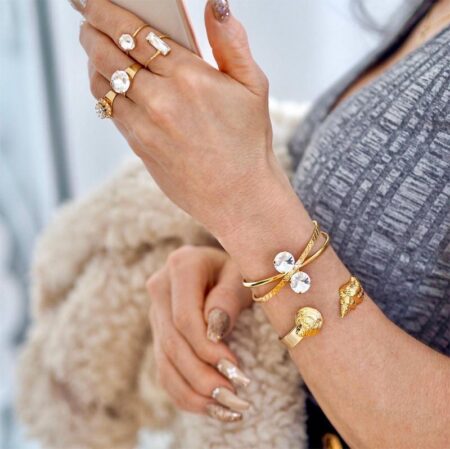
A wedding or engagement ring and a simple band or two are all you need. Big cocktail rings knock against the table and catch the eye every time you gesture. If you have a ring you twist when you’re anxious, a spinner or a loose band you play with, take it off for the hour. Nervous habits look more nervous with a prop.
Watches and Smartwatches
A classic watch with a simple face is an easy, safe choice. Just don’t glance at it during the conversation, which reads as impatient whether it’s a watch or a phone. If you need help choosing a size that suits your wrist, our watch case size guide walks you through it.
Smartwatches are everywhere now, and wearing one is fine. Just give it two small checks before the interview. If you’re wearing a worn or sweaty-looking gym strap, clean it or swap in a leather or metal band if you already have one, and turn on Do Not Disturb (on an Apple Watch, a Focus mode does the same job) so texts don’t light up your wrist in the middle of an answer. A buzzing wrist is hard to ignore, for you and the person across the table.
Bracelets: One Slim Piece That Stays Quiet
One slim bracelet or a thin cuff is fine. The test is noise: rest your wrist on a table and talk with your hands for a minute. If it clicks, slides, or catches on your sleeve, leave it home. Stacks of bangles almost always fail this test, so save them for the weekend.
Match the Industry
How much personality you show depends on where you’re interviewing. A corporate law, finance, or government interview still calls for quiet, classic pieces: studs, a fine chain, a plain watch. Creative, media, fashion, and tech roles leave room for a sculptural ring, a modern layered chain, or mixed metals, especially if your style is part of what you bring to the job. If the job involves food, patients, lab work, or machinery, there may be real safety or hygiene rules about rings, watches, and bracelets, so check the posting or ask the recruiter. When in doubt, dress one step above what people wear there day to day; our guide to women’s dress codes breaks down what each level looks like.
Jewelry for Zoom and Video Interviews
If your interview is on video, the webcam changes the math. Tiny studs can disappear entirely on a laptop camera, while small hoops or a clean pendant sitting just above your collar frame your face nicely. Down at the desk, it’s the opposite: heavy bracelets and long, dangling necklaces bang against the table right next to the laptop mic, and every tap comes through louder than you’d expect.
Do a short test call or record yourself for 30 seconds wearing the exact outfit. You’ll see what reads on screen and hear anything that clinks. For the rest of the look, here’s how to approach dressing for video calls from the waist up.
Skip the Logos and the Cologne
You don’t need designer jewelry to make a good impression, and nobody should feel pressured to spend serious money before they even have the job. Recognizable logos can easily backfire, too, because they say “look at this” when you want the interviewer focused on your experience. Simple, clean pieces you already own and feel comfortable in beat an expensive label every time. Make sure they’re clean: polish silver that’s gone dull and check that stones are secure.
Go light on perfume or cologne, or skip it. A scent that feels subtle to you can fill a small meeting room, and you have no idea whether your interviewer is sensitive to fragrance. It’s one of the most common fragrance mistakes, and an interview is the worst place to make it.