






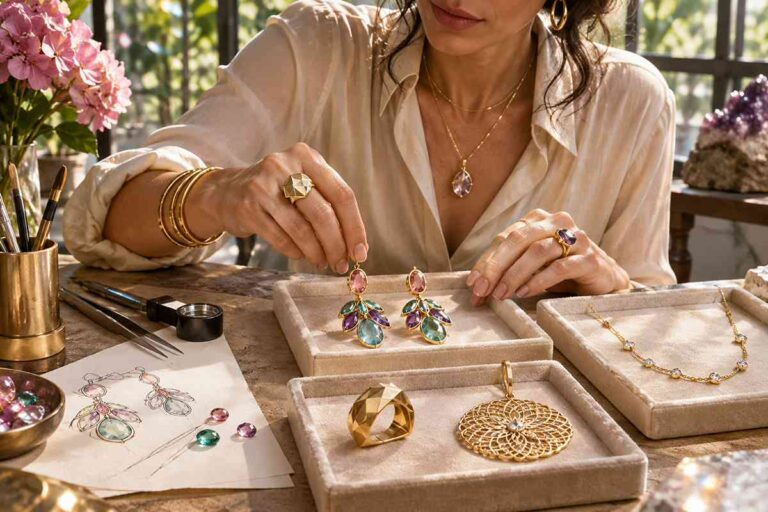
Some jewelry designers are known for a single signature shape. Others have changed the way we think about gemstones, craftsmanship, or who gets represented in fine jewelry. These eight women offer a little of everything, from Kendra Scott’s colorful, accessible designs to Paloma Picasso’s bold work for Tiffany & Co. and Coreen Simpson’s Black Cameo Collection.
What I love about this group is that their styles are so different. If you’re curious about the women behind memorable jewelry, here are the names, design signatures, and stories worth knowing.
Irene Neuwirth
Irene Neuwirth established her namesake jewelry business in 2003 with partner Tracy Stoll. The Los Angeles designer is known for expressive color, unusual gemstone cuts, and pieces that feel playful without losing their fine-jewelry appeal. Her early relationship with Barneys New York helped build the brand, but that retailer has since closed its original stores. Today, her work is available through her own boutiques and other retailers.
Her design style is so widely loved, she has become a favorite among celebrities and is now a red carpet staple in Hollywood.
Kendra Scott
Kendra Scott started her jewelry company in Austin, Texas, in 2002 with $500, shortly after the birth of her first son. Her designs helped build a widely recognized brand around bright color, approachable statement pieces, and recognizable silhouettes. Scott’s story is a reminder that the business side of jewelry design can be just as distinctive as the pieces themselves.
Eva Zuckerman
Eva Zuckerman, cofounder of Eva Fehren, turns New York City’s architecture into jewelry. Look closely at her angular rings and geometric diamonds and you can see the influence of skyscrapers, power lines, and patterns in the sidewalk. Trained in fine art at Cooper Union, she brings an unmistakably urban edge to delicate, wearable pieces.
Paloma Picasso
Paloma Picasso, the daughter of artists Pablo Picasso and Françoise Gilot, made a name for herself in jewelry on her own terms. She began designing for Tiffany & Co. in 1980. Her vivid gemstones, strong shapes, and graffiti-inspired motifs are a striking alternative to quietly traditional fine jewelry. Tiffany’s Paloma’s Graffiti collection is one of her best-known contributions.
Farah Khan Ali
Farah Khan Ali is an Indian jewelry designer and graduate gemologist whose work places gemstones at the center of the story. Her designs draw on nature, architecture, travel, and intricate craftsmanship. Expect bold combinations of color and elaborate details rather than understated minimalism.
“I view the world around us from a different perspective,” Ali reflects. “What necessarily is to others is not what I see it as. I am captivated by our natural environment, and any form, shape that catches my fancy stimulates me to translate that inanimate thought into an animate object of beauty and art.”
Jennifer Meyer
Jennifer Meyer founded her namesake jewelry line in 2005 after working in communications for Ralph Lauren and Giorgio Armani. Her simple gold pieces and meaningful motifs are designed to feel personal and easy to wear every day. There is something appealing about jewelry that can mark a memory without demanding all the attention in a room.
“Ask any woman where they received or bought a certain piece of jewelry, and they will tell you a story,” Maguire emphasizes, knowing full well the sentimental impact jewelry can have.
Coreen Simpson
Coreen Simpson came to jewelry after building a career in photography. Her best-known work, the Black Cameo Collection, challenged a familiar jewelry tradition by representing Black women in a form that had long favored white profiles. That makes her work memorable for its imagery as much as its style. Her shift from documenting people through a camera to representing them in jewelry is a fascinating part of her creative story.
Bai Jingyi
Bai Jingyi, also known as Master Jingyi Bai, is celebrated for preserving Chinese filigree inlay craftsmanship. Working with the jade jewelry house Zhaoyi, she helped bring intricate gold-thread techniques and traditional motifs into contemporary high jewelry. According to the Gemological Institute of America, she was named an official representative inheritor of filigree inlay art in 2008. Her work shows how an old technique can continue to inspire new designs.
Appropriate use of the local culture, combined with your own wisdom and creative ideas, naturally leads to good designs. Works that can reflect the East-West collision present the most beautiful spark.”
Related Articles:
- Facts About December’s Birthstones
- 5 Luxury Accessories Everyone Should Have in Their Wardrobe
- Jewelry Trends & News
Q&A With the Founder of The Smith Jewelry & Living
Another woman with a different perspective on the jewelry business is Christina Catsavis, founder of The Smith Jewelry & Living. In this earlier interview, she talks about building a retail business, choosing designs that last, and navigating an industry where earning trust can be a challenge.
Catsavis discusses everything from personal style to the realities of running a store through the COVID-19 pandemic. Her answers below are preserved from the original interview, so references to the pandemic and future business plans reflect the time of that conversation, not a current update. You can also visit The Smith Jewelry & Living to see the business.
How did you get into the fine jewelry industry?
I spent over 8 years in my family business and observed firsthand the daily struggles customers encountered both online and offline, trying to not only find the right items that suited their needs but a fair shopping experience that made them feel good about their purchase knowing they are receiving an authentic item at a fair price. Based on the principle that luxury shopping and selling should be a fully enjoyable experience rather than an intimidating one, I wanted to offer individuals the transparent experience they deserve.
Why buy designer jewelry?
Purchasing designer items is about a statement and style. Many consumers are loyal to their favorite brands and choose to purchase these brands repeatedly. Also, designer items have always had a price premium vs. similarly made unsigned pieces, which has made them difficult to purchase for the mass audience who have a brand affinity. Having the capability of purchasing pre-owned certified designer jewelry allows a much larger audience to afford the brands they’ve always wanted.
What would you say is your personal style, and how does that influence your product selection?
I have always favored really simple and classic pieces that are timeless. When I select jewelry for my store or when I create a custom piece, it is always with the idea that in ten years or twenty years the piece will be just as beautiful and relevant as it is today.
Where do you draw inspiration from?
I always feel really inspired when I travel and draw a lot of ideas from that.
In a word, concept. For me, it’s the flash of an idea, beginning with a memory, a place, a name from ancient Rome, a swatch of fabric. The challenge and passion for me is to create something tangible from that concept that can be touched, seen, emotionally ‘felt,’ and ultimately become part of wearable art or a sculptural piece of art in jewelry.
Who are your favorite jewelry designers?
My favorite ones are Cartier and Van Cleef & Arpels. I love the color combinations and intricate design of Van Cleef & Arpels jewelry that truly shines when it’s worn.
What are some of the challenges you have faced as a woman in business?
I do feel that being a woman presents its own unique set of expectations to overcome. I had to work really hard to be taken seriously, especially trying to move through the very male-dominated industry of jewelry. I’m a working mom, so in the beginning, I was running around New York with a baby strapped to my chest, begging people to take meetings with me. It was not “professional” by most standards, but I knew I had to make it work, and eventually, it did.
So, you have to be relentless?
I would say you have to be persistent. There’s no room for hurt feelings; when a door is slammed in your face, you have to knock on the next door and the next one…
I’m sure COVID-19 has presented its own unique set of challenges.
When I was opening my business, I knew it needed to be nimble so that I could pivot quickly if needed. I didn’t realize I would need to completely change things six months in, but I didn’t stop for a second. I found ways to generate business by securing 500 units of hand sanitizer when it was impossible to find, and I sold it all within a weekend. I really poured myself into online sales and have continued to grow that side of the business, along with creating bespoke shopping experiences for my clients through private appointments as well as video and text shopping.
What is the best advice you’ve ever been given?
“Don’t try to be everything to everyone.”
What advice do you have for other women who may be thinking about opening their own business?
Be very selective about who you seek advice from. Make sure it is people who really understand your vision and keep that circle small. I knew exactly who I wanted to speak with and for what purpose. I didn’t solicit business advice from the creatives, and I didn’t ask for creative input from the tech guys. It’s important to think about both the big picture and the nuances of your business.
What do you feel is important for small retail businesses to be aware of?
Know your market, know your products, and be honest with yourself. I know I’m not a strong salesperson, but I’m great at spotting quality products and curating a selection. I need my products to sell themselves. In politics, they say, “If you’re explaining, you’re losing.” It’s the same way in a retail environment. If the customer has to ask too many questions, it spoils the fun of the shopping experience. You want products that stand out and speak to your customer.
It has endlessly been declared that brick and mortar stores are dead. How do you feel about that?
I actually think people crave a fulfilling in-store experience, but so many brick and mortar stores have lost touch with the basics of customer service. Setting yourself apart with services is key. In the beginning, I asked myself why do people shop online vs. in the store. It’s not just for the convenience of “add to cart.”
I have offered free gift wrapping and free local delivery since the day I opened my doors. I try to make shopping in my store as easy as going online but with the added benefit of personal service. Everyone leaves knowing their business is appreciated, and that is the foundation of building a strong relationship with your customers.
What piece of jewelry should every woman have in her collection?
I think every lady should own a strand of pearls. Pearls are a timeless classic and can be dressed up or down. They’re also great layered with other pieces.
Finally, where do you see your business in five years?
I hope it is still growing; I am extremely interested in product development and would love to have my own jewelry line and products that are unique to The Smith.


