At-home laser hair removal has come a long way. What once required pricey clinic appointments can now be done from your bathroom, on your schedule.
But here’s the thing: not all devices use the same technology.
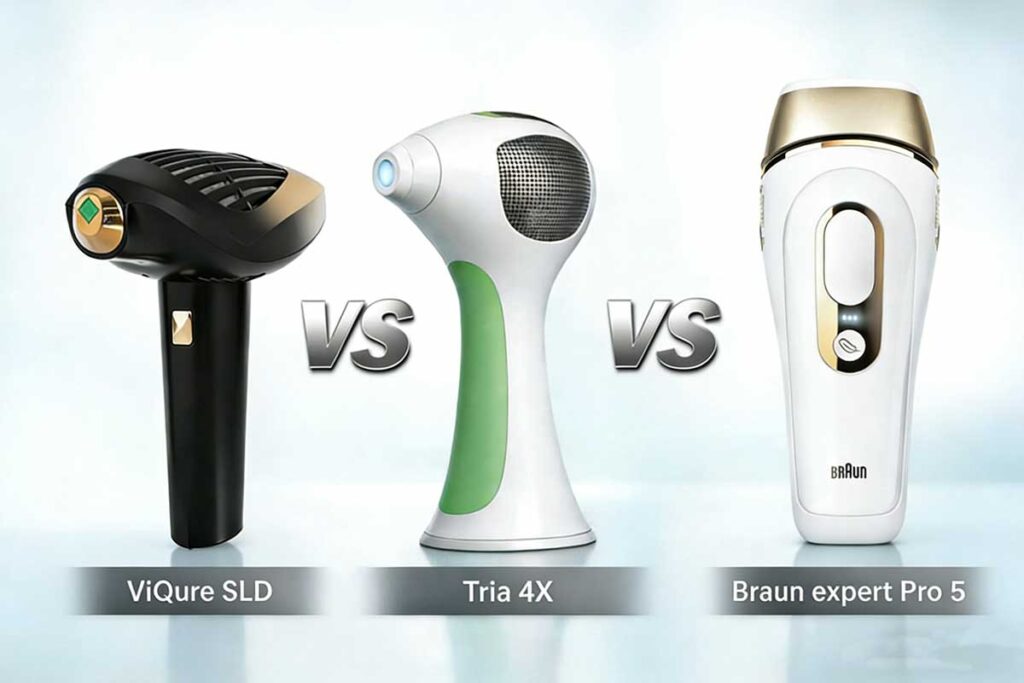
If you’re comparing the ViQure SLD Hair Removal Device, Tria 4X, and Braun Silk Expert Pro 5, the differences go far beyond brand names. They use completely different light systems — and that directly impacts power, comfort, and long-term results.
Let’s break it down clearly.
Understanding the Technology Behind Each Device
Hair removal works by targeting melanin in the follicle and disrupting the growth cycle. The key factors are:
- Wavelength
- Energy density
- Delivery precision
- Cooling & comfort
ViQure SLD Hair Removal Device
Uses Superluminescent Light-Emitting Diode (S-LD) technology.
It emits focused near-infrared light in the 780–850nm range, allowing deeper follicle penetration.
Unlike traditional diode lasers or IPL, it uses a flat-panel focused beam, distributing energy evenly instead of concentrating it into a sharp pinpoint.
Energy density reaches up to 25 J/cm², which is significantly higher than IPL systems.
Tria 4X
Uses an 810nm diode laser.
It delivers concentrated laser energy but through a small single-point tip.
Energy density reaches up to 22 J/cm², but coverage area is limited.
Battery-powered and runs approximately 30 minutes per charge.
Braun Silk Expert Pro 5
Uses IPL (Intense Pulsed Light).
IPL spreads light across a broad spectrum (510–2000nm).
Energy density is much lower, typically 3–6 J/cm², because the light is scattered rather than focused.
It treats larger areas quickly but may require more sessions over time.
Side-by-Side Comparison
| Feature | ViQure SLD | Tria 4X | Braun Expert Pro 5 |
| Technology | Superluminescent LED | Diode Laser | IPL |
| FDA Clearance | Yes | Yes | Yes |
| Wavelength | 780–850nm | 810nm | 510–2000nm |
| Energy Density | Up to 25 J/cm² | Up to 22 J/cm² | 3–6 J/cm² |
| Cooling | 360° surround cooling | None | None |
| Light Modes | Stamping + Gliding (1–3Hz) | Single mode | Stamping + Gliding |
| Power | Mains powered | Battery (30 mins) | Mains powered |
| Treatment Frequency | Every month | Every 2 weeks | Weekly |
| Sustained Reduction | 3–5 treatments | 6–8 treatments | ~12 treatments |
| Skin Tone | Fitzpatrick I–V | I–IV | I–V |
| Lifespan | 100M flashes | 90,000 pulses | 400,000 flashes |
Why S-LD Technology Stands Out
The biggest differentiator is energy delivery.
IPL spreads energy across multiple wavelengths, which reduces follicle intensity.
Traditional diode lasers concentrate energy into a small point.
ViQure’s flat-panel S-LD distributes high energy evenly while maintaining depth.
What that means in real life:
- Strong follicle targeting
- Smoother sensation
- Fewer total sessions
- Less overheating
Because it also includes 360° surround cooling, it feels noticeably more comfortable than Tria, especially on sensitive areas.
Comfort & Treatment Speed
Let’s talk practical experience.
Tria 4X
- Can feel sharp at higher levels
- Small tip means longer sessions
- Battery may run out mid-leg
Braun IPL
- Warmer sensation
- Faster coverage
- Requires more frequent sessions
ViQure SLD
- Cooling reduces sharp heat
- Stamping + gliding modes (1–3Hz) allow flexible speed
- Mains powered, no interruptions
If you’re treating large areas like legs, that uninterrupted power alone is a major advantage.
Energy Density & Long-Term Efficiency
Energy density is often overlooked, but it matters.
- IPL: 3–6 J/cm²
- Tria: up to 22 J/cm²
- ViQure SLD: up to 25 J/cm²
Higher energy density allows deeper penetration and potentially fewer maintenance sessions.
Additionally, the 780–850nm wavelength range tends to be more versatile across Fitzpatrick I–V, offering broader usability.
Final Thoughts
All three devices reduce hair growth at home.
- Tria 4X: Strong diode precision but slower and less comfortable.
- Braun Expert Pro 5: Fast IPL coverage but lower intensity.
- ViQure SLD: High energy, deeper targeting, cooling comfort, uninterrupted sessions.
If you’re looking for newer technology that blends clinical-level power with home usability, the ViQure SLD feels like a meaningful upgrade in 2026.
The right choice depends on your skin tone, patience level, and how much long-term maintenance you’re willing to commit to.
But from a pure technology standpoint, S-LD brings something genuinely new to the at-home market.
A Thoughtful Gift Idea
Beyond personal use, the SLD Hair Removal Device can also make a thoughtful and practical gift. With more people investing in self-care and at-home beauty technology, gifting an advanced hair removal device feels modern, useful, and long-lasting. It has even been featured in curated gift inspiration lists. You can explore it here: Top 10 Valentine’s Day Gift Guide 2026
- About the Author
- Latest Posts

I’m Iskra Banović, editor of Blufashion and the voice behind its fashion, beauty, and lifestyle stories. Fashion, beauty, and lifestyle are my playground, but I’m just as likely to share the messy side of it all, like the time I tested a “must-have” skincare gadget and ended up with glitter stuck in my hair. I love turning trends and everyday finds into something useful (and fun) for real people.