




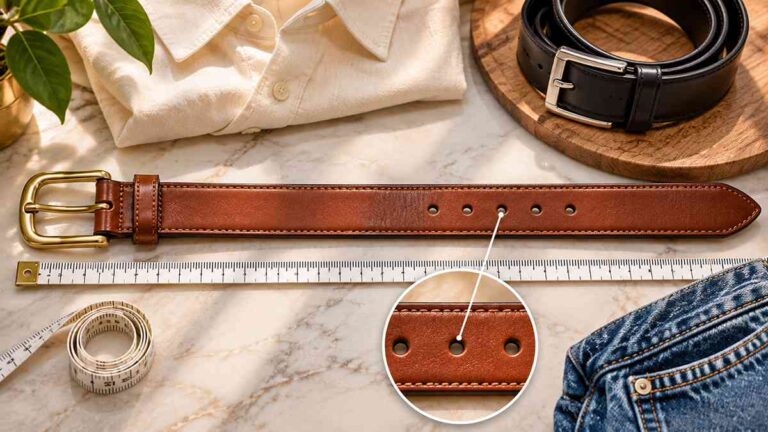
Buying a belt should be simple, but pants sizes, belt labels, and EU measurements don’t always agree. Use our Belt Length Calculator to estimate your size from your jeans waist or a belt you already own. You’ll get a recommended length, a hole range, and US and EU size equivalents.
Belt Length Calculator
Quick answer: Start with a belt two inches larger than your usual pants waist size. For example, size 32 jeans generally pair with a size 34 belt. It’s a useful shortcut, but measuring a belt that already fits is more reliable, especially when you’re switching brands.
How to use the Belt Length Calculator
- Choose whether you’re entering your jeans size or a measurement from a belt you already wear.
- Enter your number and select inches or centimeters.
- Choose the hole spacing shown on the calculator.
- Click Calculate to see the recommended middle-hole length, hole range, and labeled sizes.
The calculator uses a five-hole belt as its reference. With holes spaced one inch apart, you get approximately two inches of adjustment in either direction from the middle hole.
Keep in mind: The result is a starting point. Belt manufacturers don’t all measure from the same part of the buckle, and some brands use different sizing conventions. Check the seller’s measurement diagram before ordering.
How to calculate your belt size by hand

Method A: Add two inches to your pants size
Take your usual pants waist size and add two inches. If you wear size 32 jeans, start with a size 34 belt. If you wear size 34 jeans, try a size 36 belt.
This rule works as a quick estimate for many conventional men’s belts. It’s less dependable when pants sizing varies between brands or when you’re choosing a belt to wear at a different point on your waist or hips.
Method B: Measure a belt that fits
- Lay your favorite belt flat.
- Measure from the buckle’s fastening point to the hole you normally use.
- Find a new belt with a matching measurement to its middle hole.
Here’s the detail that trips people up: some brands measure from the buckle prong, while others start where the leather folds around the buckle. Follow the measurement method used by the brand you’re buying. Don’t measure the entire belt from end to end.
Method C: Measure through your belt loops
- Put on the pants you’ll wear with your belt.
- Thread a soft measuring tape through the belt loops, following the path your belt would take.
- Keep the tape comfortably snug and record the circumference.
- Compare that measurement with the brand’s middle-hole sizing chart.
Because you’ve measured where the belt actually sits, you don’t automatically need to add another two inches. Check the manufacturer’s instructions and choose the closest suitable size.
US and EU belt size conversion chart
Shopping for a belt labeled in centimeters? Many EU belt sizes refer to the approximate distance to the middle hole. Use this chart to compare common EU measurements with US belt sizes.
| EU size (cm) | Approximate middle-hole length | Common US size |
|---|---|---|
| 80 | 31.5 in | 32 |
| 85 | 33.5 in | 34 |
| 90 | 35.5 in | 36 |
| 95 | 37.5 in | 38 |
| 100 | 39.5 in | 40 |
| 105 | 41.5 in | 42 |
| 110 | 43.5 in | 44 |
| 115 | 45.5 in | 46 |
| 120 | 47.5 in | 48 |
Conversions are rounded for shopping. US labels and EU sizes aren’t exact equivalents across every brand.
For example, an EU 90 belt measures approximately 35.4 inches to its designated sizing point, so a US 36 is a common comparison. Before buying, check whether the retailer measures from the buckle fold, the prong, or another reference point.
Choosing the right belt width

Getting the length right is only half the job. A belt can fit your waist perfectly and still be too wide for your pants.
- Jeans: A 1.5-inch (38 mm) belt is a classic choice. Thicker leather and a sturdy keeper work well with denim.
- Dress pants: Try a slimmer 1.25-inch (32 mm) belt with a simple buckle and clean edges.
- Smart casual: A 35 mm suede or smooth leather belt works nicely with chinos and relaxed tailoring.
- Adjustable buckles: Ratchet belts offer smaller adjustments than traditional holes, while braided belts let you fasten at different points along the strap.
Always check your belt loops before buying. Their width matters more than any general style rule.
Materials and simple quality checks
- Full-grain leather: A durable option that can develop an attractive patina with use.
- Top-grain leather: Another practical choice for everyday or office belts. Construction and finishing still matter.
- Bonded leather: Often less durable than a solid leather strap and more prone to surface peeling.
- Webbing or stretch: Comfortable options for casual outfits, travel, or days when you want more flexibility.
Look at the stitching, buckle attachment, strap edges, and keeper. For leather care, wipe away surface dirt with a soft cloth and use products suitable for the leather’s finish. Follow the manufacturer’s care instructions rather than conditioning on a fixed schedule.
Buying a belt as a gift or for changing sizes
If you don’t know someone’s exact belt measurement, an adjustable design gives you more room for error.
- Ratchet belts: Offer small, frequent adjustments without traditional belt holes.
- Braided or stretch belts: Provide flexibility and are comfortable for casual wear.
- Trim-to-fit belts: Let you shorten the strap, provided you follow the manufacturer’s cutting instructions.
- Reversible belts: Offer two looks in one and can save packing space.
For another gift that depends on getting the measurements right, our Ring Size Finder can help.
What I tried and what actually worked
I bought a 34 labeled belt that the seller measured end to end. It ran short on me.
I remeasured buckle tip to used hole on my favorite belt, came out to 35.5 in. The EU 90, US 36 I ordered next closed perfectly on the middle hole.
For suits, 32 mm looked cleaner and slid through every loop. For denim, 38 mm stayed put and felt right when I sat at my desk.
Common belt sizing mistakes
- Measuring end to end: This includes extra strap length that doesn’t determine your fit. Measure to the fastening hole instead.
- Trusting pants size alone: The two-inch rule is a shortcut, not a guaranteed fit. Check an existing belt when possible.
- Ignoring hole spacing: A five-hole belt with one-inch spacing gives about two inches of adjustment on either side of the middle hole.
- Assuming EU and US labels match exactly: Use the measurements to compare sizes, then check the brand’s chart.
The 60-second belt fit check
- The buckle closes near the middle hole, leaving room to adjust.
- The belt lies flat without pulling or bowing.
- The loose end reaches the keeper without leaving an awkwardly long tail.
- The strap slides comfortably through the belt loops.
- You can sit, stand, and breathe comfortably without the belt digging in.
If your belt only fastens on the first or last hole, compare the next size up or down. For a traditional five-hole belt, the middle hole usually offers the most flexibility.
FAQ
How do I calculate belt size from jeans size?
Add 2 inches to your jeans waist size as a starting point. For example, size 32 jeans often pair with a size 34 belt. Check the brand’s chart for the best fit.
Where do I measure a belt?
Measure from the buckle’s fastening point to the hole you normally use. Brands differ on whether to measure from the prong or buckle fold, so follow the seller’s instructions.
What belt width works for jeans and dress pants?
A 1.5-inch (38 mm) belt is a common choice for jeans, while a 1.25-inch (32 mm) belt works well with many dress pants. Check the belt loops first.
What is EU 90 in US belt sizing?
EU 90 is approximately 35.4 inches and often corresponds to a US size 36 belt. Exact labeling varies by brand.
Are ratchet belts good for changing sizes?
Yes. Their small incremental adjustments make them useful for changing waist measurements and gift buying.
Need to check another measurement? Our International Size Converter helps with clothing sizes across countries, and the Bra Size Calculator covers another common fit challenge.