





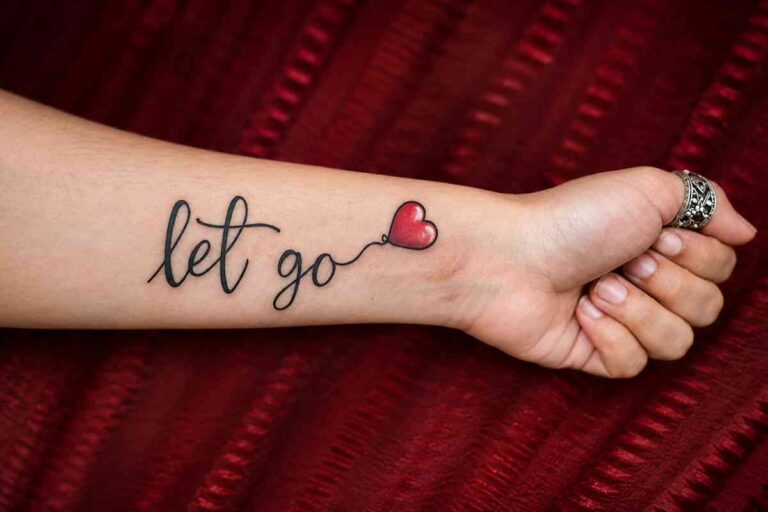
Common letting go tattoos include birds in flight, dandelion seeds blowing off the stem, feathers, open birdcages, waves, and simple script that reads “let go” or “let it be.” Each one says something a little different, so the best design starts with what you’re actually letting go of: a relationship, a loss, an addiction, an old grudge, or the habit of trying to control everything.
Quick Picks by What You’re Letting Go Of
- A relationship: an open birdcage, a broken chain, or the words “let them.”
- Grief: a dove or swallow in flight, a butterfly, or “let go” written in a loved one’s handwriting.
- Addiction: “let go and let God,” a phoenix, or your recovery date.
- Anger or resentment: “forgive,” or a lotus.
- Anxiety and the urge to control: “breathe,” waves, or an ensō circle.
- A hard chapter of life: a dandelion, a compass, or an arrow.
What Does a “Let Go” Tattoo Mean?

At its simplest, a “let go” tattoo is a reminder you can see: release what you can’t change, stop replaying the past, and make room for what comes next. For people of faith, it often means handing worry over to God. For others, it’s closer to the Buddhist idea of non-attachment, or plain old acceptance.
Because the message is so personal, the same two words can mark very different things. One person’s “let go” on the wrist is about a divorce; another’s marks a year of sobriety. That’s a big part of the appeal. You decide what it means, and you don’t owe anyone the backstory.
Singer Demi Lovato has one of the best-known versions: “Let go and” on one foot and “Let God” on the other, inked in 2012. In a 2013 interview, Lovato called the phrase a favorite life motto.
Symbols That Mean Letting Go

A symbol carries the message without spelling it out, which many people prefer for a tattoo that strangers will see.
Symbols of Release
- Birds in flight: Doves and swallows flying away are the classic image of release, and a small flock trailing up the forearm or behind the ear still reads clearly when it’s tiny. Doves also stand for peace and, for many Christians, the Holy Spirit.
- Dandelion seeds: A dandelion with its seeds drifting off is about letting things scatter where they will. It works well as a long, narrow design, with the stem near the wrist and the seeds traveling up the arm.
- Feather: Lightness, and setting down something heavy. Feathers are also a common memorial symbol. A single feather suits the forearm, ribs, or back of the shoulder.
- Floating balloon: The most literal option. You held the string, and then you opened your hand. Keep it simple; a fine-line balloon with a loose string is plenty.
- Open birdcage: An empty cage with the door open, often with the bird already outside, says you’ve left something confining, whether that’s a relationship or an old version of yourself.
- Broken chain or open padlock: Freedom from something that held you, such as an addiction or a controlling relationship. It’s bolder in tone than the other release symbols.
Symbols of Change and Renewal
- Butterfly: Transformation, and for many people a memorial for someone who has died. Our guide to butterfly tattoo meanings covers the styles in more detail.
- Lotus: The lotus grows out of muddy water and opens clean, so it stands for rising out of a hard situation. It’s a sacred flower in Buddhism and Hinduism.
- Phoenix: Rebirth from the ashes, chosen by people rebuilding after trauma, abuse, or a life that fell apart. It usually needs room for detail, so think back, thigh, or side rather than wrist.
- Semicolon: This one is often misread. The semicolon became a mental health symbol through Project Semicolon, a movement Amy Bleuel started in 2013 after losing her father to suicide. A semicolon marks a place where a sentence could have ended but didn’t, so the tattoo says your story isn’t over. It’s worn by people who have lived through depression, self-harm, addiction, or suicidal thoughts, and by people who support them. If you’re struggling right now, you can call or text 988 to reach the 988 Suicide & Crisis Lifeline in the US.
Spiritual Symbols
- Cross with “let go and let God”: A faith-based option, often a small cross or dove paired with the phrase in script. For more faith-inspired lettering, see our guide to the God is greater than the highs and lows tattoo.
- Unalome: A spiral that straightens into a single line. It comes from Theravada Buddhism in Southeast Asia, especially Thailand, where it appears in traditional Sak Yant tattoos with religious meanings that vary by tradition. In Western tattooing, it’s usually read more simply: the twists are life’s struggles, and the straight line is clarity. It’s a sacred symbol, so learn about it before you wear it, and avoid the feet, which Thai tradition treats as an inappropriate place for sacred imagery.
- Ensō: A circle painted in a single brushstroke, a symbol of enlightenment in Japanese Zen Buddhism. It’s often left slightly open, and once it’s drawn, it isn’t corrected, so many people also read it as accepting imperfection. If that meaning matters to you, ask your artist to keep the brush texture.
Symbols for Moving On
- Compass: Finding your direction again after a stretch of feeling lost.
- Arrow: An arrow has to be pulled back before it flies, so it’s a popular way to say a setback launched you forward.
- Waves: Going with the current instead of fighting it. Fine-line waves sit nicely on the ankle, wrist, or collarbone.
Phrases for a Let Go Tattoo
Short phrases age better than long quotes, because lettering needs space to stay legible. These come up again and again:
- “Let go”: Two words, endlessly flexible, and small enough for a finger or the inner wrist.
- “Let it go”: Softer and more conversational, with a slightly different focus: it’s about accepting a specific thing, like a past you can’t rewrite, rather than a general practice of release. It suits flowing script, or the words trailing into a few birds or dandelion seeds. Some people will think of the Frozen song; if that bothers you, choose “let go.”
- “Let go and let God”: A faith-based reminder to stop carrying what isn’t yours to carry. More on its origin below.
- “Let go or be dragged”: Usually called a Zen proverb, though its origin is hazy. It’s blunter, for people who want a kick rather than a hug.
- “Let it hurt, then let it go”: Gives grief its due before release, which appeals to anyone tired of being told to just move on.
- “Let them”: About letting other people make their own choices instead of trying to manage them. The phrase circulated in a viral 2022 poem by Cassie Phillips, then spread widely after Mel Robbins began talking about it in 2023, which led to her 2024 book The Let Them Theory.
- “Accept what is, let go of what was, and have faith in what will be”: A popular quote, but a long one. It needs a larger spot, such as the forearm, ribs, or upper back, to stay readable.
- “This too shall pass”: An old proverb about impermanence that works for hard times and good ones.
- “Let it be”: Acceptance, without the need to fix anything.
- “Breathe”: One word for anxiety, often paired with a small wave or written with widely spaced letters.
- “Forgive”: For letting go of resentment, whether it’s aimed at someone else or at yourself.
Combining a phrase with a symbol, like “let go” in script with a few birds lifting off the last letter, gives you something more personal than either one alone. For more lettering ideas, browse these phrase and quote tattoos.

Where “Let Go and Let God” Comes From
You’ll often see the phrase credited to Norman Vincent Peale, but the idea is older. It’s tied to the 19th-century Higher Life and Keswick movement in evangelical Christianity, which taught believers to surrender their own striving and trust God completely. Hannah Whitall Smith’s best-seller The Christian’s Secret of a Happy Life is one of the best-known expressions of that teaching. Nobody knows for certain who first put it in those exact words.
The phrase isn’t in the Bible. It’s also a familiar slogan in Alcoholics Anonymous and other 12-step programs, where it’s about accepting what you can’t control, and where some members read “God” as any higher power. Not everyone loves it: some pastors criticize it as a recipe for passivity. Most people who wear it mean something simpler: do your part, then stop gripping what you can’t change.
Design Tips So It Still Looks Good in 10 Years
- Go a little bigger than you think. Ink spreads slightly under the skin over the years, so tiny script and very fine lines can blur. As a rough guide, a single word or small symbol fits in 1 to 2 inches, a symbol with a word needs about 3 to 5 inches, and a phoenix or long quote needs a back, thigh, or rib panel. Ask your artist for the smallest size they’d recommend for your lettering.
- Ask to see healed work. Fresh fine-line tattoos photograph beautifully. Photos taken months later tell you how the artist’s work actually holds up.
- Know which spots fade fastest. Fingers, hands, and feet get constant friction and washing, so expect touch-ups. The inner forearm, upper arm, ribs, and back hold up better.
- Decide who should see it. A wrist or forearm piece is a reminder you’ll see every day. The ribs, hip, or back keep it private, which also matters if your workplace is conservative about visible tattoos.
- Check every letter. Read the stencil slowly before the needle starts. If you’re using a loved one’s handwriting, give the artist a clean, high-resolution scan.
How Much a Let Go Tattoo Costs
If you’re choosing a small design, the price usually comes down to the shop minimum, the lowest fee a studio charges for any tattoo. Treat these as rough budgeting numbers: many US shops set minimums somewhere around $80 to $200, and sought-after artists charge more. A 2- to 4-inch piece often lands around $150 to $400, depending on detail and the shop. Larger custom work, like a phoenix across the back, is billed by the hour or day and can reach the thousands.
Color, fine detail, and extra sessions all add to the bill, and more experienced artists charge higher rates. For permanent fine-line work, that’s usually money well spent. If you’d like to tip your artist, around 20% is common in the US.
Aftercare and Healing
A new tattoo is an open wound, so treat it like one. Your artist’s instructions come first. These are the basics:
- Leave the wrap on for as long as your artist says, then wash gently with lukewarm water and a mild, fragrance-free soap. Pat dry with a clean paper towel, and keep washing it gently twice a day while it heals.
- Apply a thin layer of the fragrance-free moisturizer or aftercare product your artist recommends. More isn’t better; a thick coat can trap moisture. Dermatologists at Cleveland Clinic advise skipping petroleum jelly while it heals.
- Don’t pick at or scratch the scabs and flakes, even when it itches.
- Stay out of baths, pools, hot tubs, and the ocean until it’s healed. Short showers are fine.
- Keep it out of the sun and cover it with loose clothing. Hold off on sunscreen until the skin has fully healed. After that, a broad-spectrum SPF 30 or higher helps keep it from fading.
- Avoid tight waistbands, straps, and socks that rub against it.
Expect redness and some oozing for the first few days, then itching and flaking for a week or two. Most tattoos look healed in two to four weeks, though the deeper skin keeps repairing for a while after that, and fine-line work can look slightly cloudy until it settles. Spreading redness, pus, worsening pain, or a fever aren’t normal. See a doctor if you notice any of them.
Finding the Right Tattoo Artist
- Match the artist to the style. If you want delicate script, look for a portfolio full of fine-line lettering rather than mostly bold traditional work.
- Ask around. Friends with tattoos you admire are the best source of names, and online reviews tell you how past clients were treated.
- Book a consultation. Bring reference images and explain what the tattoo means to you. A good artist will listen, suggest changes so the design lasts, and be honest if your idea won’t work at the size you want.
- Check the studio. It should be licensed and clean, and the artist should open fresh needles in front of you.
Our guide to researching and hiring a skilled tattoo artist covers the questions to ask before you book.
Choosing the Right Moment
A “let go” tattoo works best as a marker of something you’ve already started, not a shortcut to get there. If the hurt is only days old, give the design a few months and see if it still feels right. A temporary tattoo of the same design is an easy way to test the size and placement before you commit.
Some people make the appointment a small ceremony: they write about what they’re releasing beforehand, bring a friend who knows the story, or schedule it around an anniversary. Whatever you choose, the tattoo will be there as a reminder of inner strength on the days when letting go is harder than it looks on your skin.