




Nose piercings look simple until you try to buy jewelry for one. Suddenly you’re comparing 18G and 20G, 8mm and 9mm hoops, and studs with names like fishtail and bonxne. Here’s the short version: nostril piercings are usually 18G or 20G, the most common nostril hoop is 8mm (about 5/16 inch), and a standard nostril stud has about 6mm of wearable post. The chart and guide below cover each common placement, the jewelry it takes, and how long it needs to heal.
Nose Piercings Chart
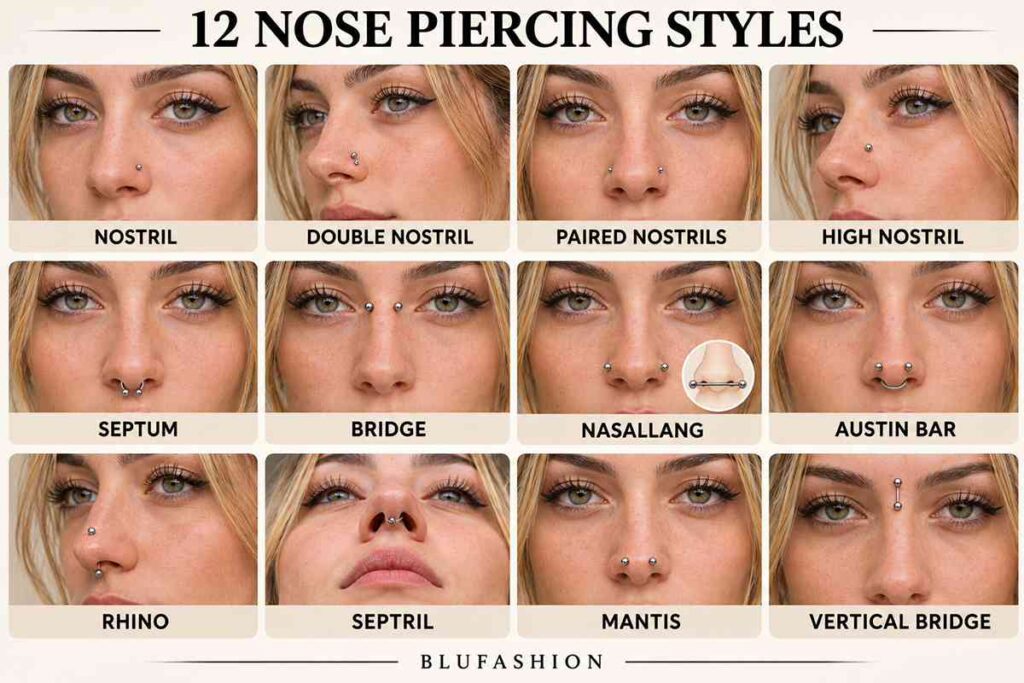
Here’s the nose piercings chart showing the main types of nose piercings: nostril, septum, bridge, and high nostril. Use it to picture the placement, then check the size chart further down for the jewelry each one takes.
Types of Nose Piercings
Still deciding whether a nose piercing suits you at all? Try our no-needle test before you book.
- Nostril Piercing: The most common type, placed on the outer curve of the nostril. It can be on either side, and many people pair two, on the same side or one on each. Once healed, it takes almost anything: studs, L-shapes, nose screws, and hoops.
- High Nostril Piercing: Similar to the standard nostril piercing but placed higher up, closer to the bridge, where the cartilage is thicker. Flat-back studs are the norm because hoops rarely sit well that high. Expect a longer, fussier heal than a standard nostril.
- Septum Piercing: Goes through the nasal septum, usually in the softer space below the cartilage. Suitable for hoops, circular barbells, and captive bead rings. A circular barbell (horseshoe) can be flipped up inside the nose, which makes this the easiest nose piercing to hide at work. Our septum piercing guide covers pain and placement in more detail.
- Bridge Piercing: A horizontal piercing across the bridge of the nose, between the eyes. It passes through skin only, not cartilage, so it’s a surface piercing with a higher risk of migrating or rejecting. It’s typically pierced with a straight barbell; some people switch to a curved one once it has healed.
- Rhino (Vertical Tip) Piercing: Runs vertically through the tip of the nose, entering on top and exiting underneath. It’s worn with a curved barbell and is one of the slowest nose piercings to heal.
- Nasallang Piercing: A complex piercing that goes through both nostrils and the septum in one line, using a single straight barbell. Not every nose has the anatomy for it, and many piercers will only do it after an in-person assessment.
Nose Ring Sizes and Jewelry Measurements

Nose jewelry has up to three measurements, and mixing them up is the most common sizing mistake. Gauge is the thickness of the post or wire. Diameter is the size of a hoop. Length is how much post sits inside a stud. Gauge numbers run backward: the higher the number, the thinner the jewelry.
To find your size, measure jewelry rather than the hole: a spare piece, or one you’ve taken out of a fully healed piercing. A digital caliper reads gauge and length in seconds. If your piercing is still healing, don’t remove the jewelry to measure it. Ask your piercer, who can also do any jewelry changes. When in doubt, stay with the gauge you were pierced at. Thinner jewelry can let the hole tighten, and forcing in thicker jewelry irritates the piercing.
Gauge (Thickness)
| Gauge | Millimeters | Inches (approx.) | Common for |
|---|---|---|---|
| 20G | 0.8mm | 0.031″ | Nostril (the daintiest look) |
| 18G | 1.0mm | 0.039″ | Nostril, high nostril |
| 16G | 1.2mm | 0.047″ | Septum, some nostrils and high nostrils, rhino |
| 14G | 1.6mm | 0.063″ | Septum, bridge, rhino, nasallang |
Body jewelry is sold by these nominal millimeter sizes, so the inch figures are rounded conversions. Thinner isn’t always better: very fine jewelry in a fresh piercing is more prone to migrating, which is why piercers rarely go below 20G for a new nostril.
Hoop Diameter
Hoops are measured by their inside diameter. For nostrils, 8mm and 9mm are the most popular sizes for a snug fit. A 6mm or 7mm hoop hugs a small nostril tightly, while 10mm sits looser and shows more. Septum rings usually run 8mm to 10mm (roughly 5/16 to 3/8 inch). If your piercing sits farther from the edge of the nostril, or higher on the septum, you’ll need a larger diameter for the ring to close comfortably.
Stud Length
Wearable length is the part of the post that sits inside your nose, and it’s separate from the size of the gem or decorative top. On a flat-back stud it’s measured from the underside of the top to the disc; on an L-shape or screw, from the top to the bend. Standard nose stud lengths are around 6mm to 7mm, and 6mm (about 1/4 inch) fits most healed nostrils. New piercings start on a longer post to leave room for swelling, and your piercer swaps it for a shorter one once the swelling settles. A post that’s too short presses the top and back into your skin; one that’s too long tilts, moves, and snags.
Size Chart by Piercing Type
| Piercing | Typical gauge | Starter jewelry | Common size once healed |
|---|---|---|---|
| Nostril | 18G or 20G (sometimes 16G) | Flat-back stud | Stud: 6mm wearable length. Hoop: 8mm diameter |
| High nostril | 18G (sometimes 16G or 20G) | Flat-back stud | Flat-back stud; length depends on anatomy |
| Septum | 16G or 14G | Circular barbell or captive bead ring | Ring, clicker, or retainer: 8mm to 10mm diameter |
| Bridge | 14G (sometimes 12G or 16G) | Straight barbell | Straight or curved barbell; length depends on anatomy |
| Rhino | 14G or 16G | Curved barbell | Curved barbell; length depends on anatomy |
| Nasallang | 14G or 16G | Long straight barbell | Straight barbell; custom length |
These are typical starting points, not rules. Your piercer may choose a different size for your anatomy, and your real size is whatever you were pierced with.
Jewelry Types
- Studs: Available in L-shape (easy to put in, but can slip out), screw (a curved end that’s secure but fiddly), bone (straight post with a small ball at the end that pops in and out, which can irritate the piercing), fishtail (long straight post to be custom bent), and flat-back labret (a flat disc sits inside the nostril). Flat-backs, usually threadless or internally threaded, are what many professional piercers use for new nostril piercings, and the flat disc is less likely to catch than a bent or balled end.
- Hoops: Include seamless rings, captive bead rings, circular barbells, and hinged clickers. Diameter choice depends on personal preference and the placement of the piercing. Most piercers start a nostril with a stud and save hoops for after healing, because a ring rotates through the piercing with every bump and a snug one leaves little room for swelling.
Choosing the Right Jewelry
When selecting nose jewelry, consider the following:
- Comfort and Fit: Match the gauge first, then the length or diameter. A gorgeous hoop is useless if it’s 16G and your nostril was pierced at 20G.
- Material: For a new or healing piercing, stick to the metals the Association of Professional Piercers accepts. That means implant-certified titanium (ASTM F136 is the standard to look for), niobium, implant-grade steel that meets a recognized standard such as ASTM F138, or solid 14k to 18k gold that’s nickel- and cadmium-free and alloyed for body wear. Gold above 18k is too soft for body jewelry. A plain “surgical steel” label doesn’t tell you which standard the metal meets, so ask. Skip plated, gold-filled, and sterling silver jewelry in fresh piercings.
- Style: Choose a style that reflects your personality and fits your lifestyle. Whether it’s a subtle stud or a bold hoop, the right piece can enhance your look. If you’re choosing by face shape, see our best piercings for round faces.
Aftercare and Healing
Proper aftercare is essential for a healthy piercing. Follow your piercer’s instructions, which typically mean washing your hands before you touch the area, rinsing with a sterile saline wound wash (0.9% sodium chloride, no additives) once or twice a day, and otherwise leaving it alone. Don’t twist the jewelry, keep makeup and skincare products away from the piercing, and skip homemade salt soaks, which are easy to make too strong.
Healing times vary by placement and by person. These are estimates drawn from Healthline’s healing guide and professional piercing studios:
- Septum: 2 to 3 months
- Bridge: 2 to 3 months
- Nostril: 4 to 6 months
- High nostril: 6 to 9 months
- Rhino: 6 to 9 months
- Nasallang: 4 to 12 months (estimates vary widely)
Many piercings take longer. Cartilage often looks healed on the outside well before it has settled inside, so get your piercer’s okay before downsizing or switching to a hoop. A bump beside a nostril piercing can come from irritation, an allergic reaction to the metal, or infection, so have your piercer or a doctor take a look rather than guessing. Spreading redness, heat, or thick yellow or green discharge are reasons to see a doctor promptly, and a fever or feeling unwell means getting medical care right away. Leave the jewelry in unless a doctor tells you otherwise.