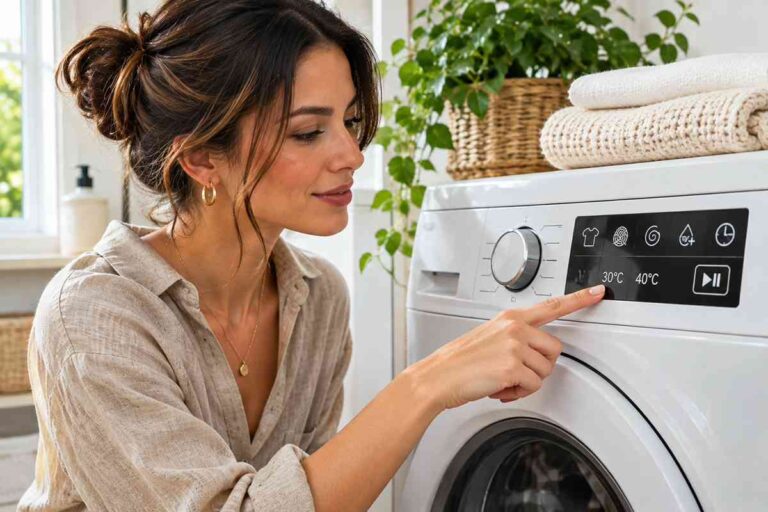
Washing machine symbols aren’t standardized the way clothing care labels are, so the same little picture can mean slightly different things on a Bosch, a Samsung, and a Whirlpool. Most of them still fall into four groups: cycle pictures around the dial, option buttons, status lights on the display, and markings on the detergent drawer. The common ones look similar from brand to brand, and that’s what this guide decodes, along with the words you’ll find on European machines if you’re doing laundry in a rental abroad.
Your model’s manual always has the final word. If an icon on your machine doesn’t match anything here, skip to finding the right manual.
Common Washing Machine Symbols at a Glance
| Symbol | What it often looks like | What it means |
|---|---|---|
| Cotton | A cotton boll or a T-shirt | Normal agitation and full spin for sturdy cotton and linen |
| Synthetics or Easy Care | A shirt on a hanger | Gentler action and medium spin for polyester and blends |
| Delicates | A feather, flower, or bow | Low agitation and low spin |
| Wool or Hand Wash | A ball of yarn, or a hand in a tub | A very gentle program for machine-washable wool and hand-wash items |
| Mixed | Two garments, or the word Mix | Cotton and synthetics together at moderate settings |
| Quick or Rapid | A clock, or a number such as 15′ or 30′ | A short program for small, lightly soiled loads |
| Eco 40-60 | A leaf, or the words Eco 40-60 | An energy-saving cotton program that runs long (see below) |
| Rinse | A tub or basin with water | Rinse only, or sets how many rinses the cycle runs |
| Extra Rinse | A basin with a plus sign | Adds a rinse to clear detergent residue |
| Spin | A spiral | Spin only, or sets the spin speed |
| Drain | A tub with a downward arrow | Pumps the water out (on some machines, drain and spin are one setting) |
| Prewash | Varies; often labeled in words | A short wash before the main cycle for heavily soiled loads |
| Door Lock | A padlock or a key | The door is locked; don’t force it |
| Child Lock | A padlock, a key, or a smiley face on some Samsung models | The buttons are disabled |
| Delay Start or Delay End | A clock | The cycle will start or finish later |
| Time Remaining | An hourglass on some models | Minutes left in the cycle |
| Add Garment | A T-shirt with a plus sign | You can pause and add forgotten items now |
| Steam | Clouds | The steam option is on |
| Drum Clean or Tub Clean | A drum | Runs the cleaning program, or reminds you it’s due |
| Tap | A faucet | Low water supply: check that the tap is open and the hose isn’t kinked |
| Foam | Bubbles | Too many suds detected; the machine adds a rinse, so use less detergent next time |
| Sound Off | A crossed-out bell or speaker | End-of-cycle beeps are off |
| Wi-Fi | Wi-Fi waves | Connected to the brand’s app |
The appearance column describes common designs, not a rule. Samsung and Bosch both publish symbol legends for their machines (Samsung’s washing machine symbols, Bosch’s display symbols), and both note that icons vary between models.
Detergent Drawer Symbols: I, II, and the Flower
- I is the prewash compartment. Add detergent here only when you select prewash.
- II is the main wash compartment, and the one you’ll use most. On Bosch machines it also takes water softener, powdered bleach, and stain remover.
- The flower is for fabric softener. Don’t fill past the MAX line, or it can flush out too early.
- A flap or insert (Bosch marks it A) appears in some drawers for liquid detergent. If yours has none, the manual says where liquid goes.
Pods and tablets usually go straight into the drum, not the drawer. Follow the package directions.
Temperature Numbers and Spin Speeds
Most machines outside the US show temperature in Celsius. The number is the temperature the program aims for, not a guarantee: energy-saving programs often wash cooler and make up for it with time.
| Dial setting | Fahrenheit | Typical use |
|---|---|---|
| Cold, 0, or — | Tap temperature | No heating; lightly soiled items and colors that bleed |
| 20 °C | 68 °F | Lightly soiled, color-sensitive loads |
| 30 °C | 86 °F | Darks, brights, delicates, most everyday clothes |
| 40 °C | 104 °F | Normally soiled cotton and mixed loads |
| 60 °C | 140 °F | Towels, bedding, heavily soiled cotton |
| 90 or 95 °C | 194 or 203 °F | White cotton only, and only if the care label allows it |
Spin numbers are revolutions per minute (rpm). A higher spin gets more water out, so clothes dry faster, but they also wrinkle more and delicate fabrics take more stress. European front-loaders often top out around 1,200 to 1,400 rpm. Towels and jeans can take the top speed; turn it down for delicates, synthetics, and anything you’d rather not iron. If a load comes out dripping, check whether No Spin or Rinse Hold was on. Rinse Hold leaves the laundry sitting in the last rinse water until you choose to drain or spin.
Eco 40-60: Why It Takes So Long
Eco 40-60 is a program name set by EU ecodesign rules: it has to be able to clean normally soiled cotton labeled for 40 °C or 60 °C, together in the same cycle. It saves energy by washing cooler for longer, so the water may never actually reach 40 °C, and a run of two to four hours is normal on many machines.
Use it for everyday cotton when you’re not in a hurry. If you need the load done this afternoon, a regular cotton program will finish much sooner. And don’t read “eco” as “cold”: on other brands, an Eco button can mean less water, a lower temperature, a longer cycle, or some mix of the three. Your manual says which.
European Washing Machine Words, Translated
If you’re renting an apartment in Europe, expect a front-loader with labels in the local language, temperatures in Celsius, and often no dryer. These are the most common terms. Labels vary by brand and model, so treat them as a starting point.
| English | German | French | Italian | Spanish |
|---|---|---|---|---|
| Cotton | Baumwolle | Coton | Cotone | Algodón |
| Synthetics | Pflegeleicht / Synthetik | Synthétique | Sintetici | Sintéticos |
| Delicates | Feinwäsche | Délicat | Delicati | Delicado |
| Wool | Wolle | Laine | Lana | Lana |
| Hand wash | Handwäsche | Lavage à la main | Lavaggio a mano | Lavado a mano |
| Mixed | Mix | Mixte | Misti | Mixto |
| Quick | Kurz / Schnell | Rapide | Rapido | Rápido |
| Prewash | Vorwäsche | Prélavage | Prelavaggio | Prelavado |
| Rinse | Spülen | Rinçage | Risciacquo | Aclarado |
| Spin | Schleudern | Essorage | Centrifuga | Centrifugado |
| Drain | Abpumpen | Vidange | Scarico | Desagüe |
| Cold | Kalt | Froid | Freddo | Frío |
For a mixed travel load, Mixed or Synthetics at 30 or 40 °C is a safe first try. A quick program saves time, but many are rated for a smaller load, so check the maximum before you stuff the drum. If the display shows three hours or more, you’ve probably landed on Eco 40-60. With no dryer, a higher spin speed is your friend for towels and jeans.
US Washers: Words and Status Lights
American washers, top-loaders especially, usually label cycles in words: Normal, Heavy Duty, Bulky, Delicates, Quick Wash, Rinse and Spin, Drain and Spin. The lights on the display are where people get stuck.
- Sensing (Whirlpool and Maytag): the washer is measuring the load so it can set the water level. Depending on the model, it turns the load slowly or adds some water while it does, and opening the lid pauses or restarts the process. Whirlpool explains the Sensing light.
- Lid Locked or Door Locked: locked for spinning. To open it, press Start/Pause and wait; after a high-speed spin, the lock can take several minutes to release.
- Add Garment: the window when you can pause and toss in a missing sock.
- Clean Washer, Tub Clean, or tCL: time to run the cleaning program. LG washers show tCL roughly every 30 cycles; Samsung says its interval depends on the model. For the full routine, see how to clean your washing machine.
When a Symbol Isn’t in This Guide
- Find the model number. On front-loaders it’s often on the door frame; on top-loaders, under the lid or on the back panel.
- Download the exact manual from the brand’s support site. Searching the model number plus “manual” also works.
- Read the symbol legend first, then the cycle guide.
- Test unfamiliar settings on an old towel before you try them on a favorite sweater.
- Note your go-to temperature, spin, and rinse settings so you can repeat them.
Washer Symbols vs. Care Label Symbols
The icons on your machine control the washer. The symbols on a clothing tag tell you how the garment can be cleaned, and those are standardized. The two meet in one place: the washtub on a care label. On international labels, the number inside the tub is the maximum wash temperature in Celsius, so match it to your dial. US labels may use dots instead: one dot is cold (up to about 85 °F, 30 °C), two is warm (about 105 °F, 40 °C), and three is hot (about 120 °F, 50 °C). For the triangles, squares, irons, and circles, use our laundry symbols chart for clothing labels.
FAQs
Why won’t my washing machine door open after the cycle?
The door lock usually stays on until the drum has stopped and, on many front-loaders, the water has drained. Wait a few minutes. If there’s still water inside, run Drain or Spin. Don’t force the door, because that can break the latch.
Why is there still water in my washer when the cycle ended?
Rinse Hold or No Spin was probably selected. Run a Drain or Spin program. If the water still won’t pump out, check the manual for the drain filter and error codes.
Is hand wash the same as delicate?
Not exactly. On many machines the hand wash or wool program moves the drum even less than Delicates. Check your manual and follow the care label.
Why do washing machine symbols vary by brand?
Unlike care labels, washer panel icons aren’t standardized. Each brand designs its own and defines them in the manual.