




Healthy Spaces With Utility Room Ventilation
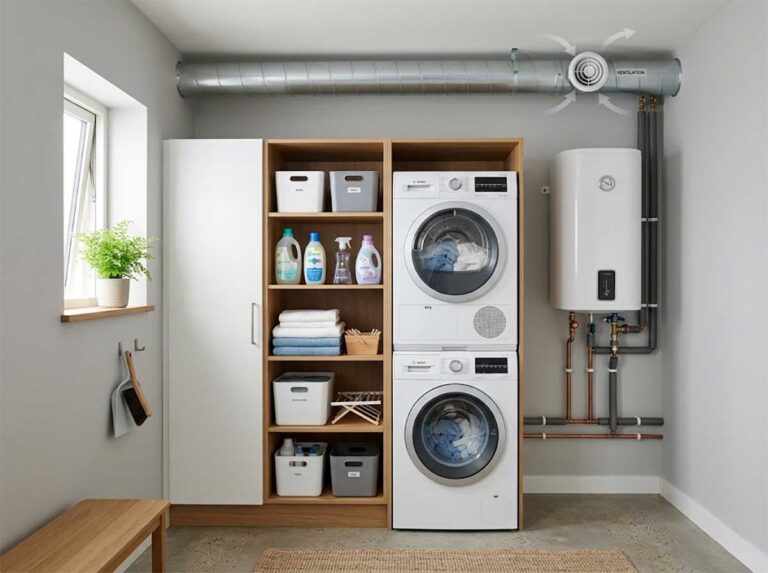
A healthy utility room stays dry, has controlled temperature and humidity, provides enough air for the equipment inside it, and prevents pollutants from spreading through the home. Good conditions start with source control: repair plumbing leaks promptly, keep dryer lint under control, maintain water heaters and HVAC equipment, store household chemicals securely, and preserve the service clearances around appliances.
Humidity deserves particular attention because utility rooms often contain water lines, drains, washing machines, water heaters, and other moisture sources. Persistent dampness and condensation can encourage mold growth and damage building materials.
Rooms containing fuel-burning equipment also need correctly installed combustion-air and exhaust systems. Working carbon monoxide alarms provide an additional layer of protection for homes with combustion appliances, including gas water heaters and furnaces.
A well-performing utility room manages four things at the same time: air, moisture, heat, and pressure. Problems often begin when one of those gets out of balance. A dripping pipe raises humidity, a dryer adds heat, an exhaust fan removes air, and a naturally vented water heater may depend on that same room for combustion air.
Homeowners can learn a surprising amount simply by watching how the room behaves. Persistent condensation on cold pipes, a musty smell that returns after the door has been closed, unusually warm air, corrosion around equipment, or a door that becomes difficult to open when an exhaust fan runs can all reveal an underlying airflow or moisture problem.
The healthiest utility rooms therefore function as small mechanical environments rather than storage closets. Equipment has breathing room, wet appliances have a strategy for leaks and humidity, exhaust systems have somewhere to discharge, and replacement air can enter without creating undesirable pressure conditions elsewhere in the house.
Does A Utility Room Need Ventilation
Many homes benefit from well-planned utility room ventilation, although the exact requirement depends on what the room contains, how the home is constructed, and the locally adopted building and mechanical codes.
Three separate air-management needs may apply. The room may need general air exchange to remove heat, humidity, and odors. Fuel-burning equipment may need combustion air so it can burn fuel safely. The appliance itself may also require a dedicated vent or flue that carries combustion gases outdoors. These functions should be evaluated separately because utility room ventilation requirements can differ from appliance combustion-air and venting requirements.
The better question for design purposes is what the room needs to get rid of and what its equipment needs to operate. A laundry-heavy utility room may need help removing moisture and heat. A room containing an atmospheric gas appliance may need a dependable supply of combustion air. A heat-pump water heater may need enough surrounding air to operate efficiently. A room containing paints, cleaners, or solvents may have an indoor-pollutant problem that should be solved primarily through safer storage and source control, while HVAC maintenance such as air duct cleaning should be considered separately.
A window is only one possible source of ventilation. A windowless utility room can use mechanical exhaust, transfer grilles, ducted outdoor air, or a whole-house ventilation system where appropriate.
This is why adding a fan indiscriminately is not always a good solution. Every cubic foot of air exhausted from a closed room has to be replaced. If replacement air cannot enter easily, the room becomes depressurized. In a room containing naturally drafted combustion equipment, that pressure change deserves particular attention.
Utility Room Ventilation Requirements
Because utility room ventilation requirements depend on the equipment and moisture sources actually present, the design should be tailored to the room. Local requirements vary, so the applicable building code, mechanical or fuel-gas code, and each appliance manufacturer’s installation instructions should be checked for the specific property, especially during water heater replacement.
For fuel-burning appliances, adequate combustion air is fundamental. Conventional gas appliances that obtain combustion air from the surrounding space may require appropriately sized openings or another approved source of air. Direct-vent and sealed-combustion equipment typically obtains combustion air through a dedicated system installed according to its listing and manufacturer instructions. The 2024 International Residential Code, which serves as a model code and is adopted or modified differently by individual jurisdictions, addresses both combustion air and gas-appliance venting.
Appliance exhaust must terminate where required outdoors and must remain unobstructed. Clothes dryers should also vent outdoors, with the exhaust duct and exterior termination kept clear of lint and restrictions.
The room also needs a practical way to manage persistent humidity and excess heat. That may involve mechanical exhaust, conditioned-air transfer, dehumidification, or a combination designed for the house.
Exhaust fans, range hoods, dryers, fireplaces, and HVAC systems elsewhere in the house can influence pressure inside a utility room. Ventilation should therefore be considered as part of the home’s airflow system rather than as an isolated opening in one wall. Effective utility room ventilation needs to account for these pressure relationships as well as the room itself.
In practice, utility room ventilation requirements for opening sizes, duct arrangements, clearances, and combustion-air provisions depend on the appliance and locally adopted codes.
When Basement Utility Room Ventilation Matters
Planning basement utility room ventilation deserves extra attention when the space contains fuel-burning equipment, laundry appliances, several sources of water, or persistent humidity. Basements commonly have cooler surfaces and less natural air movement, so moisture can condense on walls, pipes, ducts, and other materials when humidity rises. A basement dehumidifier can be useful when humidity cannot be controlled through the home’s normal ventilation and HVAC systems.
That makes seasonal behavior important. A basement utility room may seem perfectly dry during one part of the year and become clammy during another. Moist summer air entering a cool basement can create condensation even without a plumbing leak.
This makes basement utility room ventilation especially important to review after air-sealing or energy-efficiency improvements. Changes to the home’s pressure relationships and natural infiltration can affect combustion appliances that rely on surrounding room air, which makes proper combustion-air provisions and appliance inspection important.
A basement containing an atmospheric gas water heater, furnace, or boiler also deserves close attention to vent condition, draft, and combustion air. Loose, damaged, disconnected, or obstructed venting can allow combustion gases to enter the building. A large kitchen hood, clothes dryer, bathroom fan, fireplace, or tightly sealed renovation can alter the pressure relationship between the basement and outdoors.
Signs worth investigating include recurring rust on metal surfaces, damp cardboard, condensation on pipes, peeling coatings, persistent odors, or exhaust smells that appear when other fans in the home are operating.
Basements are also relevant to radon assessment because EPA guidance generally focuses testing on the lowest level of a home that could be occupied. Even where basement utility room ventilation is improved, it should not be treated as a substitute for proper radon testing or a dedicated radon mitigation system when one is needed.
How To Ventilate A Utility Room Without Windows
A windowless utility room can be ventilated effectively with mechanical airflow. A common approach is an exhaust fan ducted directly outdoors, paired with an appropriate path for replacement air. Depending on the design, replacement air may enter through a transfer grille, door undercut, dedicated duct, or the home’s mechanical ventilation system.
Then address the dominant load. A room that gets humid after laundry has a different problem from a room that stays hot because of mechanical equipment. Persistent humidity may justify dehumidification. Excess heat may require greater air exchange. Chemical odors should lead to better source control and storage practices.
Humidity should be measured instead of judged only by how the room feels. If the room remains damp even with adequate air exchange, a properly sized dehumidifier can help.
The airflow strategy requires additional care when the room contains an atmospheric gas water heater, furnace, or other naturally drafted appliance. A strong exhaust fan can depressurize the space and potentially interfere with chimney or vent draft. Combustion-air openings, transfer grilles, and exhaust equipment therefore need to work as a system. Sealed-combustion and direct-vent appliances reduce dependence on room air because their combustion-air and exhaust arrangements are specifically designed for the appliance.
One useful test is to observe the room with the door closed and major equipment operating. A dramatic change in door pressure, airflow through cracks, or appliance behavior can indicate that the room lacks an adequate replacement-air path.
Exhaust air should be discharged to an approved outdoor location. Sending warm, damp utility-room air into an attic, wall cavity, garage, or crawlspace can simply relocate the moisture problem.
Humidity And Pollutants With Utility Room Ventilation
Humidity changes both air quality and the condition of the room itself. Prolonged high relative humidity encourages condensation and creates conditions that support mold growth. It can also contribute to corrosion on metal equipment, ducts, fasteners, and vent components. Keeping relative humidity ideally around 30% to 50% provides a useful target for most homes.
Warm air can hold more water vapor, while cold pipes, foundation walls, or ducts can create surfaces where that moisture condenses. Once materials remain damp, odor and microbial growth can develop in places that are difficult to see, including behind appliances or along wall edges.
Excess heat can make a small utility room uncomfortable and can contribute to higher concentrations or emissions of some indoor pollutants. EPA guidance notes that elevated temperature and humidity can increase concentrations of certain pollutants.
Pollutants in a utility room can come from several sources: dryer lint and dust, cleaning products, stored paints or solvents, mold associated with moisture, and combustion appliances. Fuel-burning water heaters, furnaces, and dryers can produce combustion pollutants when equipment is improperly vented, adjusted, or maintained.
Pollutants should therefore be considered according to their source. Moisture calls for leak repair and humidity control. Dryer lint calls for duct maintenance. Combustion pollutants call for appliance and vent inspection. Chemical vapors call for better storage or removal.
Good air quality therefore depends on several measures working together: removing pollutants at their source, controlling moisture, maintaining equipment, providing appropriate ventilation, and keeping combustion exhaust completely separated from indoor air.
That source-by-source approach usually produces a healthier room than treating every air-quality problem as a need for “more ventilation.” It also makes utility room ventilation more purposeful by matching airflow measures to the problem actually present.
Understanding Water Heater Ventilation
The first consideration is the type of water heater because different technologies have very different air and venting needs. The words water heater ventilation can describe several completely different things, and distinguishing them prevents a lot of confusion.
A conventional atmospheric gas water heater usually takes combustion air from the surrounding space and sends exhaust gases into a vent or chimney through a draft hood. The room must provide the combustion air required by the appliance and applicable code, and the vent system needs the correct size, configuration, clearances, and termination. Gas water heaters are covered by fuel-gas venting and combustion-air provisions as well as their manufacturer instructions. For this type of appliance, water heater venting relies on both a suitable exhaust path and an adequate supply of combustion air.
Direct-vent and many sealed-combustion water heaters use a dedicated outdoor-air intake and exhaust arrangement. Power-vent and condensing models have their own approved venting, termination, drainage, and installation requirements, so vent components should always match the appliance’s listing and installation manual.
Electric resistance water heaters do not produce combustion exhaust and therefore do not need a combustion flue. Heat-pump water heaters also have no combustion flue, although they move significant quantities of air and need sufficient surrounding air volume or a properly designed duct or grille arrangement. For these units, water heater ventilation refers to managing surrounding airflow rather than combustion exhaust. ENERGY STAR notes that space requirements vary by model, with many heat-pump water heaters designed around approximately 450–700 cubic feet of surrounding air unless another approved ventilation arrangement is provided.
That means the correct water heater ventilation strategy for one water heater may be unnecessary or unsuitable for another. The model, vent configuration, room volume, surrounding appliances, and manufacturer instructions should be identified before altering airflow around the unit. For fuel-burning models, water heater venting should likewise be evaluated according to the specific appliance and its approved vent configuration.
Homeowners should also treat soot, scorching, unusual condensation, rust or water streaking on a vent, a loose vent connection, repeated pilot problems, exhaust odors, or a carbon monoxide alarm as reasons for prompt professional inspection.
Why Water Heater Venting Matters
Proper water heater venting keeps combustion products on a controlled path from the burner to the outdoors. With a fuel-burning water heater, that protects the utility room and adjoining living spaces from pollutants that can include carbon monoxide and other combustion byproducts. The EPA recommends venting combustion appliances outdoors and maintaining them according to manufacturer instructions.
Correct venting also supports stable appliance operation. A properly designed vent system provides the draft or mechanical exhaust conditions the water heater was designed to use, while adequate combustion air helps the burner operate correctly. Damaged, blocked, disconnected, or poorly configured vents can allow exhaust to spill or backdraft into the room.
This is especially relevant in modern homes that have become tighter through air sealing, new windows, insulation upgrades, or remodeling. The water heater may remain unchanged while the airflow environment around it changes considerably.
There is a comfort and durability benefit as well. Combustion exhaust carries heat and water vapor along with other combustion products. Keeping that exhaust out of the utility room helps limit unwanted heat and moisture around the appliance and building materials.
Proper venting, suitable combustion air, equipment maintenance, and working carbon monoxide alarms form a coordinated safety system. A CO alarm provides important warning protection, while correct appliance installation and venting address the source of the hazard itself.
- About the Author
- Latest Posts

I’m Iskra Banović, editor of Blufashion and the voice behind its fashion, beauty, and lifestyle stories. Fashion, beauty, and lifestyle are my playground, but I’m just as likely to share the messy side of it all, like the time I tested a “must-have” skincare gadget and ended up with glitter stuck in my hair. I love turning trends and everyday finds into something useful (and fun) for real people.