Installing a mini split in a bedroom can improve comfort, efficiency, and temperature control, but the results depend heavily on proper sizing, placement, and HVAC installation. Before choosing a system, it helps to understand the key factors that affect performance, noise, cost, and long-term reliability.
Is A Mini Split For Bedroom Worth It?
A mini split for bedroom can be an excellent option when you want independent temperature control, quiet operation, and efficient heating and cooling without extending ductwork into the room.
Bedroom mini splits are especially useful for additions, converted attics, older homes with uneven temperatures, rooms above garages, upstairs bedrooms, large primary suites, and bedrooms that consistently run warmer or colder than the rest of the house. In these situations, a bedroom mini split can provide targeted comfort without requiring major changes to the home’s existing HVAC system.
One advantage that receives less attention is what happens at night when the bedroom door is closed. A central HVAC system may have difficulty maintaining balanced airflow in a closed room, especially if the return-air path is limited. A ductless unit conditions the bedroom directly, so its performance is less dependent on air moving back through the rest of the house. This is one reason a ductless mini split for bedroom can be particularly useful in rooms that become uncomfortable overnight.
Because most modern systems use inverter-driven compressors, they can adjust output gradually instead of repeatedly cycling on and off. That helps maintain a steadier room temperature and can make the space feel more comfortable overnight.
A properly sized system can also reduce energy waste because you can condition the bedroom separately rather than heating or cooling the entire home just to correct one uncomfortable room. Many units include sleep modes, timers, dehumidification settings, and remote or app-based controls. A mini split air conditioner for bedroom can therefore provide both temperature control and convenient nighttime operation.
Before choosing one, consider whether the room actually needs independent conditioning. If several adjacent bedrooms have the same temperature problem, treating the underlying insulation, air-sealing, ductwork, or return-air issue may sometimes make more sense than installing a separate unit in every room.
The key is proper system design.
Sizing A Mini Split In Bedroom
Many bedrooms need a mini split in the range of 6,000 to 12,000 BTU per hour, although square footage alone should not determine the final size.
As a rough starting point, a small bedroom of roughly 150–250 square feet may need around 6,000 BTU. A bedroom around 250–400 square feet may fall near 7,000–9,000 BTU. A larger primary bedroom or bedroom suite may require approximately 9,000–12,000 BTU or more.
The correct capacity also depends on ceiling height, insulation, window area, sun exposure, climate, exterior walls, air leakage, and whether the room sits over an unconditioned garage or below a hot attic. These factors can significantly affect how a mini split in bedroom performs during peak heating and cooling conditions.
For the most accurate result, an HVAC contractor should perform a heating and cooling load calculation, often called a Manual J calculation. This matters because an oversized mini split in bedroom may satisfy the thermostat too quickly, limiting dehumidification and causing unnecessary cycling. An undersized system may struggle during the hottest or coldest weather.
The more revealing specification is often the system’s minimum output, not simply its maximum rated capacity. A bedroom has a relatively small cooling load for much of the night. If the mini split cannot reduce its output far enough, it may cycle on and off even though it uses inverter technology. That can create temperature swings, more noticeable airflow changes, and weaker humidity control.
This is one reason two nominally “9,000 BTU” mini splits may behave differently in the same bedroom. Their modulation ranges can be different. When comparing a mini split for bedroom, reviewing both minimum and maximum output can provide a clearer picture of how well the system will match the room’s actual load.
For bedrooms in cold climates, also check the unit’s heating capacity at low outdoor temperatures. The capacity printed prominently on a product page may be measured under much milder conditions than the coldest nights the system will experience.
With a multi-zone system, it is also important to examine how its minimum output behaves when only one small bedroom is calling for heating or cooling.
Placing A Bedroom Mini Split
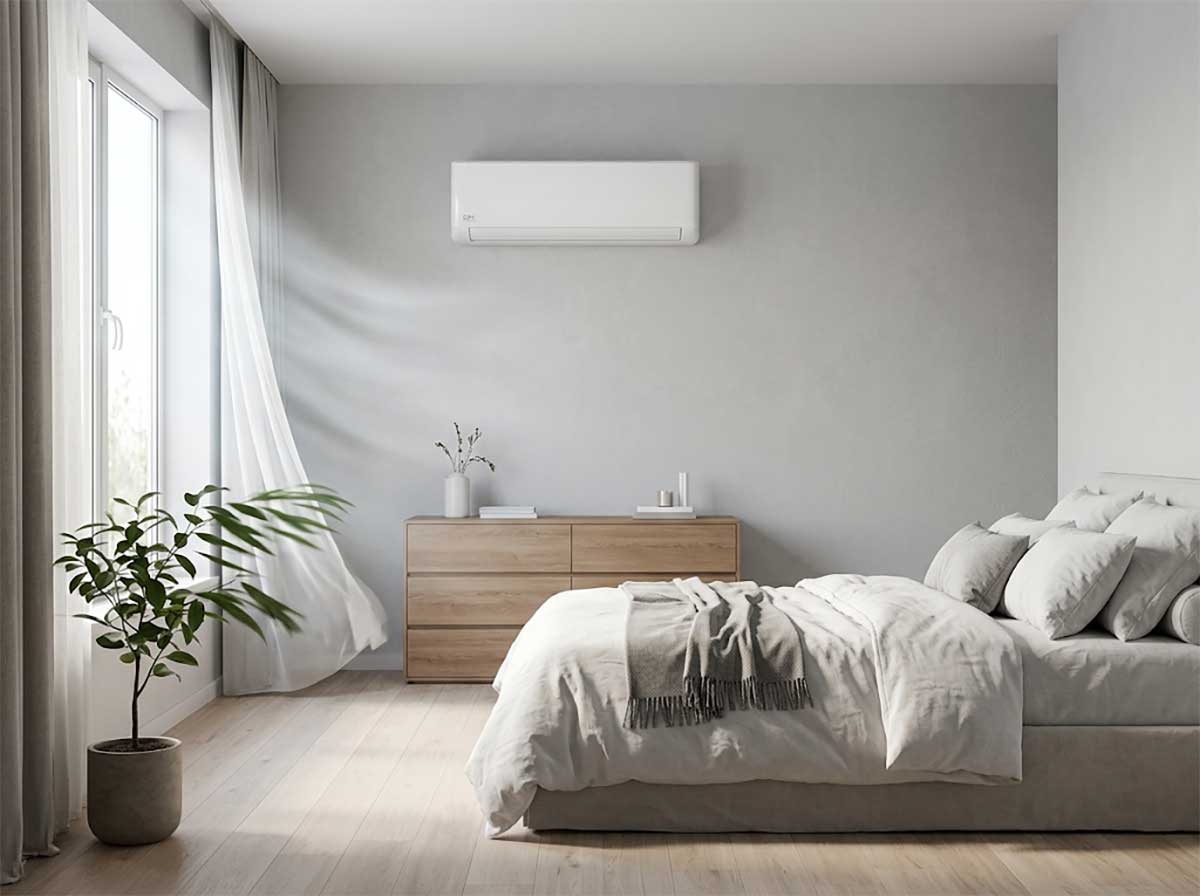
A wall-mounted bedroom mini split usually performs best when it has a clear path to distribute conditioned air throughout the room without blowing directly onto the bed.
A common location is high on an exterior wall with enough open space in front of the indoor unit. Placing it where the airflow can travel across the room generally produces more even temperatures. Proper placement can make a significant difference in how comfortable a mini split air conditioner for bedroom feels during long periods of overnight operation.
A unit can technically distribute air across the entire room and still be uncomfortable if the bed sits directly in its primary discharge path.
Try to avoid installing the unit directly above the head of the bed when possible, where curtains, tall furniture, shelving, wardrobes, doors, or ceiling beams will block airflow, in a narrow corner that restricts air circulation, or too close to the ceiling or adjacent walls to meet the manufacturer’s clearance requirements.
Before installation, consider where the bed is now and where it could reasonably be placed in the future. Mounting the indoor unit directly over a headboard can restrict future furniture arrangements and may make subtle fan, refrigerant, or plastic expansion noises more noticeable at night.
It is also worth looking beyond the indoor unit. The shortest refrigerant-line route is not automatically the best installation. The installer needs to consider whether condensate can drain by gravity, where the exterior line set will appear, access for future cleaning and repair, and manufacturer-required clearances.
The outdoor unit also needs a suitable location with adequate airflow, service access, and protection from conditions that could obstruct it.
A useful installation test is to imagine someone lying in the bed at 2 a.m. with the system running continuously. The preferred location should provide room-wide circulation without making that person feel a constant draft. This is especially important when planning a ductless mini split for bedroom, since direct airflow can be more noticeable when someone is sleeping in one position for several hours.
Noise From A Ductless Mini Split For Bedroom
For a bedroom, look closely at the indoor unit’s lowest operating sound rating, not only its maximum rating.
Many quality ductless systems can operate at approximately 19 to 30 decibels on their lowest fan setting. At the quieter end of that range, the sound is typically subtle enough for most sleepers.
Sound levels rise as fan speed increases, so the system’s sizing matters here as well. A correctly sized ductless mini split for bedroom can often maintain the desired temperature at a low, steady output. A system that frequently has to run at high speed may be more noticeable.
The published indoor-unit rating does not tell the whole story. Other sounds can become more noticeable in a quiet bedroom, including louvers moving during temperature adjustments, refrigerant flowing through the line set, plastic components expanding or contracting, condensate-pump noise, and outdoor-unit vibration transmitted through the structure.
A condensate pump deserves particular attention. The indoor fan may be extremely quiet, yet a small pump cycling beside the bedroom can be clearly audible to a light sleeper.
Outdoor-unit placement also matters. Mounting a condenser on brackets attached directly to a bedroom wall can sometimes transmit low-frequency vibration indoors. Ground mounting or an alternative wall location may provide a better result, depending on the property.
If you are particularly sensitive to noise, ask your installer about the manufacturer’s published low-speed decibel rating and the proposed location of both the indoor and outdoor units. Noise performance can be an important deciding factor when selecting a mini split AC for bedroom, particularly for light sleepers.
Requirements For A Mini Split Air Conditioner For Bedroom
Most mini splits require a dedicated electrical circuit sized for the specific equipment. Depending on the system, it may operate on 115/120 volts or 208/230 volts.
A typical installation may involve a dedicated breaker and appropriately sized wiring, an outdoor electrical disconnect, refrigerant lines connecting the indoor and outdoor units, communication or power wiring between system components, a condensate drain, a wall penetration for the line set, wiring, and drain, and a mounting bracket or pad for the outdoor unit.
The exact electrical requirements are listed on the equipment’s nameplate and installation documentation, so circuit size should never be selected from a generic rule of thumb or from the system’s BTU rating alone. This applies whether you are installing a basic cooling unit or a heat-pump-style mini split air conditioner for bedroom.
The condensate drain deserves particular attention in a bedroom installation. Gravity drainage is usually preferable when the layout allows it. If a condensate pump is necessary, ask where it will be installed.
Homeowners should also ask whether the proposed line-set length falls within the manufacturer’s allowable length and elevation limits, how the wall penetration will be sealed against water, pests, and uncontrolled air leakage, whether refrigerant lines will be concealed in line-hide covering, and whether the outdoor unit will sit on a pad, stand, or wall brackets.
If the mini split will heat during winter, consider where water from defrost cycles will go. Heat pumps periodically enter a defrost cycle, and the resulting water must be able to drain without creating problematic ice around the outdoor unit.
A professional installation should also include secure line-set routing, proper evacuation, pressure testing, and refrigerant commissioning, and verification that the system is operating within manufacturer specifications.
Cost Of A Mini Split AC For Bedroom
For a single-zone bedroom system in the U.S., a professionally installed mini split AC for bedroom commonly falls somewhere around $3,000 to $7,000, although simple projects may cost less and premium or complicated installations can cost more.
A useful estimate should separate the cost of the equipment from the cost created by the house itself. Several factors affect the final price, including equipment brand and efficiency rating, heating performance in cold climates, unit capacity, length and routing of the refrigerant lines, electrical-panel capacity, need for a new circuit or electrical upgrades, outdoor-unit mounting requirements, difficulty accessing the installation area, condensate-pump requirements, local labor costs, permits and inspections, and manufacturer and contractor warranty coverage.
A bedroom located directly above an accessible exterior wall may be relatively straightforward. The same system installed in a second-story interior bedroom could require a longer line-set route, condensate pumping, exterior coverings, difficult ladder work, or more extensive electrical work. As a result, the installation cost of a mini split for bedroom can vary considerably even when the equipment itself is identical.
When comparing estimates, review what is included rather than looking only at the total price. One quote may include electrical work, permits, equipment stands, line-hide covers, condensate drainage, refrigerant pressure testing and evacuation, startup and commissioning, manufacturer warranty registration, and labor warranties, while another treats those as additional charges.
The least expensive proposal can become more expensive once omitted electrical, drainage, permit, and finishing work is added.
Mistakes With A Mini Split In Bedroom
One of the most common mistakes is selecting equipment solely by bedroom square footage.
Another mistake is assuming every “quiet” mini split will sound the same in an actual bedroom. Low-speed operation, condensate-pump noise, and vibration can all affect how the system sounds at night.
Poor condensate drainage can lead to leaks, odors, or water damage.
A well-planned mini split in bedroom should be easy to operate, quiet at night, comfortable from every part of the room, and accessible for future maintenance. Choosing the right bedroom mini split also means considering minimum capacity, airflow direction, drainage, and noise rather than focusing only on the advertised BTU rating.
Maintaining A Bedroom Mini Split
Routine maintenance for a bedroom mini split is relatively straightforward, but it should be done consistently.
Start by checking the indoor unit’s washable filters every few weeks during periods of regular use. Cleaning frequency depends on dust levels, pets, occupancy, and how often the system runs. Many homeowners clean reusable filters every four to six weeks, while heavily used systems may require more frequent attention.
Keep the indoor unit’s intake and discharge areas unobstructed, and watch for dust buildup on louvers and accessible surfaces. Check occasionally for water around the indoor unit or drain line, and make sure the condensate drain remains unobstructed. Keep leaves, vegetation, snow, and debris away from the outdoor unit, and maintain the manufacturer’s required clearance around the outdoor coil.
The indoor unit continually moves bedroom air across its coil and blower wheel. Over time, fine dust can pass through the filter and accumulate on internal components. In cooling mode, moisture on the coil can also create conditions where dirt adheres more readily.
The indoor coil, blower wheel, drain pan, and condensate system can accumulate contamination that ordinary filter cleaning will not remove. The blower wheel is particularly easy to overlook because homeowners cannot see most of it during routine filter cleaning. A dirty blower can reduce airflow even when the filters appear clean, so periodic internal cleaning may be appropriate for systems that operate heavily during the cooling season.
Periodic professional inspection and deeper cleaning can help maintain airflow, drainage, efficiency, and indoor air quality. This is particularly useful for a mini split AC for bedroom that operates every night for extended periods during hot or humid weather.
One useful maintenance indicator is change, not merely elapsed time. If the unit starts producing less airflow, becomes noticeably louder, develops a musty odor, takes longer to reach the set temperature, or begins dripping water, it deserves inspection even if the normal service interval has not arrived.
The maintenance schedule should ultimately follow the manufacturer’s instructions and operating conditions in your home. A bedroom system that runs every night for much of the year will generally need more attention than one used only during occasional temperature extremes.
- About the Author
- Latest Posts

I’m Iskra Banović, editor of Blufashion and the voice behind its fashion, beauty, and lifestyle stories. Fashion, beauty, and lifestyle are my playground, but I’m just as likely to share the messy side of it all, like the time I tested a “must-have” skincare gadget and ended up with glitter stuck in my hair. I love turning trends and everyday finds into something useful (and fun) for real people.