




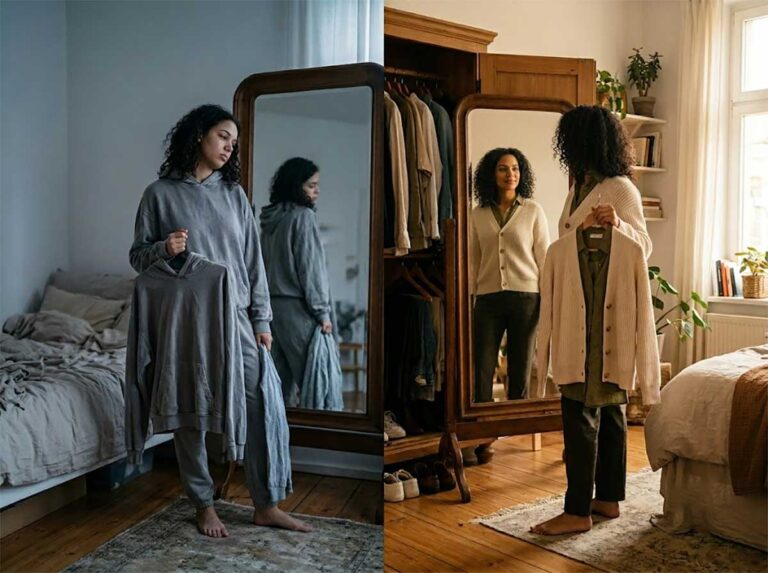
Many of us have had that morning where nothing feels quite right; you hunt through the wardrobe, throw on something that technically fits and matches, yet spend the day feeling slightly off without being able to explain why. It sounds trivial, but that feeling is real and there’s actual psychology behind it.
Researchers call it “enclothed cognition” — the idea that the clothes you wear have a measurable effect on your mental state and behaviour. It’s not about dressing to impress anyone else. It’s more about what your brain does when it registers what you’ve got on. Studies going back to the early 2010s have shown that people who wore a white lab coat made fewer errors on attention tasks than those who didn’t, even when they knew it was just a coat. The clothing carried a meaning, and that meaning shaped how they performed.
Now, obviously most of us aren’t wearing lab coats to the shops in Huddersfield. But the principle carries over. If you pull on something that feels ‘sloppy’, there’s a reasonable chance your brain leans into that signal. However, if you put on something that feels more intentional – something that fits properly and feels like you’ve made a choice rather than just grabbed whatever was on the floor – you tend to carry yourself differently. Not dramatically, but enough to notice.
Comfort Isn’t the Enemy of Looking Put-Together
There’s a persistent idea, especially in fashion media, that you have to sacrifice one for the other. Either you look good or you feel comfortable. That’s largely nonsense, and it does a particular disservice to older adults, people with mobility considerations, or anyone whose daily life doesn’t involve sitting at a desk or turning up to photoshoots.
This is actually something that dressing for everyday life and the psychology behind it explores pretty thoughtfully — the idea that clothing choices should reflect who you actually are and how you actually live, not some aspirational version of yourself that exists mainly on Pinterest boards.
The reality for a lot of people is that everyday life involves a fair bit of getting up, sitting down, walking, bending, carrying things, and generally existing in a body that has its own preferences. Clothing that fights against that creates a low-level friction that adds up through the day. You’re constantly adjusting, tugging, holding yourself differently to avoid something gaping or pulling. That kind of physical discomfort bleeds into your mood, often without you realising it’s the clothes doing it.
The Confidence Thing Is Real, But Complicated
People talk a lot about clothes giving you confidence, and while there’s truth in it, the relationship is messier than a motivational caption makes it sound. It’s not simply “wear something nice, feel amazing.” A lot of it depends on fit, familiarity, and whether what you’re wearing matches the context you’re in.
Wearing something that feels wrong for the occasion — too formal, too casual, too attention-grabbing when you’d rather blend in — can actually knock your confidence rather than build it. There’s comfort in appropriateness. Turning up to a family lunch in something that feels right for the setting, that lets you move around and eat without worrying about it, is genuinely different from spending the afternoon fussing with something impractical.
And fit matters enormously, probably more than style choices do. Clothes that actually correspond to your body as it is right now, not how it was five years ago or how you hope it’ll be after a few months of good intentions, tend to read as more put-together even when they’re not especially fashionable. The brain is remarkably good at detecting when something fits and when it doesn’t.
Getting Dressed on Purpose
The psychological case for caring about what you wear isn’t really about vanity. It’s more about the quiet signals you send to yourself throughout the day. Choosing something deliberate, even if that choice is “I want to be comfortable and warm and I’m going to a garden centre,” is still a choice that your brain registers as intentional. That matters.
It doesn’t require spending a lot of money or overhauling everything you own. Often it’s just about being honest with yourself about what you actually need from your wardrobe — and making sure the clothes in it are working for the life you’re actually living, not some other one.