





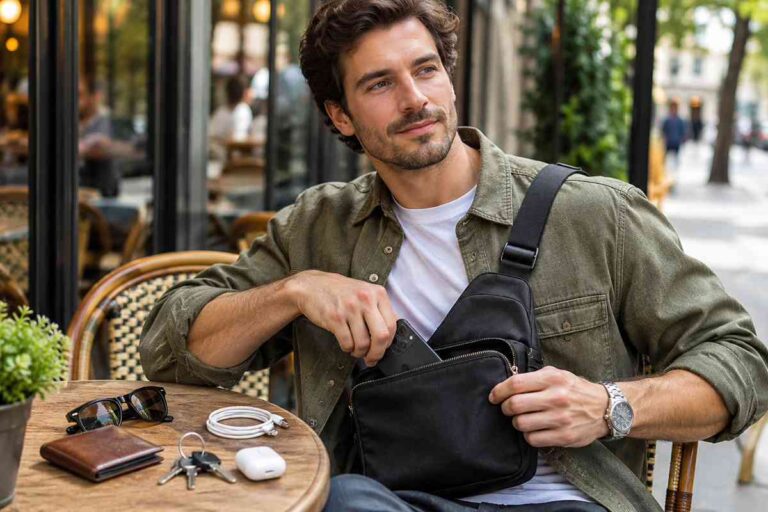
The everyday essentials for a men’s crossbody bag are a phone, a wallet or card holder, keys, and earbuds. Those are the things that make your pockets bulge and your jeans sit wrong. After that, it depends on the bag’s size and your day: sunglasses, a charger and power bank, a passport when you travel, a compact umbrella, something to read, and in a larger bag, a tablet or laptop.
Just keep an eye on what piles up in there. Sunscreen, cologne, receipts, yesterday’s lunch (whoops, forget about that…). Below: whether a crossbody is right for you, how to wear one, what’s worth carrying, and what size bag you need for it.
Should Men Wear Crossbody Bags?
Yes. Messenger bags have been part of menswear for decades, and designer menswear collections now show crossbody bags and slings season after season. A crossbody keeps your hands free and your pockets flat, and a well-chosen one looks practical and put-together, not like a costume.
How to Wear a Crossbody Bag for Men
You can easily wear crossbody bags in three main positions, and the right one depends on the bag’s size and what you’re doing:
- Across the chest. Shorten the strap so a small sling sits high on your chest. It’s the most current look, and the bag stays in front of you where you can see it and reach into it.
- At the hip. The classic messenger position: strap over one shoulder, bag resting on the opposite hip. It suits medium and laptop-size bags and works with smarter outfits.
- On the back. Slide the bag around behind you for cycling or long walks. It stays out of the way, but you can’t see it, so swing it back to the front in crowded places.
Get the strap tight enough that the bag doesn’t swing when you walk, but loose enough that you can unzip it one-handed. Tuck away any loose strap end. In winter, let the strap out so it fits over your coat instead of crushing it.
What to Wear It With
- T-shirt and jeans: A small nylon or leather sling worn on the chest. This is where a bolder color works.
- Hoodie or sweatshirt with joggers or cargo pants: A lightweight nylon chest sling in black or gray, strap snug so the bag doesn’t sink into the fabric.
- Chinos and an oxford or polo: A slim, more structured leather crossbody at the hip in black, brown, or tan.
- Suit: Skip the chest sling, which fights the line of a jacket. A structured leather messenger at the hip is the version that works with tailoring.
Crossbody bags generally look best with relaxed shapes, like tapered pants and casual layers, rather than very fitted outfits. Choose a bag that suits your wardrobe. If you’re not confident with fashion and want to avoid standing out, a dark or neutral bag in black, brown, or navy will go with nearly everything. If you like bold outfits, a brighter color can match your style. For more outfit ideas, browse our men’s fashion section.
What to Carry: The Everyday Basics
Any crossbody worth buying should hold these without a fight:
- Phone. Check that your phone, in its case, fits the exterior pocket, not just the main compartment, so you aren’t unzipping everything to answer a call.
- Wallet or card holder. A slim card holder frees up a surprising amount of room in a small sling.
- Keys. Give them their own pocket, away from your phone screen and sunglasses. A key clip keeps them from wandering but won’t stop scratches if everything shares one compartment.
- Earbuds or headphones. Earbud cases are easy to lose in a deep pocket, so give them a small zip pocket of their own.
- Small extras. Lip balm, hand sanitizer, a pen, gum, a few dollars in cash for places that don’t take cards.
Sunglasses (Before You Sit on Them Again)
As the weather heats up, sunglasses become a must-have in any man’s crossbody bag. Instead of taking them off indoors and hanging them from your shirt pocket (where they get lost) or dangling them off your pants pocket (where they get…you know, lost), you can slip them away safely until you need them.
I lost count of the number of times I sat on mine. If I’d had a crossbody bag to store them when not in use, many sunglasses would have survived the wrath of accidents, like my Ray-Bans. I’m yet to get past that in my head, *unhappy grin*. Keep them in a hard case, though. Loose in a bag with your keys, the lenses won’t last much longer than they did in your back pocket.
Chargers, Cables, and a Power Bank
An extra charging cable can be a lifesaver when you’re away from home and your phone’s battery is low. A slim power bank is even better, since it doesn’t depend on finding an outlet. Choose one that fits flat against the back panel so it doesn’t turn the bag into a brick.
If you fly, the FAA requires power banks and spare lithium batteries to travel in carry-on baggage, never checked, and limits them to 100 watt-hours each unless your airline approves a larger one. Everyday phone power banks are well under that, but some airlines add their own rules, so check before you fly.
Passport and Travel Documents
A passport fits in most crossbody bags, which makes them handy when you travel. Wear the bag in front of you in airports and crowds so it stays in view, and keep the passport in an interior zip pocket rather than the quick-access front one, so it doesn’t come out every time you reach for your phone.
That Useful Umbrella When Rain Hits in the Fall
Fall and winter weather can turn suddenly, and a compact travel umbrella fits in a medium crossbody or messenger. That small umbrella tucked away in the bag serves the old “best to have it and not need it” adage well when the weather turns. It won’t fit in a small sling, so check the bag’s depth before you count on it.
A Book or Magazine
Whether you’re meeting a friend or heading out for a solo day trip, it’s always a good idea to have something to read in case you find yourself waiting around. A paperback, a magazine about cars or travel, or the unfinished book from your to-read pile all slide into a medium crossbody. Just one, though. Two hardcovers are how a strap starts digging into your shoulder.
What Size Crossbody Bag Do You Need?
Work out what you carry on a normal day, then buy the smallest bag that holds it. Slings are usually sold by capacity in liters, while laptop bags are sold by the screen size they fit. These ranges are a rough guide:
| Bag type | Typical size | What fits |
|---|---|---|
| Small sling | About 1 to 3 liters | Phone, wallet, keys, earbuds, sunglasses |
| Medium crossbody | About 4 to 8 liters | The basics plus a power bank, compact umbrella, paperback, or small tablet |
| Laptop crossbody or messenger | Padded sleeve for a 13″ to 15″ laptop | Laptop, charger, notebook, files, and the basics |
Capacity alone won’t tell you whether something fits. Two bags with the same liter rating can have very different shapes, so measure your largest item (a cased phone, a tablet, a glasses case) and compare it with the bag’s interior dimensions and pocket openings.
If You Carry a Laptop or Tablet
A laptop crossbody is a good fit for designers, illustrators, and anyone who works away from a desk. Look for these features:
- A built-in padded compartment sized for your laptop (most bags list 13″ or 15″).
- An exterior zipper pocket for the things you grab most, like your phone and wallet.
- A back slip pocket for magazines or files.
- An organizer panel to hold pens, keys, and other small items in place.
- Water-resistant fabric or coated leather to fend off light rain and splashes. It won’t make the bag waterproof, so seams and zippers can still let water through in a downpour.
- A wide, padded strap, which spreads a heavy load across your shoulder far better than a thin one.
A crossbody still puts all the weight on one shoulder. A laptop, charger, and notebook add up fast, and if you carry that load every day and your shoulder complains, a backpack that spreads the weight is the better tool.
Surely, a Backpack Is Better?
For heavy loads, usually. For lighter days, a crossbody has its own advantages. You can reach your phone or wallet without taking the bag off, it’s less bulky on a crowded train or in a café chair, and worn in front, it stays where you can keep an eye on it.
What to Leave Out
If your crossbody bag is so heavy that the strap digs into your shoulder, that’s not cool. Every few weeks, empty it and clear out the receipts, dead pens, and anything you haven’t touched. A full water bottle rarely belongs in a small bag unless it has a dedicated sleeve, and neither does lunch, as we’ve established.
Pack it with what you actually use, then strap it on and walk, hike, or explore a new city with your hands free and everything you need within reach. For more styles, browse our bags section.