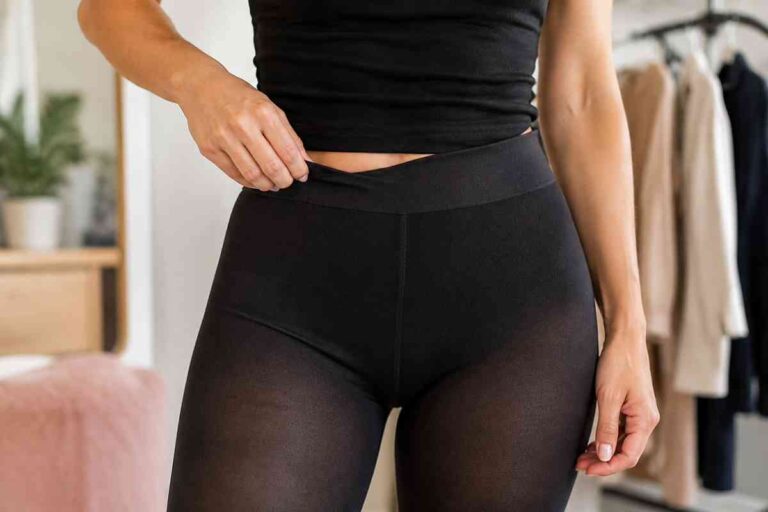
Tights rolling down at the waist? It usually comes down to two things: the waistband sits at your narrowest point with nothing to grip, or the tights are too short in the torso, so every step pulls the band down toward your crotch. Fix the fit first (size by height and hips, and size up when you’re between sizes), pull them on in stages so the crotch sits where it should, then anchor the waistband with a pair of high-waist briefs worn over the top. For a long day or a night of dancing, add a stripe of roll-on body adhesive, or skip the waistband entirely with thigh-high stockings.
Quick Fixes That Work
- Size by height and hips, not waist. If you fall between two sizes, take the larger one.
- Pull them on in stages. Gather each leg down to the toe, ease it up to the knee, then the thigh, and get the crotch snug against your body before the waistband reaches your waist. Before you leave, smooth the fabric over your hips, then sit down and bend once: if the waistband already wants to fold, fix it now rather than halfway through the day.
- Choose a high rise with a wide waistband, ideally double-layered or seamless knit.
- Wear high-waist underwear or light shapewear over your tights to hold the waistband in place.
- Fold the waistband down once to make a thicker band that’s less likely to curl.
- Use roll-on body adhesive on clean, dry skin where the top edge sits, as backup for tights that already fit.
- Switch to thigh-high stockings when you want no waistband at all.
- Wash cold and skip the dryer and fabric softener, so the elastic keeps its stretch.
Why Tights Roll Down in the First Place
Figure out which of these is happening before you buy anything new.
- The torso is too short for you. If the rise doesn’t reach your waist comfortably, the fabric pulls down from the crotch every time you sit or take a step, and the waistband rolls to relieve the tension. Tall women and anyone with a long torso feel this most.
- The size is off. Too small, and the waistband is stretched past what it can hold. Too big, and there’s nothing to grip, so the tights slide down slowly. Bagging at the knees and ankles can mean they’re too big, but it can also mean the leg length is wrong for you or the fabric has lost its stretch.
- Your hips are much wider than your waist. The band settles at your narrowest point, and when you sit or bend, it folds over.
- The control top cuts in. A tight panel pushes soft tissue up over its edge, which can flip the band over like a rolled yoga mat.
- The elastic is worn out. Dryer heat, fabric softener, and age all wear down stretch and recovery.
- There’s no friction. Freshly moisturized skin, slick underwear, or a satin slip underneath gives the waistband nothing to hold on to.
- Your body has changed. Pregnancy, postpartum, or a change in weight means the size and rise that used to work may not anymore.
Get the Fit Right First
- Use the brand’s own chart. Many US hosiery charts plot height against weight, and some add hips. Your usual dress size won’t tell you much. If you land on a line between two sizes, choose the larger one: slightly roomy tights stay up better than ones stretched to the limit.
- Tall or long torso: look for tall sizes or a high rise that reaches your natural waist or a little above it.
- Short torso or petite: petite sizes shorten the legs and the rise, so there’s less extra fabric to bunch up and drag the waistband down. If you’re not sure whether you count, here’s what petite means in women’s clothing.
- Curvy and plus size: tights labeled curvy or plus usually have a roomier gusset and a wider, contoured waistband that follows your hips instead of fighting them.
- Pregnant: maternity tights with a stretchy panel that goes over the bump, not under it.
If you plan to wear shapewear over your tights, measure for it too. Our Shapewear Size Finder works out a starting size from your waist and hip measurements in inches.
What to Look for in the Waistband

Read the product description, not just the photo.
- A wide band, about 2 inches or more, ideally double-layered. Wider bands spread the pressure and are harder to fold over.
- A silicone grip strip along the inside top edge can add hold, but it’s optional: it won’t save a pair that’s the wrong size, and you should skip it if silicone irritates your skin.
- A seamless knit band with no hard seam for the fabric to fold on.
- A contoured or V-shaped band that dips slightly at the front and follows your curves.
- A control top that supports without digging. If it leaves a deep red groove after an hour, it’s too tight or the wrong size, and it will roll.
- Telling words in the copy, such as “no roll,” “stay up,” “high waist,” or “silicone waistband,” plus reviews from people of a similar height and build.
Fabric matters too. A nylon and spandex blend snaps back after you sit, while pairs with little stretch tend to bag and slide. Our guide to hosiery fabrics explains the common blends.
How to Anchor Tights So They Stay Put
Layer Underwear Over the Top
This is the easiest fix and it costs nothing. Put your tights on, then pull high-waist briefs, boy shorts, or light shapewear shorts over them. The underwear’s elastic holds the tights’ waistband against your body and stops the crotch from sagging. Some people wear a pair underneath as well, so the tights are sandwiched between two layers. Keep anything under your tights thin and smooth, though: bulky underwear or thick seams underneath can push the waistband out of place. On long days, a bodysuit over tights does the same job.
Use Body Adhesive or Tape
Roll-on body adhesive, the kind dancers and costume wearers use to keep socks and tights in place, can hold a waistband steady for a night out. It works as backup for tights that already fit; it won’t fix a pair that’s too short in the torso. Choose one made for use on skin. Apply a thin stripe to clean, dry skin where the top edge of the waistband will sit, let it turn tacky, then press the waistband onto it. Patch-test it on a small area first, keep it off broken or irritated skin, and wash it off as the label directs. Double-sided fashion tape works in a pinch, but it can rub when you sit.
Switch to Stockings
If no pair of tights stays up on you, take the waistband out of the equation. Thigh-high stockings held by a garter belt, or stay-ups with silicone bands at the top, can’t roll at the waist because there’s nothing there. Our guides cover how to keep thigh highs from slipping and how garter belts work. One catch: many “suspender tights” are regular tights with a garter-belt pattern knitted in. They look the part but still have a waistband, so they won’t solve rolling.
Pin or Clip Them
Lingerie or garment clips that hook the tights to a camisole or slip are the safer option. In a pinch, a small safety pin can join the tights’ waistband to slip shorts or shapewear at each hip. Pin through the thick waistband, never the sheer leg, or you’ll start a run, keep the pin on the outside of the layers so it isn’t pressing into your skin, make sure it’s fully closed, and check it after you sit down.
Quick Fixes When You’re Already Out
- Reset from the bottom up. In the restroom, work the tights up from the ankles and get the crotch snug before you touch the waistband. Yanking the waistband alone just moves the problem.
- Then anchor what you have. Folding the waistband once and moving your underwear over your tights both take under a minute in a stall, and no one will know.
- Keep a travel-size body adhesive and a safety pin in your bag for next time.
Save a Favorite Pair With Tired Elastic
If the waistband has lost its snap but the legs are fine, sew a strip of silicone-backed gripper elastic, the kind used in strapless bras and shapewear, inside the top edge. Use a zigzag stitch so the seam stretches with the band. A fresh strip of plain elastic stitched inside the waistband also helps. If the whole pair bags at the knees and ankles, the stretch is gone everywhere, and it’s time to retire them.
Care Tips That Keep the Waistband Snug
- Hand wash, or use a mesh laundry bag on a gentle cycle in cold water.
- Skip fabric softener. It coats the fibers and can break down spandex over time.
- Air dry. Dryer heat wears down spandex and shortens the life of the waistband.
- Rotate pairs so the elastic gets a rest between wears.
- Store them folded or loosely rolled, not hanging.
When in doubt, follow the care label. Our laundry symbols chart decodes the icons.
When Leggings, Shapewear, or Underwear Roll Down
These problems share some causes with tights, such as a rise that’s too short, a band that’s too tight or too narrow, and worn-out elastic, but each garment has its own fixes.
- Leggings: look for a tall, double-layered waistband, and try a tall size if the crotch drops when you squat.
- Shapewear: firmer compression makes the top edge more likely to fold, so check the size against your waist and hip measurements, tuck the top edge under your bra band, or choose a style with straps.
- Underwear: a waistband that folds over is usually either too tight, so it digs in and flips, or too low, sitting where your stomach pushes it down when you sit. Try the next size up or a higher rise, look for a wider, flat or bonded band instead of a thin elastic edge, and replace pairs once the elastic has gone wavy.
Troubleshooting by Symptom
- Digs in and flips over: size up, or switch to a wider, softer waistband.
- Slides down slowly and bags at the knees: check your height and weight against the brand’s chart, whether the gusset sits snug, and whether the elastic still springs back. If the pair is simply loose all over, try the next size down.
- Crotch sags and the waistband keeps dropping: the torso is too short. Pull them on in stages, then try the next size up or a tall size.
- Rolls at the front when you sit: the band is sitting at your narrowest point. Go higher rise and wear underwear over the top.
- Started rolling after a few washes: the elastic is worn. Check how you’re washing and drying them, and replace the waistband or the pair.
FAQs
Should I size up or down if my tights roll?
If they cut in and roll, or the crotch sits low, size up. If they slide down and feel loose all over, and the gusset already sits snug, try the next size down. Between sizes, the larger one usually stays up better.
Do control-top tights roll more or less than regular?
They can roll more if the control panel is too tight or too short for your torso, because it pushes soft tissue up over the edge. A softer, wider control top in the right size usually rolls less than a thin standard waistband.
Can I use the same body adhesive I use for strapless bras?
If it’s a roll-on body adhesive applied to your skin, usually yes: many are sold for strapless tops, socks, and hosiery alike. Stick-on bras carry their own adhesive, which you can’t reuse for tights. Choose one made for use on skin and patch-test it on a small area first.
What if silicone grips irritate me?
Skip silicone and adhesive. Choose a wide, seamless knit waistband and anchor it with high-waist underwear or light shapewear worn over the tights.
Why do my expensive tights still roll but my cheap pair does not?
Fit, rise, and waistband construction matter more than price. An inexpensive pair with the right rise for your torso will usually stay up better than a pricey pair that’s too short.