




In a world where almost everything can be searched, filtered, and delivered in a few clicks, truly rare jewelry still follows a different rhythm. The most interesting pieces are not always waiting in obvious places. They may be tucked inside old estate boxes, held quietly in private collections, offered through specialist dealers, or discovered during travel, auctions, and long-standing conversations with people who understand the value of history.
That is what makes the jewelry hunt so fascinating. It is not only about buying beautiful pieces. It is about recognizing them before everyone else does.
For collectors, stylists, and jewelry lovers, vintage and antique jewelry carry something that newly made pieces often cannot imitate: evidence of a life already lived. A ring may reveal the taste of the Art Deco period. A brooch may show the sculptural imagination of mid-century design. A pair of cufflinks may speak of old-world tailoring, formal dressing, and personal refinement. A vintage Chanel necklace, a Christian Dior brooch, a Tiffany & Co. accessory, or an unsigned gold piece with remarkable craftsmanship can each tell a different story.
But finding these pieces requires more than luck. It requires experience, patience, and a trained eye.
Why Rare Jewelry Is Not Always Easy to Find
The best vintage and antique jewelry rarely appears in large quantities. Many pieces were made by hand, produced in limited numbers, or created during periods when jewelry design was closely tied to craftsmanship rather than mass production. Some were made by famous houses, while others came from highly skilled workshops whose names are less widely known today.
Over time, many jewels are lost, altered, damaged, inherited, reset, or kept within families for generations. This makes fine examples increasingly difficult to find in excellent condition. Even when a piece does appear on the market, the challenge is knowing whether it is truly special.
That is where the hunt becomes an art.
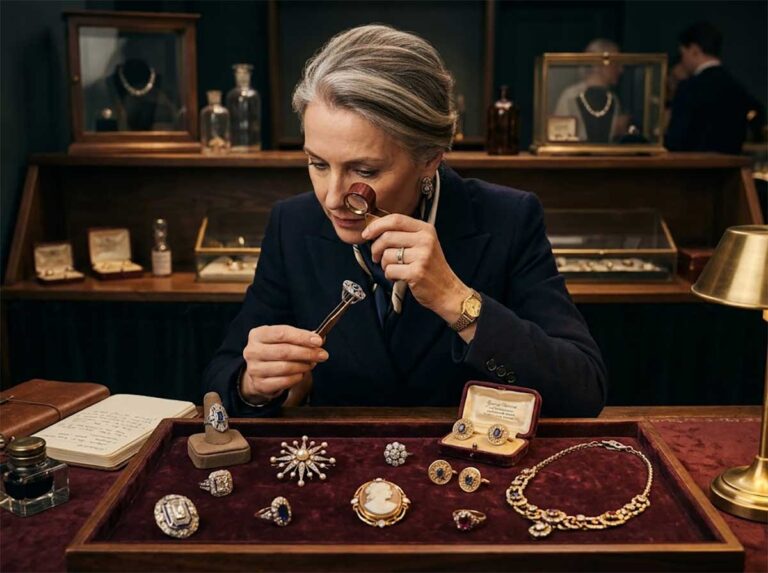
A serious jewelry search often begins with questions. Who made the piece? What period does it belong to? Are the materials correct? Is the design typical of a known movement, or is it unusual? Has it been repaired? Are the stones original? Does the piece have hallmarks, maker’s marks, signatures, or construction details that help tell its story?
For many collectors, these details are part of the pleasure. A jewel is not just an object; it is a puzzle.
The Eye Behind the Selection
A good jewelry hunter does not simply look for famous names. Signed pieces by Cartier, Van Cleef & Arpels, Tiffany & Co., Chanel, Dior, Gucci, and other major houses can be highly desirable, but a signature alone is not enough. Condition, quality, rarity, wearability, and design all matter.
Sometimes the most exciting discovery is not the most obvious one. It may be an Art Nouveau stick pin shaped like a creature, a Victorian gold bracelet with exceptional engraving, a vintage compact with refined metalwork, or a rare brooch that captures the bold style of its era. These are the pieces that reward careful looking.
This is also why experienced curators often travel, build relationships, and study pieces across many categories. The strongest collections are not assembled by chance. They are built through repeated exposure to good objects and through the ability to compare one piece against another.
At DSF Antique Jewelry, this idea of discovery is central to the selection process. The inventory is not limited to one narrow category. It includes antique and vintage jewelry, signed designer pieces, luxury watches, rare objects, cufflinks, brooches, rings, necklaces, bracelets, pins, and unusual finds chosen for character, craftsmanship, and collectability.
That broad approach matters because the modern collector is no longer interested in only one type of jewel. A person may love Georgian jewelry, Art Deco diamond rings, vintage Chanel pieces, men’s gold cufflinks, and collectible watches at the same time. The new luxury collector is often guided by individuality rather than a single category.
What Makes a Piece Worth Hunting For?
A rare piece of jewelry usually has several qualities working together.
First, there is design. Strong design is recognizable even before a name or signature is considered. It may appear in the balance of a ring, the movement of a brooch, the proportions of a bracelet, or the way gemstones are arranged.
Second, there is craftsmanship. Older jewelry often reveals handwork that is difficult to reproduce today. Engraving, enamel, stone setting, hinge construction, gold texture, and small finishing details can all show the care that went into a piece.
Third, there is condition. A jewel may be beautiful, but condition affects both desirability and long-term value. Collectors often prefer pieces that preserve their original character, especially when the design, stones, and structure remain intact.
Fourth, there is provenance or context. Not every jewel has a famous previous owner, but every good piece has a story. The story may come from its maker, its period, its materials, its hallmarks, or its place within a design movement.
Finally, there is rarity. A rare jewel does not have to be extravagant. Sometimes rarity comes from an unusual motif, an uncommon maker, a hard-to-find period, or a design that feels surprisingly modern decades after it was made.
The Importance of Research and Hallmarks
One of the most important parts of the jewelry hunt is research. Hallmarks, signatures, maker’s marks, metal purity marks, and assay marks can help identify where and when a piece was made. They may also confirm whether a jewel is gold, silver, or platinum, and whether it belongs to a particular country or period.
For collectors, these small marks can make a big difference. They add confidence and context. They can also reveal unexpected stories, especially in antique jewelry where design, materials, and history are deeply connected.
This is why educational resources, such as the DSF Antique Jewelry Hallmarks Guide, are useful for anyone learning how to look more closely at vintage and antique pieces. The more a collector understands marks and construction details, the more rewarding the search becomes.
Of course, not every important piece is fully marked. Some jewels have worn marks, incomplete stamps, or no visible signature at all. In those cases, expertise becomes even more important. Construction, style, materials, and period details must be read together.
The best jewelry hunters combine knowledge with instinct. They study the facts, but they also develop a feeling for quality.
Why the Hunt Still Matters
The jewelry hunt matters because rare pieces cannot be recreated in exactly the same way. A new jewel may be beautiful, but an older piece carries time within it. It has survived changing fashions, private ownership, travel, storage, and history itself.
That survival gives vintage and antique jewelry emotional depth. It also gives the wearer something personal. In an age of repeated trends and mass-produced luxury, rare jewelry offers individuality.
This is especially true for collectors who want pieces that feel meaningful rather than simply fashionable. A vintage brooch can transform a simple jacket. A pair of gold cufflinks can bring personality to formalwear. A signed designer necklace can connect fashion history with modern style. A rare ring can become part of someone’s daily identity.
The right piece does not only decorate. It starts conversations.
A More Personal Kind of Luxury
Today, luxury is changing. Many buyers are looking beyond newness. They want craftsmanship, history, sustainability, rarity, and pieces with a sense of discovery. Vintage and antique jewelry answer that desire beautifully.
The hunt is part of the romance. It reminds us that meaningful objects are not always the easiest to find. They must be recognized, researched, and chosen with care.
For DSF Antique Jewelry, this search is not just about inventory. It is about finding pieces with character — jewels and objects that feel distinctive enough to be remembered. Whether the piece is a signed designer jewel, an Art Deco bracelet, a rare brooch, a luxury watch, a vintage compact, or an antique gold ring, the goal is the same: to connect collectors with objects that have presence, history, and lasting appeal.
That is the true art of the jewelry hunt. It is the ability to see not only what a piece is, but what it has been — and what it can become for the next person who wears it