Even the smallest bathroom can feel open and functional with smart plumbing design. The key isn’t just smaller fixtures, it’s rethinking how pipes, drains, and layouts work together to make every inch count.
Small Bathroom Plumbing Mistakes That Waste Space
The biggest mistake isn’t poor layout, it’s failing to think in three dimensions.
Most people treat small bathroom plumbing as flat, focusing on floor space instead of wall depth, corner angles, or height. Bathrooms end up built like plumbing diagrams, not rooms meant to be lived in.
Stacked plumbing lines, when the toilet, sink, and shower share one wall, can reclaim nearly a foot of space, yet most layouts scatter them. Meanwhile, oversized vanities sit flush to the wall but waste the corner gap behind pipes, space perfect for slim shelving or built-ins. Floor-mounted fixtures like traditional toilets and sinks also eat up visual space and make cleaning harder.
Even the air gets wasted more than the floor. Pipes often sit inside thick stud walls that could hide shelves, niches, or pocket storage. A wall-mounted or tankless water heater can also fit within that cavity, combining heating and plumbing runs for a cleaner, more efficient layout. Many small bathroom plumbing layouts run drains the long way around instead of aligning everything on a single wet wall, burning inches and flexibility. And “full-size” small bathroom fixtures aren’t always smart, just a few extra inches in sink depth can throw off the room’s balance. People even lose volume by boxing in every pipe for noise; modern insulation sleeves or sound panels can do the same job with half the bulk.
In short, space is wasted when plumbing dictates design instead of serving it.
Smart Layout Tips For Plumbing A Small Bathroom
You don’t need to rip out walls to reimagine a layout. Plumbing a small bathroom efficiently means using what’s already there. A smart plumber can make subtle shifts that transform the space: moving a sink drain or supply lines a few inches to center it under a new vanity, scheduling regular drain cleaning to keep everything flowing efficiently, installing an offset toilet flange to adjust placement without touching the main stack, or using flexible PEX lines instead of rigid copper to route around obstacles.
These small adjustments can reclaim valuable inches, enough for a floating shelf, slim cabinet, or wider walkway that instantly makes the space saving bathroom feel larger. Think of it as sliding your plumbing, not moving it. Offset connectors can shift toilets or drains just enough to realign fixtures for better flow. Adding a shallow false wall (about 2-3 inches) creates room to reroute water lines vertically, opening the door to floating vanities or recessed storage.
It’s less about tearing things apart and more about plumbing a small bathroom that works in layers, not rows, using depth, height, and alignment to make every inch count.
Stylish Small Bathroom Fixtures That Save Space
The secret isn’t “mini” fixtures, it’s proportion and purpose. The goal isn’t to shrink everything but to choose small bathroom fixtures that feel light, open, and intentional.
Corner sinks turn awkward corners into functional zones, freeing up central floor space, perfect for powder rooms. Wall-mounted toilets like Toto Aquia or Duravit models can reclaim up to 10 inches of floor area and make cleaning effortless. Narrow-depth vanities (14-16″) with built-in drawers or sliding shelves offer practical storage without bulk.
Focus on visual lightness, not just smaller scale. Trough sinks let two people share a 36″ span without needing dual basins. Wall-mounted toilets expose more floor, tricking the eye into reading “more room.” Curved-edge vanities remove sharp visual breaks and guide foot traffic naturally. Console sinks with open frames turn small bathroom sink plumbing into design, letting air and light move freely while still offering towel storage.
In short, it’s not about tiny fixtures, it’s about small bathroom fixtures that keep the visual plane uninterrupted, creating balance and openness even in tight spaces.
Hidden Small Bathroom Plumbing Tricks That Open Up A Room
Think of small bathroom plumbing as part of the architecture, not just the mechanics. When done right, it shapes how space feels, cleaner, taller, and more intentional.
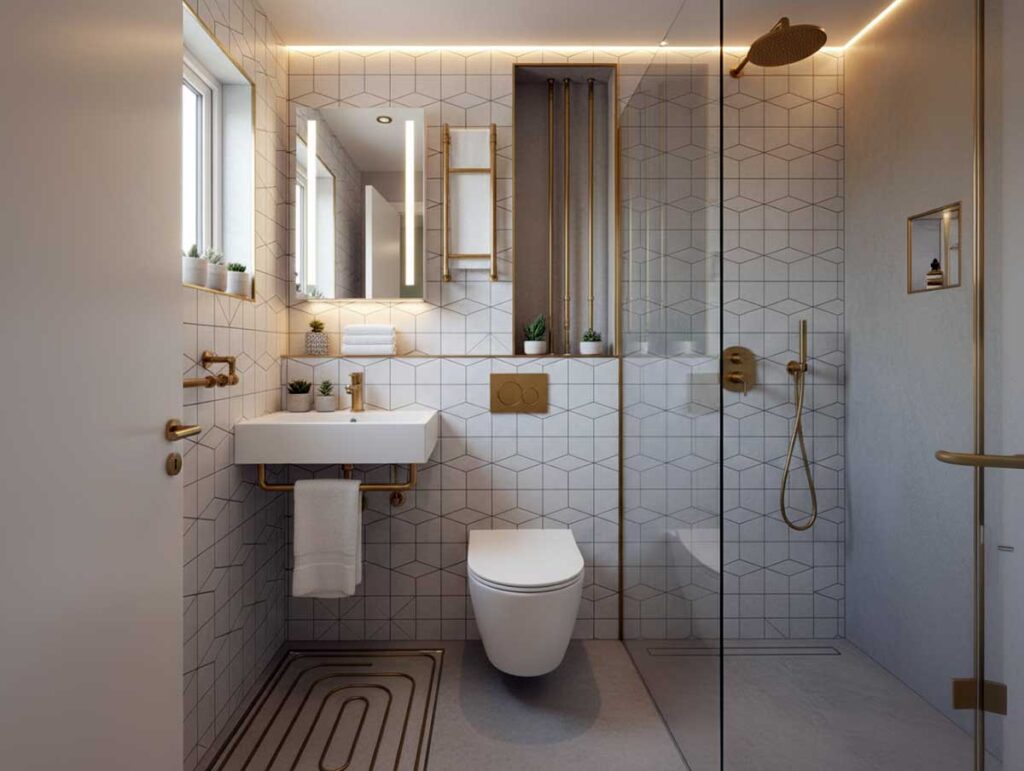
In-wall tanks eliminate bulky toilet bases, creating continuous flooring and lifting the room’s visual center of gravity for an illusion of height. Wall-mounted faucets free countertop space and allow for shallower sinks or vanities, expanding both floor area and usable counter depth. Underfloor pipes or linear trench drains remove the need for boxed-in walls or shower curbs, turning the floor into one uninterrupted surface.
Concealed small bathroom sink plumbing changes the spatial rhythm. Hiding the bulk, tank, trap, or supply, extends every line, simplifying sightlines and reducing visual clutter. The result isn’t just hidden hardware but strategic invisibility: design that makes function disappear so form can take the spotlight.
Space Saving Bathroom Storage That Works With Your Pipes
Smart storage follows the pipes, it works with small bathroom plumbing, not against it.
Under-sink pullouts with U-shaped organizers wrap neatly around the drain instead of wasting that central void. Split drawers shaped around the P-trap turn awkward gaps into functional, organized zones. Vertical shelving built from slim tubing or reclaimed copper can frame risers and transform exposed plumbing into a design statement.
Built-in niches above toilets or between studs add recessed storage without stealing floor space, while wall-niche drawers above pipe chases create subtle, flush “shadow storage” perfect for everyday items.
The key is to let storage frame the plumbing rather than hide it poorly. If you can see it, it should earn its place, by serving a purpose or adding texture. Every space saving bathroom detail should look deliberate.
Chic Ways To Show Off Small Bathroom Sink Plumbing
If your pipes will show, make them intentional. Small bathroom sink plumbing can be part of the design when treated like décor instead of hardware.
Exposed copper adds warmth and craftsmanship, especially in vintage or mid-century spaces, it tells a story and ages beautifully. Matte black or gunmetal piping creates crisp graphic lines, adding structure and contrast against white tile or light wood. Brushed nickel or stainless finishes subtly reflect light, softening corners and visually expanding the room.
The trick is consistency: match visible plumbing to your hardware palette so it feels curated, not accidental. Think of it as the bathroom’s jewelry, each visible line should echo the tone and shape of the surrounding small bathroom fixtures, tying the whole space together.
Quick Small Bathroom Plumbing Upgrades For More Space
Homeowners can make a big difference without touching the main lines.
Swap bulky vanities for floating or open-frame ones, the illusion of floor space alone can make a space saving bathroom feel up to 30% larger. Replace standard P-traps with slim or decorative bottle traps to free up under-sink clearance while adding style. Install aerators or pressure-balanced valves to cut water use and reduce splash in small sinks, and add under-sink LED lighting to visually “lift” the space.
For quick upgrades, mini shut-off valves let you isolate a single fixture for easy swaps without touching the system. Floating vanities with hidden brackets need no plumbing changes but instantly open up the room.
It’s less about replacing fixtures and more about fine-tuning what’s already there, small small bathroom plumbing tweaks that double as efficiency and design improvements.
Design Ideas For Plumbing A Small Bathroom With Style
A space saving bathroom only feels cramped when it looks unplanned. The key is visual order, making every element feel like it belongs, not squeezed in.
Align small bathroom fixtures along one wall for cleaner geometry and smoother flow. Use large-format tiles and continuous grout lines to widen the visual footprint. Keep fixtures “light”, floating, wall-mounted, or with visible legs, to preserve open sightlines and a sense of airiness.
Consistency matters. When your vanity and mirror edges align, the space feels calm and resolved. Matching grout and fixture lines builds subtle structure, creating a quiet rhythm the eye follows naturally. Leave 4-6 inches of breathing space between major elements to give the eye room to rest, like white space in design. And always reflect, don’t multiply, one large mirror expands light and depth far better than several small ones.
In the end, plumbing a small bathroom should feel like part of the composition, the bathroom designed around water, not constrained by it.
Affordable Space Saving Bathroom Hacks Anyone Can Try
You can fake the impact of a full remodel with a few smart swaps.
Use pre-assembled wall-mount sink kits or modular corner units, no custom small bathroom plumbing required. Install adhesive mirror panels or a full-wall mirror to instantly double the sense of depth. Paint or wrap exposed pipes to match your walls or fixtures for instant cohesion, or even an industrial-chic accent, all for under $20.
Small budgets thrive on clever staging. Stick-on LED strips under vanities or behind mirrors lift dark corners and add dimension. Upgrading only trim kits, handles, spouts, and flanges, refreshes the look without replacing valves. And shopping European or RV suppliers can yield compact, high-design small bathroom fixtures made for tight spaces.
Every inch counts in a space saving bathroom, but what really matters is that every choice looks deliberate. Good small bathroom plumbing design isn’t about money; it’s about intentionality per inch.
FAQ: Small Bathroom Plumbing
How Much Does Plumbing Cost For A Small Bathroom?
Most “average cost” lists miss the point, it’s not about size, it’s about access. A small bathroom plumbing project can cost less in materials but more in labor if it’s tucked in a corner or needs new venting.
Here’s a sharper breakdown:
Reuse existing lines: $1,500-$3,000, smart if you’re updating fixtures, not locations.
Full re-plumb: $4,000-$6,000, needed for new layouts or older galvanized pipes.
Tight-space premium: Add 10-15% if walls or crawlspaces make access tricky.
A skilled plumber can often save you money by reconfiguring the order of your small bathroom fixtures instead of running all new pipes.
How To Plumb A Small Bathroom?
You don’t “just run pipes”, you design a path for water and air. Plumbing a small bathroom is like a puzzle: every inch counts, and bad venting can ruin perfect tile work later.
Try this approach pros use in tight remodels:
Start with the venting plan, not the drains, it’s what makes everything flush smoothly.
Stack fixtures smartly, line up the toilet, sink, and shower on one wall to share a vent.
Use PEX manifolds, they let you control water flow like a circuit board, perfect for compact layouts.
Prebuild the wall plumbing frame on the floor, then lift it into place, it saves hours of contortion later.
In small spaces, noise matters, insulate the wall behind the toilet and shower to block water flow sound.
- About the Author
- Latest Posts

I’m Iskra Banović, editor of Blufashion and the voice behind its fashion, beauty, and lifestyle stories. Fashion, beauty, and lifestyle are my playground, but I’m just as likely to share the messy side of it all, like the time I tested a “must-have” skincare gadget and ended up with glitter stuck in my hair. I love turning trends and everyday finds into something useful (and fun) for real people.