






You don’t have to be flexible to start yoga. In fact, being able to barely touch your knees during a forward fold is a perfectly reasonable place to begin.
Some people come to yoga hoping to feel less stressed. Others want better balance, more mobility, or a way to move that doesn’t involve running on a treadmill. And plenty simply want an hour when nobody expects them to answer an email.
Whatever brings you to the mat, yoga has more to offer than impressive poses and matching workout sets.
The main benefits of yoga include improved flexibility, strength, balance, stress management, and potentially better sleep. Research also suggests that yoga may help with certain types of pain and support general well-being, although the results depend on the type of practice, your health, and how regularly you do it.
Not every claim you’ve heard about yoga is backed by science. It won’t magically reverse aging or replace medical treatment. But as part of a healthy routine, it can be genuinely worthwhile.
Here’s what yoga may do for your body and mind, along with a few easy ways to get started.
What Makes Yoga Different From Other Exercise?
Yoga originated in India and has developed over thousands of years. Today, many popular classes combine physical postures, called asanas, with breathing exercises and periods of relaxation or meditation.
That combination is part of what makes yoga appealing.
A typical workout might focus mainly on strength, endurance, or cardiovascular fitness. Yoga can challenge your muscles and mobility while also encouraging you to slow down and pay attention to your breathing.
Of course, not all yoga classes are the same.
A vigorous Vinyasa session can leave you sweating, while a restorative class may involve spending several minutes resting in supported positions. Both are yoga, but they serve different needs.
If you’re completely new, I’d recommend looking for a beginner-friendly instructor rather than jumping straight into the most advanced class you can find.
Some people prefer private instruction, while others enjoy the atmosphere of a small group. Services such as yogihearts.com are among the options readers may encounter when researching yoga instruction, although you should independently check any provider’s current offerings, instructor qualifications, and reviews before booking.
1. Yoga Can Improve Flexibility and Mobility
Let’s start with one of yoga’s most familiar benefits.
Regular practice can help you move more comfortably through your joints’ available range of motion.
And no, that doesn’t mean you need to become someone who can casually fold themselves in half.
Flexibility is about how much a muscle and surrounding tissues can lengthen. Mobility is about how comfortably and effectively you can move a joint.
Yoga often works on both.
Think about spending most of the day at a desk. Your hips may feel stiff, your shoulders tense, and your back less comfortable than it was that morning.
Gentle poses can introduce movement to areas that have spent hours in the same position.
Try These Beginner-Friendly Poses
- Cat-Cow: A gentle movement between rounding and extending your spine while on your hands and knees.
- Child’s Pose: A resting position that can be modified with cushions or props.
- Seated side stretch: A comfortable way to introduce movement through your upper body.
Move slowly and stop if you experience sharp pain. Stretching shouldn’t feel like a competition between you and your hamstrings.
2. Yoga Builds Strength Without Always Feeling Like Strength Training
Yoga can look surprisingly gentle from the outside.
Then you hold a Warrior pose for longer than expected and suddenly understand why your legs are shaking.
Many yoga postures require your muscles to support your body weight. Depending on the pose, you may work your shoulders, core, legs, hips, and back.
For example, holding a modified plank challenges your core and upper body, while standing poses help develop lower-body strength and stability.
That makes yoga a useful addition to a regular exercise routine.
But it isn’t necessarily a replacement for every kind of strength training. If your goal is substantial muscle growth or maximal strength, progressive resistance exercises may still be important.
And beginners certainly don’t need to attempt handstands to benefit.
A handstand is an advanced skill that requires strength, balance, technique, and careful preparation. I’d leave that to supervised instruction rather than treating it as a starting exercise.
3. Yoga May Help You Manage Stress
One reason yoga appeals to so many people has nothing to do with flexibility.
It’s the opportunity to switch gears.
Between work, family responsibilities, and everything happening on our phones, it’s easy to spend an entire day feeling busy without getting a moment to yourself.
Yoga creates a little space to focus on something simpler, moving your body and paying attention to your breathing.
The National Center for Complementary and Integrative Health reports that studies have found potential benefits for perceived stress and aspects of emotional well-being.
That doesn’t mean everyone will experience the same results, or that yoga automatically reduces stress hormones by a predictable amount.
Still, the combination of gentle movement, concentration, and relaxation can be helpful.
A Simple Breathing Exercise
Try sitting comfortably with your shoulders relaxed.
- Breathe in gently through your nose for about four seconds.
- Exhale slowly and comfortably for about four to six seconds.
- Repeat for one or two minutes without forcing your breathing.
If counting makes you uncomfortable or lightheaded, return to your normal breathing rhythm.
You don’t need special equipment or an hour of free time to practice this.
And if you’re dealing with persistent anxiety or overwhelming stress, yoga can complement professional care rather than replace it.
4. Yoga Can Improve Balance and Stability
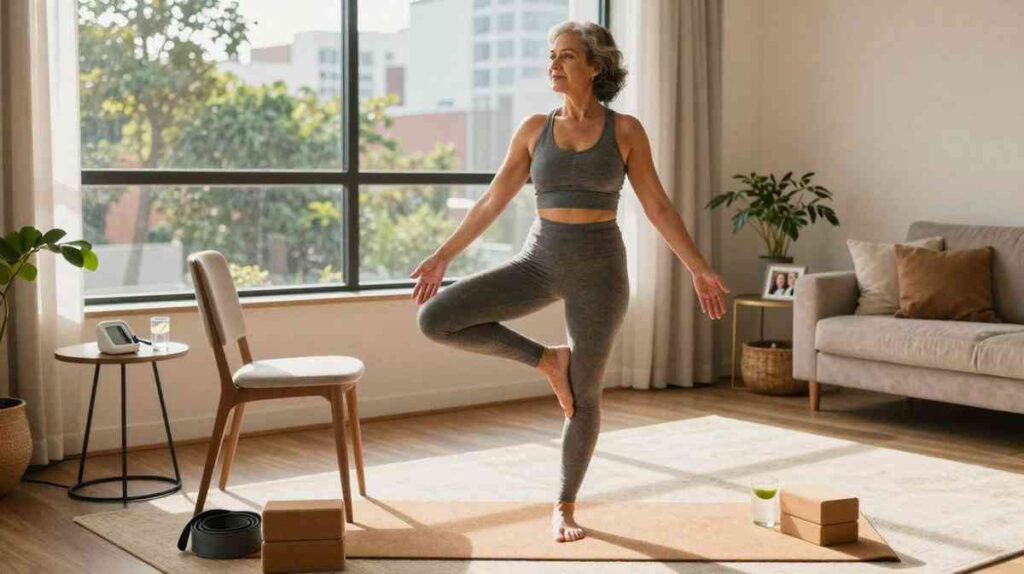
Balance is one of those things we tend to ignore until it becomes a problem.
Yoga gives it some much-needed attention.
Standing poses challenge your ability to control your body as you shift weight, adjust your posture, and maintain stability.
Research suggests that yoga can improve balance in some groups, including older adults, although the benefits vary across programs and individuals.
This matters because balance plays a role in everyday activities, from climbing stairs to walking over uneven ground.
Try a Supported Tree Pose
Stand beside a sturdy wall or chair.
Shift your weight onto one foot and gently place the toes of your other foot on the floor, with the heel resting against your standing ankle.
If you’re comfortable, you can gradually try placing the raised foot against your lower leg, avoiding pressure directly on the knee joint.
Use the wall or chair for support whenever necessary.
Hold briefly, lower your foot, and switch sides.
You don’t have to balance unsupported to benefit from the practice. In fact, modifying the pose is often the smartest choice.
5. Yoga May Help You Sleep Better
There’s something particularly appealing about gentle yoga in the evening.
No rushing between poses, no trying to beat a personal record, and ideally no phone buzzing beside the mat.
Research suggests that yoga may improve sleep quality for some people, although results depend on the population and type of program studied.
That makes sense as a reason to experiment with a calming routine, but not as a promise that yoga will cure insomnia.
A few minutes of gentle stretching, comfortable breathing, and quiet relaxation can provide a consistent way to wind down.
I’d avoid treating bedtime yoga like a strenuous workout. If the goal is to relax, choose movements that feel soothing rather than exhausting.
For persistent sleep difficulties, it’s important to look at the underlying causes and discuss them with a healthcare professional.
6. Yoga May Help With Certain Types of Pain and Stiffness
Back discomfort is common, especially among people who spend long hours sitting.
Yoga sometimes gets promoted as the solution to every aching muscle and joint, but the research tells a more nuanced story.
Studies suggest that yoga can offer small improvements for some people with chronic low-back pain. There is also evidence of potential benefits for certain neck and knee conditions.
However, yoga isn’t necessarily better than other appropriate forms of exercise, and not every pose is suitable for every condition.
According to the NCCIH, benefits for low-back pain are generally modest, and the evidence differs across other pain conditions.
If you’re experiencing pain, the goal shouldn’t be to push through it in the hope that stretching will somehow fix everything.
Look for a qualified instructor who understands modifications, and seek medical guidance if you’re dealing with an injury, significant pain, or a diagnosed condition.
Sometimes the most useful yoga pose is the one you decide not to do.
7. Yoga May Support Heart Health, but It’s Not a Miracle Treatment
This is where some articles about yoga get carried away.
You’ll find claims that yoga improves circulation, eliminates cholesterol, prevents blood clots, and dramatically reduces the risk of heart attacks.
That’s an impressive list. Unfortunately, the evidence isn’t strong enough to promise all those outcomes.
Research has found that yoga programs may improve certain cardiovascular risk factors, including blood pressure and some cholesterol measurements.
A systematic review of randomized controlled trials reported improvements in several risk markers compared with non-exercise control groups.
But studies differ in their design, duration, and types of yoga, making it difficult to draw sweeping conclusions.
Yoga has not been established as a way to prevent heart attacks, strokes, or blood clots on its own.
Nor should it replace prescribed medication, recommended exercise, or medical treatment for high cholesterol, diabetes, or cardiovascular disease.
For someone who enjoys yoga, it can be one part of a broader health routine that includes regular physical activity, adequate sleep, and appropriate nutrition.
If you’re thinking about dietary habits as well, our article on blood sugar levels is a related nutrition read, although its focus is protein intake rather than yoga or diabetes treatment.
8. Yoga Can Support Healthy Aging and Everyday Well-Being
Let’s clear up a popular misconception.
Yoga doesn’t stop the aging process.
As lovely as that would be, no amount of downward-facing dog can turn back the biological clock.
What yoga may do is help support abilities that become increasingly valuable with age, including mobility, balance, strength, and physical confidence.
The World Health Organization’s discussion of yoga and healthy aging highlights research into physical function and mental well-being.
Think less about looking younger and more about continuing to move comfortably, stay active, and enjoy ordinary daily activities.
That’s a much more realistic goal.
And while early studies have explored yoga’s relationship with stress, inflammation, and other biological markers, those findings don’t establish that yoga extends human lifespan.
Can Yoga Improve Concentration and Academic Performance?
Yoga is sometimes introduced in schools as a way to help students relax, concentrate, and become more aware of their emotions.
There is preliminary research suggesting that yoga may benefit aspects of mental well-being among children and teenagers.
However, that’s different from proving that yoga improves grades, math ability, or academic performance.
I’d be cautious about those stronger claims.
A short, age-appropriate movement or breathing session may help create a calmer classroom environment for some students, but the results will depend on the program and circumstances.
For children, yoga should be taught in an appropriate, supportive setting and never presented as a substitute for educational support or mental healthcare.
Which Type of Yoga Is Best for Beginners?
One thing I like about yoga is that you don’t have to practice it the same way forever.
Some styles are slow and gentle. Others are energetic enough to feel like a full workout.
Here’s a quick comparison.
| Yoga style | What to expect | Who might enjoy it |
|---|---|---|
| Hatha yoga | Generally slower, with individual poses and breathing practice | Beginners learning the basics |
| Vinyasa yoga | Flowing movements linked with breathing | People who enjoy more active sessions |
| Yin yoga | Longer-held, usually floor-based positions | Those comfortable with slower, sustained stretches |
| Restorative yoga | Supported, relaxing positions using props | People looking for a gentle experience |
| Chair yoga | Movements performed seated or using a chair for support | People needing additional stability or accessibility |
For a first class, I’d start with beginner Hatha, gentle yoga, or a suitable chair yoga session if additional support is needed.
And once you’ve become comfortable with the basics, there’s room to explore different approaches.
Some practitioners are even curious about clothing-free classes. Our guide to what you need to know before trying naked yoga explains how those sessions work and what to consider before attending.
How Often Should You Practice Yoga to Notice Benefits?
There isn’t one magic number that works for everyone.
Some studies use several supervised sessions per week, while others investigate shorter or less frequent practices.
If you’re starting from scratch, consistency matters more than trying to complete a demanding class every day.
I’d begin with 10 to 15 minutes, two or three times a week, and gradually adjust based on how your body responds.
That isn’t a scientifically proven minimum dose. It’s simply a manageable starting routine.
Once you feel more confident, you can increase the duration or try a longer class.
Yoga also doesn’t need to replace your other exercise. Walking, swimming, resistance training, and other activities can continue to play important roles in your fitness routine.
A Simple 10-Minute Yoga Routine for Beginners
Want to try yoga without making a major commitment?
Here’s a gentle introductory sequence for someone who can comfortably perform the movements. If you’re unfamiliar with the poses, use beginner instruction or ask a qualified teacher for guidance.
- Comfortable breathing, 2 minutes: Sit in a chair or on the floor and breathe naturally, allowing your shoulders to relax.
- Cat-Cow, 2 minutes: On hands and knees, gently move between rounding and extending your back within a comfortable range.
- Child’s Pose or supported rest, 2 minutes: Choose a position that allows your body to relax without pressure or discomfort.
- Mountain Pose, 2 minutes: Stand comfortably, notice your posture, and gently shift your weight between your feet.
- Seated relaxation, 2 minutes: Return to a comfortable seated position and let your breathing settle.
Stop if you feel dizzy, unwell, or experience pain. You can modify any movement, take breaks, or skip a pose entirely.
The goal isn’t to work through a checklist at any cost. It’s to become familiar with moving in a way that feels manageable.
Is Yoga Safe for Everyone?
Yoga is generally considered safe for healthy people when practiced appropriately, but injuries can happen.
Sprains and strains are among the more common problems, especially when people push too far into poses or attempt advanced movements without preparation.
The NCCIH advises beginners to learn with a qualified instructor and notes that certain health conditions may require modifications.
If you’re pregnant, have significant balance problems, severe high blood pressure, glaucoma, recent injuries, or other medical concerns, speak with a healthcare professional and your instructor about appropriate activities.
Hot yoga also deserves extra caution because of the risk of overheating and dehydration.
And while wellness advice online sometimes combines yoga with unrelated products, including blue dream feminized seeds, these products aren’t an established part of yoga practice or an evidence-based treatment for stress.
You don’t need supplements, herbal products, or complicated equipment to begin a basic yoga routine.
Frequently Asked Questions About the Benefits of Yoga
What are the biggest benefits of yoga?
Yoga may improve flexibility, strength, balance, stress management, and sleep. Research also suggests benefits for some types of pain and aspects of emotional well-being, although the strength of evidence varies.
Is 10 minutes of yoga a day enough?
Ten minutes can be a useful starting point, particularly if you’re new to exercise. There’s no guarantee that this duration will produce specific health outcomes, but short, regular sessions can help you establish a routine.
Does yoga help with weight loss?
Some studies suggest that yoga programs may support modest weight loss, especially when combined with broader lifestyle changes. Results vary, and yoga shouldn’t be presented as a guaranteed weight-loss method.
Can yoga lower blood pressure and cholesterol?
Research suggests possible improvements in certain cardiovascular risk factors, including blood pressure and cholesterol. However, results vary, and yoga shouldn’t replace prescribed medication or medical care.
Is yoga good for older adults?
Yoga may help some older adults maintain balance, mobility, and strength. Gentle or chair-based classes can be useful options, with appropriate modifications for individual needs.
Do you have to be flexible to do yoga?
Not at all. Flexibility is something you can work on through practice, not a requirement for starting. Poses can be adapted with chairs, cushions, blocks, and other props.
Is Yoga Worth Adding to Your Routine?
I think yoga is worth considering, especially if you want exercise that combines movement with a little mental breathing room.
You don’t have to become an expert, invest in expensive gear, or learn to stand on your hands.
Start with a comfortable class, a few basic poses, and realistic expectations.
Some days, you might enjoy an energetic flow. On others, ten minutes of gentle stretching may be all you want.
And if you eventually want to turn your practice into a bigger experience, our guide to yoga retreats in Japan looks at destinations, costs, and what to expect from a wellness getaway.
The real value of yoga isn’t how impressive your poses look. It’s finding a form of movement you enjoy enough to keep doing.
That’s a benefit worth making time for.
Sources and Further Reading
- NCCIH: Yoga, Effectiveness and Safety, a research-based overview of yoga benefits, limitations, and risks.
- Johns Hopkins Medicine: 9 Benefits of Yoga, practical examples and information on physical and mental wellness.
- World Health Organization: Yoga for Healthy Ageing, research and discussion of yoga’s role in well-being as people age.
- U.S. Department of Veterans Affairs: Evidence Map of Yoga, a 2026 research synthesis examining evidence across physical and mental health conditions.
- About the Author
- Latest Posts

I’m Iskra Banović, editor of Blufashion and the voice behind its fashion, beauty, and lifestyle stories. Fashion, beauty, and lifestyle are my playground, but I’m just as likely to share the messy side of it all, like the time I tested a “must-have” skincare gadget and ended up with glitter stuck in my hair. I love turning trends and everyday finds into something useful (and fun) for real people.